
Official document No. 3326/CT-CS was recently issued amidst tightened scrutiny of cross-border money flows by regulatory agencies. This is a direct directive from the tax authorities aimed at definitively resolving long-standing issues regarding tax exemption applications for foreign contractors.
Many businesses in Vietnam are still confused about the procedures for applying the tax agreement. A lack of understanding of the requirements for residence certificates and actual beneficiaries can lead to the collection of billions of dong in back taxes on contractors, along with late payment penalties.
Quick information about Official Letter No. 3326/CT-CS for managers
Official document No. 3326/CT-CS This is a professional guidance document from the Tax Department for processing tax exemption and reduction applications for foreign contractors under the Double Taxation Avoidance Agreement in Vietnam. This document guides local tax authorities in reviewing the legality of residence certificates and the conditions for determining the actual owner of income.
The entities directly affected are foreign contractors generating income in Vietnam and domestic enterprises that have signed contractor contracts. The effective date is immediately after the tax obligations related to the Agreement arise.
Official document No. 3326/CT-CS provides guidance on the core contents regarding tax exemptions and reductions for contractors.
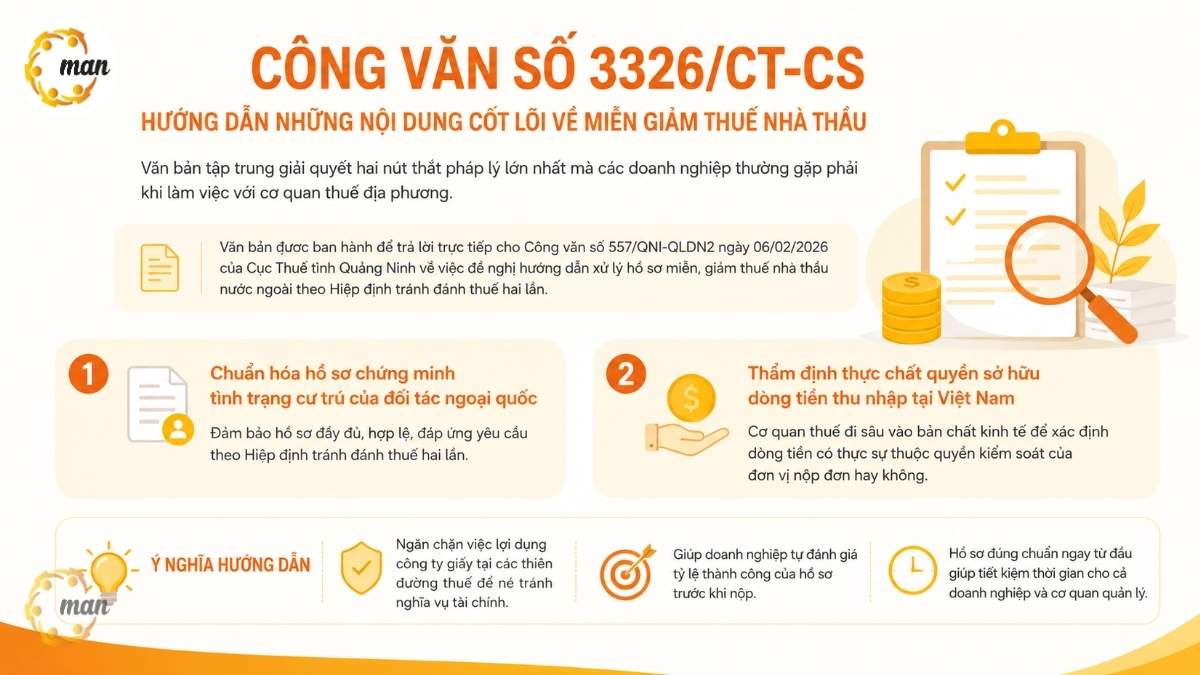
This document focuses on resolving the two biggest legal bottlenecks that businesses often encounter when working with local tax authorities. In fact, this document was issued as a direct response to Official Letter No. 557/QNI-QLDN2 dated February 6, 2026, from the Quang Ninh Provincial Tax Department regarding a request for guidance on processing applications for tax exemptions and reductions for foreign contractors under the Double Taxation Avoidance Agreement.
The first directive concerns the standardization of documentation proving the residency status of foreign partners. The second directive involves a thorough assessment of the contractor's ownership of income streams generated in Vietnam.
According to these guidelines, tax authorities will not only review documents on the surface but will also delve into the economic nature of the process to determine whether the cash flow is truly under the control of the applicant. This prevents the use of shell companies established in tax havens to evade financial obligations.
Experts at MAN, with 30 years of experience, note that clarity in this document helps businesses assess the success rate of their application before submission. Properly preparing the application from the start will save significant waiting time for both the business and the relevant regulatory body.
See more articles at: Official Document 2495/CT-CS regarding contractor tax policy
Why is determining residency the first prerequisite step according to Circular 3326/CT-CS?

To be eligible for tax exemptions or reductions under a Double Taxation Avoidance Agreement, foreign contractors must be residents of the country that has signed the bilateral agreement with Vietnam. Proof of this status is provided through a Certificate of Residence issued by the tax authority of the country of origin.
However, audits at businesses have revealed many elementary errors in submitting this paperwork. A typical example is using a current year's residence certificate to claim tax exemption for income earned three years prior. The tax authorities will immediately reject such applications with discrepancies in timing.
The regulations clearly state that the Certificate of Residence must accurately reflect the year or period in which the income for which the Agreement is requested is generated. Furthermore, the legal validity of the document must be absolutely guaranteed through consular legalization procedures at diplomatic missions.
Foreign language documents must be translated into Vietnamese by a qualified and certified translation agency. If any of these elements are missing, the business's application will be returned for further information, prolonging processing time and increasing tax risks for both parties.
See more articles at: Official Document 1918/CT-CS: Corporate Income Tax for Foreign Contractors 2026
How can I prove my legal ownership of the property?
Identifying the true beneficiary is the most complex part of tax audits and inspections of cross-border transactions. A foreign contractor may have a valid Certificate of Residence, but if they only act as an intermediary or shell company channeling money to a third country, they will not be considered the true beneficiary.
Clause 3, Article 6 Circular 205/2013/TT-BTC This concept is very clearly defined. The beneficial owner must be the entity with actual ownership and control over the income, assets, or rights that generate that income. They must have full discretion in deciding how to use the proceeds for their business operations.
If a foreign business receives money from Vietnam but is bound by an agreement to immediately transfer more than 80% of that amount to another entity in a country that has not signed a tax agreement with Vietnam within 12 months, they will be deprived of their entitlement to the funds. This is a rule of substantive verification that tax authorities often apply rigorously.
This proof requires businesses to provide documentation demonstrating their actual operational capacity. This documentation includes financial statements, organizational charts, and proof of actual operating expenses in the host country to demonstrate that the company is not a shell company.
What is the close relationship between contractor selection planning and tax risk management according to Official Letter 3326/CT-CS?
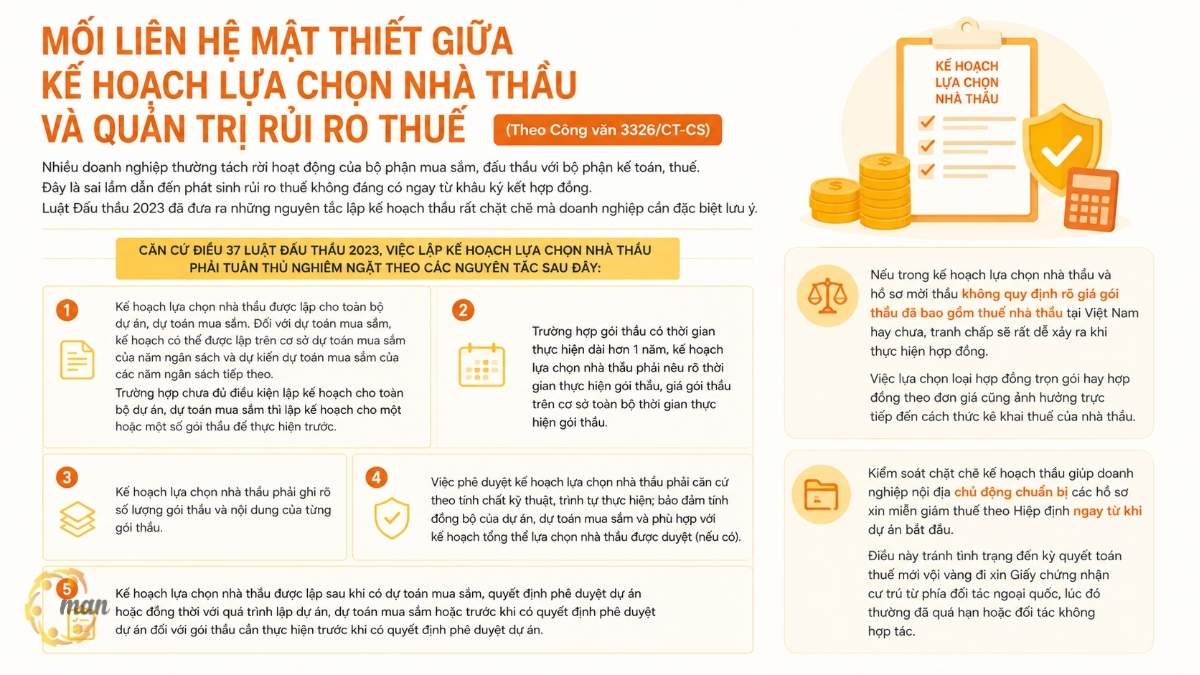
Many businesses often separate the activities of their procurement and bidding departments from their accounting and tax departments. This is a serious mistake that leads to unnecessary tax risks right from the contract signing stage. The 2023 Bidding Law has introduced very strict principles for bidding planning that businesses need to pay special attention to.
Based on Article 37 of the 2023 Bidding Law, the current contractor selection plan must strictly adhere to the following principles:
- The contractor selection plan is prepared for the entire project and procurement budget. For the procurement budget, the contractor selection plan may be based on the procurement budget for the current fiscal year and projected procurement budgets for subsequent fiscal years. If the conditions for preparing a contractor selection plan for the entire project and procurement budget are not yet met, a plan for one or more bidding packages may be prepared for implementation first.
- In cases where the contract has a duration exceeding one year, the contractor selection plan must clearly state the contract execution period and the contract price based on the entire contract execution time.
- The contractor selection plan must clearly state the number of bidding packages and the content of each package.
- The approval of the contractor selection plan must be based on the technical nature and implementation sequence; ensuring the consistency of the project and procurement budget, and conforming to the approved overall contractor selection plan (if any).
- The contractor selection plan is prepared after the procurement budget and project approval decision are available, or simultaneously with the project and procurement budget preparation process, or before the project approval decision for packages that need to be implemented before the project approval decision is issued.
If the contractor selection plan and tender documents do not clearly specify that the bid price includes... contractor tax Whether or not the contract is in Vietnam, disputes are very likely to arise during execution. The choice between a lump-sum contract or a unit-price contract also directly affects how the contractor declares taxes.
Strict control over the bidding process helps domestic businesses proactively prepare applications for tax exemptions and reductions under the Agreement right from the start of the project. This avoids the situation where they rush to apply for Certificates of Residence from foreign partners only at the tax settlement period, by which time it is often too late or the partners are uncooperative.
See more articles at: Contractor tax on foreign loan interest 2025: Draft proposes doubling the corporate income tax rate.
What are the main contents of a master plan for contractor selection as stipulated by law?
In addition to specific planning principles, businesses also need to understand the structure of the overall plan to synchronize their tax strategy. This is a crucial step in identifying financial risks arising from the investment project preparation stage.
Clause 3 of Article 36 of the 2023 Bidding Law stipulates that the overall plan for selecting contractors includes the following five main contents:
- Consider the project implementation context when conducting the bidding process;
- Assess the investor's capacity, resources, and experience in carrying out the project's bidding activities;
- Market analysis and risk identification in bidding processes;
- The specific objectives of the bidding process;
- The proposed master plan for contractor selection for the project includes: dividing the project into packages; forms and methods of contractor selection; types of contracts, principles of risk allocation and management; implementation schedule for key works and packages; and other points to note in the preparation of tender documents and contract management.
Market analysis and risk assessment in the bidding process at this stage is a crucial time for the finance and accounting department to evaluate contractor tax risks. Businesses need to clearly identify potential contractors from different countries, and whether those countries have signed double taxation avoidance agreements with Vietnam, in order to formulate the most optimal tax strategy.
Summary table of relevant legal documents on baggage
To assist managers and accounting departments in easily referencing the relevant information, the following is a systematized table of core legal documents governing contractor tax exemptions and related bidding activities.
| Document number | Date of issuance | Issuing authority | Summary of applicable content |
| Official Document 3326/CT-CS | 22/05/2026 | Tax Department | Instructions for reviewing Certificates of Residence and determining entitlement under the Tax Agreement. |
| Circular 80/2021/TT-BTC | 29/09/2021 | Ministry of Finance | Detailed instructions on the procedures for applying for tax exemption or reduction under the Agreement are provided in Clause 1, Article 62. |
| Circular 205/2013/TT-BTC | 24/12/2013 | Ministry of Finance | Definition and guidance for determining the rightful owner are provided in Clause 3 of Article 6. |
| Law on Bidding 2023 | 23/06/2023 | National Assembly | Regulations on the principles of tender planning (Article 37) and the content of the overall plan (Article 36). |
Real-world Case Study: Lessons Learned from Handling Business Documents in Quang Ninh
To help you visualize how this process works, we would like to share a real-life situation that our team of experts handled. This is a valuable lesson about the dangers of being careless in preparing administrative documents.
Context of the incident
In 2025, a large mining company in Quang Ninh province signed a contract to lease specialized machinery worth 45 billion VND from a contractor registered in Singapore. The Vietnamese company was responsible for declaring and paying the contractor tax on behalf of the company at a corporate income tax rate of 5% on taxable revenue.
According to the contract terms, the Vietnamese company is proceeding with the application for corporate income tax exemption for the Singaporean contractor under the Double Taxation Avoidance Agreement between Vietnam and Singapore. The expected tax exemption amounts to over 2.2 billion VND.
Fatal errors were discovered by the tax authorities.
When submitting the application to the Quang Ninh Provincial Tax Department, the entire dossier was rejected for consideration of the application of the tax agreement for the following reasons:
- The residence certificate provided by the Singaporean contractor is issued for the financial year 2024, while the machinery rental income is generated and actually paid in Q2 2025.
- The Vietnamese translation of the Certificate of Residence was done by a private translation office but has not been notarized by the State. The consular legalization seal of the Vietnamese Embassy in Singapore is faded, making it impossible to verify the security code.
- Upon reviewing the ownership structure, it was found that this Singaporean contractor was essentially an intermediary company established by a parent company based in a Caribbean island nation. All machinery rental payments received from Vietnam were transferred directly to the parent company's account within 15 days.
Solutions and results achieved
Facing the risk of having their tax return rejected and being fined 0.031 TP3T per day on a tax liability of 2.2 billion VND, the company sought professional assistance. Our tax consultants quickly implemented emergency procedures:
- We request that our Singaporean partner contact the Singapore In-Rate Income Collection Authority (IRAS) directly to have the supplementary Residence Certificate reissued to reflect the income generation period in 2025.
- Repeat the entire online consular legalization, translation, and judicial certification process at the district justice office in accordance with current regulations.
- We gathered documentation proving that the Singapore contractor had actual control over the leased equipment. We presented evidence that this contractor directly owned the machinery, was responsible for routine maintenance, and bore the insurance risks for the assets. This demonstrates that they were not an empty intermediary company.
As a result, after 45 working days and direct explanations to the tax authorities, the application was accepted and the business was exempted from all corporate income tax in accordance with the provisions of the Agreement.
Expert opinion from MAN on contractor tax risk management in Vietnam, as per Official Letter 3326/CT-CS.
Having directly assisted hundreds of multinational corporations and large businesses in tax settlements in Vietnam for over 30 years, I have observed that tax risks related to foreign contractors consistently rank among the highest in terms of irregularities. Many chief accountants still maintain the habit of preparing documents based on intuition and lack rigorous cross-referencing with the latest regulations.
The introduction of strict operational guidelines such as Circular No. 3326/CT-CS shows that tax authorities are increasingly standardizing inspection procedures using interconnected data technology. They can easily detect unusual transactions or records with inconsistent timelines.
A very common mistake is that businesses often wait until the tax authorities conduct an inspection at their headquarters before frantically searching for explanatory documents. By this time, the foreign partner may have terminated the contract, restructured, or even dissolved, making it impossible to obtain the original Certificate of Residence or documents proving the right to claim benefits.
The best advice from MAN's team of experts on optimizing tax costs in Vietnam is to establish a closed-loop internal control process. This process should begin with contractor vetting before contract signing, controlling tax clauses in the contract, collecting residency documents at the time of the first payment, and systematically archiving explanatory documents. Proactive prevention is always much cheaper than rectifying violations after an audit.
Conclude
Understanding the tax authority's guidelines is a prerequisite for businesses to protect their legitimate interests and avoid serious legal risks. Strict adherence to the procedures for reviewing residence certificates and proving eligibility not only helps businesses save significant tax revenue but also affirms transparency and credibility in their financial management.
If your business is struggling with international tax filing or wants to build a professional tax risk management system, contact MAN – Master Accountant Network. We offer comprehensive solutions such as tax settlement, tax accounting, tax reporting, and tax consulting. Our team of experienced professionals is always ready to support your business in achieving safe and sustainable growth.
Service contact information at MAN – Master Accountant Network
- Address: No. 19A, Street 43, Tan Thuan Ward, Ho Chi Minh City
- Mobile/Zalo: 0903 963 163 – 0903 428 622
- Email: man@man.net.vn
Content production by: Mr. Le Hoang Tuyen – Founder & CEO MAN – Master Accountant Network, Vietnamese CPA Auditor with over 30 years of experience in Accounting, Auditing and Financial Consulting.
5 most frequently asked questions about the application of Official Letter No. 3326/CT-CS
Yes. The Vietnamese tax authorities currently accept residence certificates issued electronically by tax authorities of countries with developed digital tax management systems such as Singapore, South Korea, and Japan. However, these electronic copies still require consular legalization and certified translation in accordance with Circular 80/2021/TT-BTC, except in cases where consular legalization is waived under international treaties to which Vietnam is a signatory.
If the tax authorities have sufficient grounds to determine that the foreign contractor submitting the application is not the actual owner of the generated income, the request for tax exemption or reduction under the Double Taxation Avoidance Agreement will be completely rejected. The Vietnamese enterprise will then be obligated to deduct and pay the contractor tax on behalf of the foreign contractor at the normal tax rate stipulated in Circular 103/2014/TT-BTC.
According to current regulations, the notification dossier for tax exemption or reduction under the Agreement must be submitted to the directly managing tax authority before the deadline for filing the foreign contractor tax return. If submitted late after this deadline, the enterprise may be subject to administrative penalties for late filing of tax returns or be denied the application of preferential treatment for that tax period.
The contractor selection plan determines the bid price and contract type. If the bidding plan does not clearly specify which party is responsible for paying the contractor's tax, legal disputes are likely to arise upon contract signing. Furthermore, an unclear contract structure will make it difficult for businesses to separate the different service values subject to varying tax rates within a mixed contract.
It is not mandatory for all countries. Vietnam has signed mutual legal assistance agreements or agreements waiving consular legalization with certain countries. For these countries, the original Certificate of Residence can be used directly for translation and authentication without requiring confirmation from diplomatic agencies. However, most other countries still require this consular legalization step. Are electronic certificates of residence (e-CoR) accepted in Vietnam?
What happens if a foreign contractor cannot prove they are the rightful owner?
Can a business apply for the application of a tax agreement after it has completed payment to the contractor?
How does the contractor selection process under the 2023 Bidding Law affect contractor tax obligations?
Is consular legalization of a Certificate of Residence mandatory for all countries?