


Official Document 5357/CT-CS This is a tax policy response issued by the Tax Department on July 29, 2026, addressing a very practical issue faced by businesses with investment projects: whether a complete application meets the requirements for a value-added tax refund, even if the project still has outstanding construction procedural obstacles. This is not the first time the tax authority has had to answer this type of question, but the reasoning in the document clearly demonstrates the principle: conditions VAT refund It is considered independently from other specialized administrative procedures such as building permits.
For FDI and domestic businesses implementing investment projects in Vietnam, the amount of unrefunded input VAT can reach tens, even hundreds of billions of VND, directly impacting cash flow. This article, compiled by a team of experts, provides insights into this topic. MAN – Master Accountant Network With over 30 years of experience in tax, accounting, and auditing consulting in Vietnam, we will provide a comprehensive analysis of the content of Official Letter 5357/CT-CS, the accompanying legal basis, and practical experience in handling this matter for businesses.
Summary of key points in Official Letter 5357/CT-CS
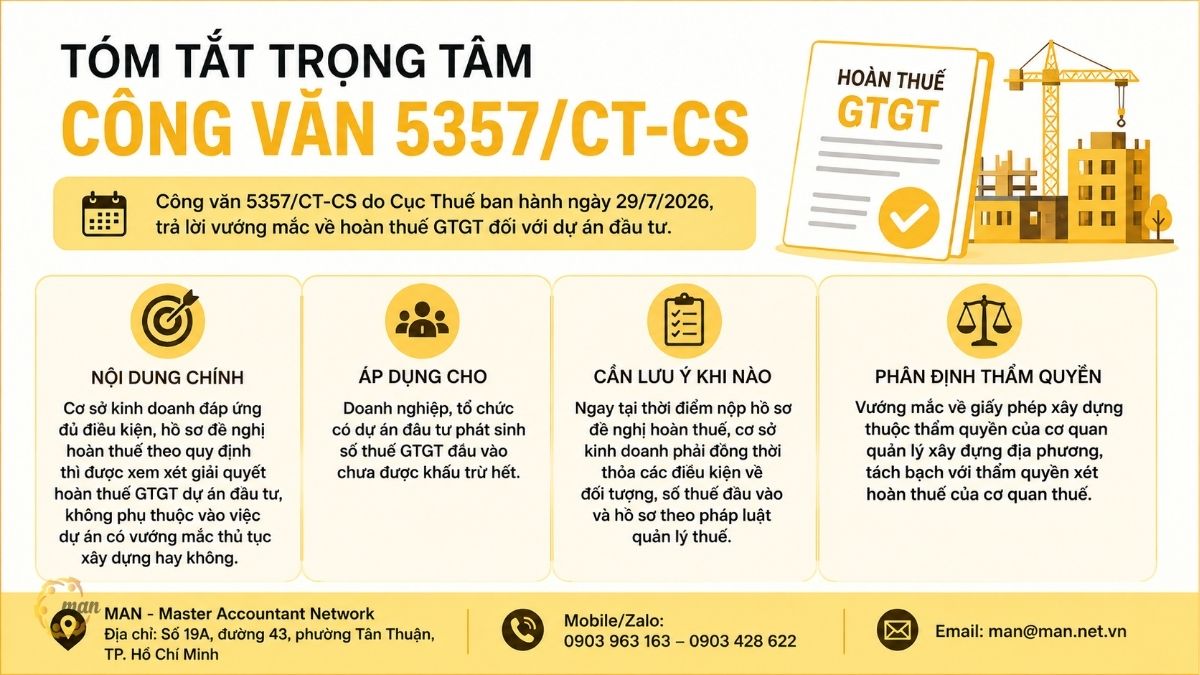
- Official Letter 5357/CT-CS is a document issued by the Tax Department on July 29, 2026, addressing issues regarding VAT refund for investment projects.
- Main content: Businesses that meet the eligibility requirements and submit a tax refund application in accordance with regulations will be considered for VAT refund for investment projects, regardless of whether the project has any construction procedural obstacles.
- Applicable to: businesses and organizations with investment projects that generate input VAT that has not been fully deducted.
- It is important to note that at the time of submitting the tax refund application, the business must simultaneously meet the conditions regarding eligibility, input tax amount, and documentation as stipulated by tax management laws.
- Issues related to construction permits fall under the jurisdiction of the local construction management agency, separate from the tax authority's authority to review tax refunds.
What is Official Document 5357/CT-CS and what issues does it address for businesses?
Official Letter 5357/CT-CS of 2026, issued by the Tax Department on July 29, 2026, belongs to the group of documents responding to tax policy requests from local tax authorities, specifically the Tay Ninh Provincial Tax Department. This is a common type of document in the Vietnamese tax management system: when unclear practical situations arise, local tax authorities send official letters requesting guidance from higher authorities, and the response becomes the basis for consistent application.
The core content of Official Letter 5357/CT-CS
The core content of the official document states that, at the time a business submits its application for a tax refund, if the business is eligible for a VAT refund for an investment project and its input VAT fully meets the legal requirements for a refund, it must have input VAT that meets all the conditions for a refund. VAT, If the applicant submits a tax refund request in accordance with tax regulations, the request will be considered for a refund.
In other words, three conditions—the subject, the amount of valid input tax, and complete documentation—are the deciding factors, not other elements outside the scope of taxation.
How are issues related to construction permits handled according to Official Letter 5357/CT-CS?
A notable point of the document is how the Tax Department handled the issue related to the construction of projects without permits. The document clearly states that construction laws already have specific regulations regarding unauthorized construction, and if difficulties arise in determining the procedures for implementing investment projects, the Tay Ninh Provincial Tax Department should consult with the relevant local specialized construction management agency, and then report to the Provincial People's Committee for consideration and handling within its authority.
This shows that the tax authorities have made a clear distinction: handling construction violations falls under the jurisdiction of the construction industry, while tax refunds are still based on the stated tax conditions.
Why is Official Letter 5357/CT-CS important for businesses with investment projects?
Value to business cash flow
In practice, corporate financial management often results in the withholding of input VAT for large investment projects for months, or even years, if the documentation is hampered by legal issues related to procedures outside the scope of taxation, such as construction permits, environmental permits, or investment certificates.
From this perspective MAN – Master Accountant Network, Many businesses have had their tax refunds temporarily suspended by tax authorities due to concerns about associated risks, even though their tax records met the eligibility criteria. Receiving tax refunds on schedule provides businesses with additional working capital to continue project implementation, instead of having to borrow additional funds with the resulting interest costs.
The value of protecting legal rights when dealing with tax authorities.
Circular 5357/CT-CS clarifies the principle of separating jurisdictions, providing businesses with a basis to protect their legitimate tax refund rights during meetings and comparisons with tax authorities. This is the greatest practical value of the document, especially for manufacturing and industrial real estate projects expanding in rapidly urbanizing provinces such as Tay Ninh, Binh Duong, and Dong Nai.
Which entities are affected by Official Letter 5357/CT-CS?
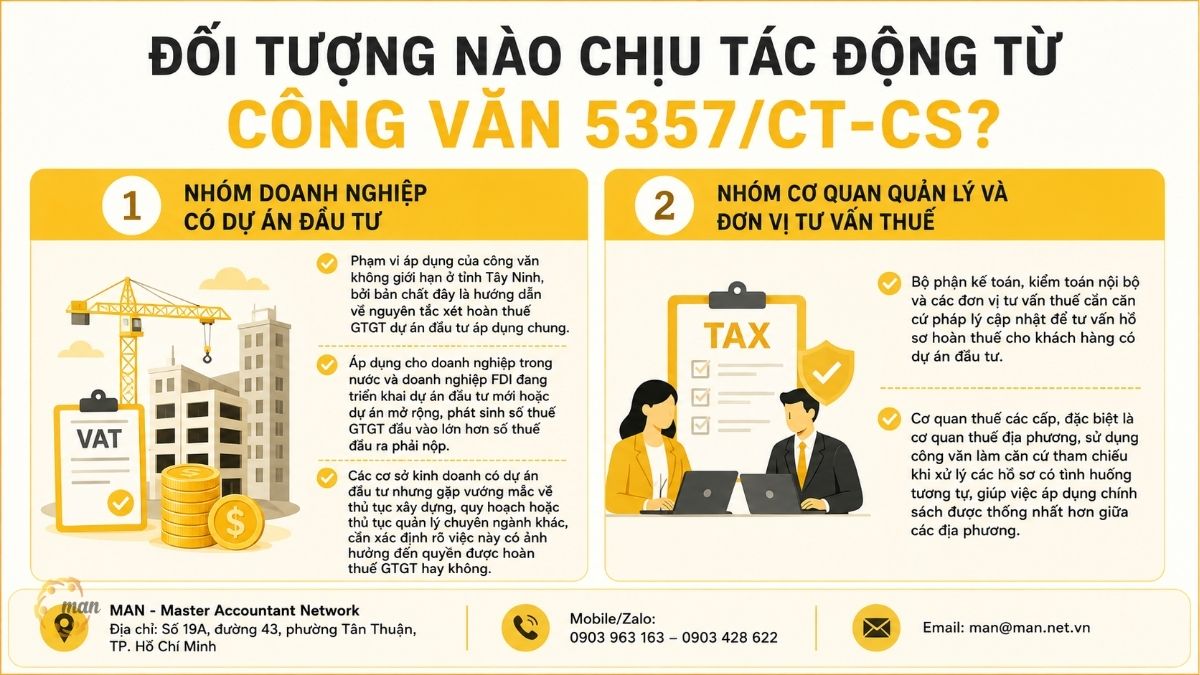
Group of businesses with investment projects
The scope of application of this document is not limited to Tay Ninh province, as it is essentially a guideline on the principles for considering VAT refunds for investment projects, applicable generally. The group directly affected includes domestic enterprises and foreign-invested enterprises (FDI) that are implementing new investment projects or expansion projects, resulting in input VAT exceeding output VAT payable.
In addition, businesses with investment projects that encounter obstacles related to construction procedures, planning, or other specialized management procedures need to clearly determine whether this affects their right to receive a VAT refund.
Group of tax regulators and advisory firms
Beyond businesses, the official document also impacts accounting departments, internal auditors, and tax consulting firms, which need updated legal information to advise clients on tax refund applications for investment projects. Tax authorities at all levels, especially local tax authorities, also use the document as a reference when handling similar cases, helping to ensure more consistent policy application across localities.
When do businesses need to apply the guidelines in Official Letter 5357/CT-CS?
Timeframes for review
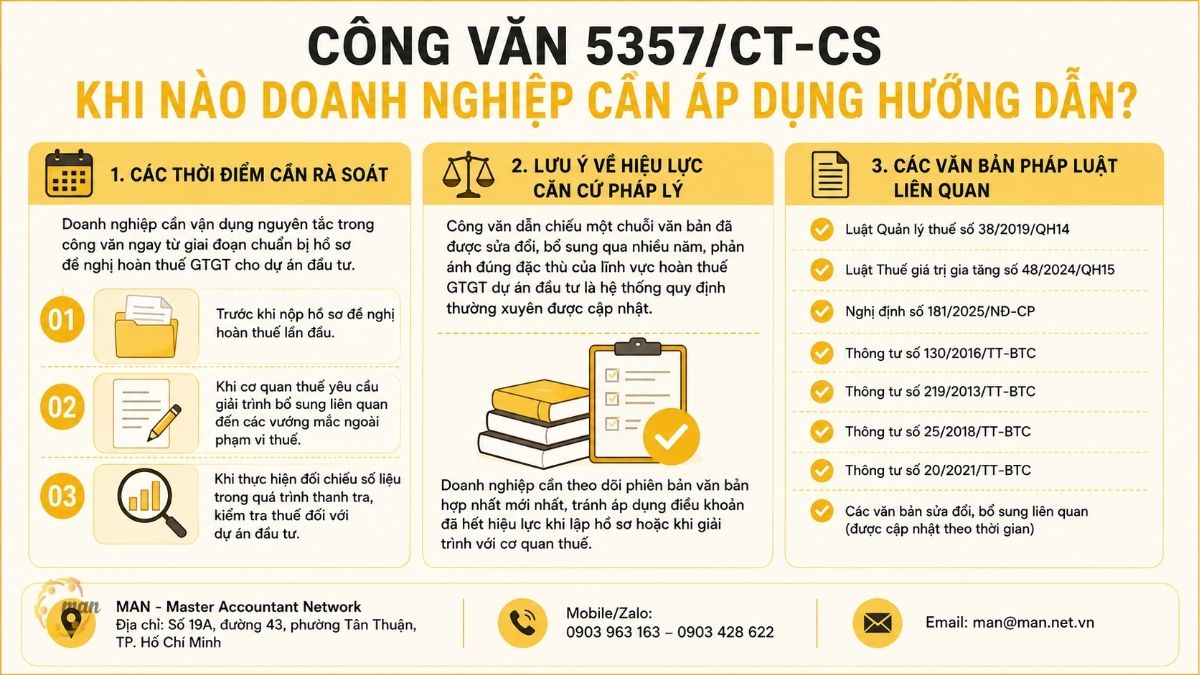
Businesses need to apply the principles outlined in the official letter right from the stage of preparing the application for VAT refund for investment projects, not just when disputes arise with the tax authorities. Specifically, three crucial times for businesses to review this are: before submitting the initial refund application, when the tax authorities request additional explanations related to issues outside the scope of taxation, and when comparing data during tax audits and inspections of the investment project.
Note regarding the validity of the legal basis
Regarding the legal basis, the official letter refers to a series of documents that have been amended and supplemented over the years, accurately reflecting the specific characteristics of the VAT refund field for investment projects, which is a system of regulations that are frequently updated. Businesses need to monitor the latest consolidated version of the documents and avoid applying outdated provisions when preparing documents or providing explanations to the tax authorities.
What legal documents are related to Official Letter 5357/CT-CS?
System of documents regarding conditions for VAT refund for investment projects.
Official document 5357/CT-CS is based on a system of legal grounds spanning multiple periods, reflecting the continuous revision process of the VAT refund policy for investment projects in Vietnam.
| Legal documents | Number / Revision Details | Related content |
| Law on Value Added Tax 2008 | Original regulations on VAT refund | The initial framework was then modified and supplemented through subsequent laws. |
| Amended Value Added Tax Law of 2013 | Amendments and additions to certain articles of the 2008 Value Added Tax Law. | First update on regulations regarding VAT refund |
| The amended Value Added Tax Law, Special Consumption Tax Law, and Tax Administration Law of 2016. | Clause 3 of Article 1, amending Clauses 1 and 2 of Article 13 of the 2008 Value Added Tax Law (as amended in 2013) | The regulations directly serving as the basis for VAT refund are specified in Official Letter 5357/CT-CS. |
| Decree 100/2016/ND-CP | Clause 6 of Article 1 amends Article 10 of Decree 209/2013/ND-CP. | Detailed instructions on VAT refund conditions |
| Decree 12/2015/ND-CP | Amendments and additions to Decree 209/2013/ND-CP | Adjusting some provisions regarding VAT refund. |
| Decree 49/2022/ND-CP | Clause 3 of Article 1 amends Clause 2 of Article 10 of Decree 209/2013/ND-CP. | Updated conditions for VAT refund for investment projects. |
| Circular 130/2016/TT-BTC | Clause 3, Article 1, amending Article 18 of Circular 219/2013/TT-BTC | Instructions for claiming VAT refund |
| Circular 13/2023/TT-BTC | Clause 3, Article 1, guiding Decree 49/2022/ND-CP, amending Circular 80/2021/TT-BTC | Guide to the documentation and procedures for VAT refund for current investment projects. |
Supplementary document on invoices and prohibited acts
In addition to the documents directly serving as the basis for Official Letter 5357/CT-CS, businesses need to also monitor documents indirectly related to the documentation and actions involved in the VAT refund process for investment projects.
| Legal documents | Number / Content | Related content |
| Value Added Tax Law 2024 | Article 13 | Regulations specifying prohibited actions in VAT deduction. |
| Circular 91/2026/TT-BTC | Article 5, paragraph 2 | Regulations on the content and format of written text on VAT invoices that also serve as tax refund declaration forms. |
| Decree 254/2026/ND-CP | Article 10 | Regulations on other contents of VAT invoices also serving as tax refund declarations. |
Important Note: This is a series of documents that have been amended and supplemented over the years, starting with the 2008 Value Added Tax Law, through the 2013 amendment, and then further amended in the 2016 amendment law, which directly serves as the basis for Official Letter 5357/CT-CS. Experts at MAN Businesses are advised to always compare the latest consolidated version before filing, to avoid mistakenly applying superseded provisions.
In addition to the legal grounds mentioned above, the full text of Official Letter 5357/CT-CS is also published by the tax authority as a complete file so that businesses and accountants can directly access the original content and compare it with the analysis in this article.
Case Study: How do businesses handle VAT refunds for investment projects when construction issues arise?
Background
A mechanical components manufacturing company is undertaking a new factory investment project in a southern province, with input VAT incurred during the construction phase exceeding 40 billion VND. During construction, an auxiliary component of the project was found to have not completed the necessary construction permits, causing the tax authorities to temporarily suspend the tax refund application for further review.
The handling method follows the principles outlined in Official Letter 5357/CT-CS.
According to advice from MAN – Master Accountant Network, In this situation, businesses need to separate two workflows: firstly, completing the VAT refund application according to the three conditions regarding the eligible entity, input tax amount, and refund documents; secondly, proactively working with the local construction management agency to supplement any missing permit procedures, avoiding having the two issues combined when explaining to the tax authorities.
The measured results
- VAT refund applications that meet the eligibility criteria are being reviewed and processed by the tax authorities according to schedule, and are not being completely "stalled" simply because of an issue with an auxiliary item.
- Businesses save an estimated 2 to 3 months waiting time for tax refunds compared to having both issues pending simultaneously.
- A clear and well-structured explanation, prepared according to the proper authority, facilitates smooth meetings with tax authorities and minimizes the risk of prolonged questioning.
Comparison table of VAT refund conditions for investment projects to note.
The group of conditions falls within the scope of taxation.
The three criteria below fall within the direct review authority of the tax agency, which determines whether a business is eligible for a tax refund.
| Criteria | Content in accordance with current regulations | Risks of omission |
| Eligible subjects and cases for tax refund | Businesses eligible for VAT refund for investment projects under VAT law. | Tax refund denied if the applicant is not eligible. |
| Input VAT amount | Fully meets the conditions for VAT refund as stipulated by VAT law. | The portion of tax that is not eligible for deduction is excluded. |
| Tax refund application | Fully compliant with tax management laws and regulations. | The application was returned, prolonging the processing time. |
Issues outside the scope of taxation
This group doesn't directly decide on tax refunds, but if businesses handle the process poorly, it can still delay the entire process.
| Criteria | Content in accordance with current regulations | Risks of omission |
| Obstacles related to specialized procedures (construction, planning) | Under the jurisdiction of the specialized management agency, processed concurrently, and not a replacement for the tax refund conditions. | Mistakes lead to delays in the entire process. |
| Prohibited behaviors in tax deductions and refunds | Article 13 of the 2024 Value Added Tax Law must not be violated, even if the application meets all three main conditions. | Denied tax refund, tax arrears collected, and penalties imposed. |
On which side should the text displayed on the VAT invoice/tax refund declaration form be placed?
As stipulated in Clause 2, Article 5 of Circular 91/2026/TT-BTC
In parallel with the regulations on VAT refund for investment projects in Official Letter 5357/CT-CS, businesses also need to understand the regulations on the form of invoices used for tax refunds, as this is a document directly serving the tax refund application. According to Clause 2, Article 5 of Circular 91/2026/TT-BTC regulating the content of value-added tax invoices combined with tax refund declarations, the text displayed on this type of invoice is in Vietnamese and English. The English text is placed to the right in parentheses or immediately below the Vietnamese text, and the English font size must be equal to or smaller than the Vietnamese font size.
Other contents of the VAT invoice and tax refund declaration form.
Circular 91/2026/TT-BTC also refers to Article 10 of Decree 254/2026/ND-CP regarding other contents of invoices, except for the sample symbol and invoice symbol, which are implemented according to Appendix I of the circular. The specific display form of the value-added tax invoice combined with tax refund declaration is stipulated in Form No. 01/GTGT-TKHT, Appendix V attached to the circular.
From this perspective MAN – Master Accountant Network, Therefore, corporate accountants need to review the invoice templates currently in use to ensure they comply with the new bilingual format regulations, avoiding situations where tax refund applications are rejected simply due to formal errors on the invoices.
What actions are strictly prohibited in VAT tax deductions?
List of prohibited acts under Article 13 of the 2024 Value Added Tax Law
Besides the conditions for tax refund, businesses need to pay special attention to the prohibited behaviors in VAT deduction, because violating this group of behaviors not only leads to the rejection of the application but can also result in back taxes, penalties, and higher legal liability. According to Article 13 of the Value Added Tax Law 2024, the prohibited behaviors in VAT deduction include:
- Buying, giving, selling, organizing advertising, brokering the buying and selling of invoices.
- Creating transactions for the purchase or sale of goods or provision of services that do not exist, or transactions that are not in accordance with the law.
- Issuing invoices for the sale of goods and provision of services during the period of temporary business suspension, except for issuing invoices to customers to fulfill contracts signed before the date of notification of temporary business suspension.
- Using illegal invoices or documents, or using invoices or documents illegally as stipulated by the Government.
- Failure to transfer electronic invoice data to the tax authorities as required.
- Falsifying, misusing, unauthorized access to, or destroying information systems related to invoices and documents.
- Giving, receiving, or brokering bribes, or engaging in other acts related to invoices and documents to obtain tax deductions, tax refunds, misappropriate tax money, or evade value-added tax.
- Collusion, cover-up, and connivance between tax officials, tax authorities, and businesses/importers, or between businesses/importers in the use of illegal invoices and documents, or the illegal use of invoices and documents to obtain tax deductions, tax refunds, misappropriate tax money, and evade value-added tax.
Impact on VAT refund applications for investment projects.
Experts at MAN Please note that even if an investment project's VAT refund application meets all three conditions in Circular 5357/CT-CS, any prohibited actions, especially the use of illegal invoices, may still result in rejection and legal action under tax management regulations. Therefore, controlling the quality of input invoices should be carried out in parallel with reviewing the three main VAT refund conditions.
Expert opinion: Common business risks when claiming VAT refunds for investment projects.
Experts at MAN – Master Accountant Network With over 30 years of experience in auditing and tax consulting in Vietnam, we note three main risk groups that businesses often encounter when processing VAT refunds for investment projects.
- The combined risk of encountering procedural obstacles related to specialized fields and tax refund conditions: Many businesses have their tax refund applications completely suspended, even though they meet the eligibility requirements, simply because they lump together specialized procedural issues with the tax refund conditions. Businesses need to proactively separate and clearly present each group of issues when working with tax authorities, similar to the principle established in Circular 5357/CT-CS.
- Risks of misreferencing legal documents: This risk relates to misreferencing legal documents due to the numerous revisions to the VAT refund regulations, from the 2008 VAT Law to the decrees and circulars of 2016, 2022, and 2023. If accountants cite expired provisions in their explanatory documents, the likelihood of being asked for additional information or being rejected increases significantly, prolonging the refund process.
- Risks include a lack of proactive coordination with specialized regulatory agencies: The final risk is a lack of proactive coordination with local specialized agencies when project issues arise outside the tax sphere. Practical experience shows that businesses that proactively work with both parties—the tax authorities and the construction or investment management agency—often significantly shorten the tax refund waiting time compared to businesses that passively wait for guidance.
Conclude
Circular 5357/CT-CS clarifies an important principle in the practice of VAT refund for investment projects in Vietnam: the right of businesses to receive a VAT refund must be considered based on the correct tax conditions, separate from other specialized procedural obstacles. This is a useful basis for businesses to proactively prepare their documents, work more effectively with tax authorities, and minimize the risk of cash flow delays during the investment phase, which is already under significant financial pressure.
Tax services at MAN – Master Accountant Network
- Tax accounting services
- Tax consulting services
- Tax settlement services
- Tax reporting services
- VAT refund service
Service contact information at MAN – Master Accountant Network
- Address: No. 19A, Street 43, Tan Thuan Ward, Ho Chi Minh City
- Mobile/Zalo: 0903 963 163 – 0903 428 622
- E-mail: man@man.net.vn
- Google Business Profile: View MAN – Master Accountant Network's Google Business Profile
- LinkedIn Founder: View expert Le Hoang Tuyen's LinkedIn profile.
Responsible for production and professional content review by: Mr. Le Hoang Tuyen – Founder & CEO of MAN – Master Accountant Network, CPA Vietnam with over 30 years of experience in accounting, auditing, taxation, and corporate financial consulting.
Frequently Asked Questions about Official Document 5357/CT-CS
When was Official Document 5357/CT-CS issued?
Official document 5357/CT-CS, issued by the Tax Department on July 29, 2026, addresses the concerns of Tay Ninh Provincial Tax Department regarding value-added tax policies related to tax refunds for investment projects.
Will an investment project facing issues with construction permits be denied a VAT refund?
According to the principle stated in the official document, issues related to construction permits fall under the jurisdiction of the construction management agency and do not automatically result in the loss of the right to a tax refund if the tax return meets all the requirements regarding the subject, input tax amount, and documentation as stipulated.
What are the conditions for receiving a VAT refund for an investment project?
The three core conditions are: eligibility for VAT refund under VAT law; sufficient input VAT to meet refund conditions; and a complete and properly submitted refund application in accordance with tax management regulations.
What should a business do when its tax refund application is suspended for reasons outside the scope of taxation?
Businesses should proactively request clarification from the tax authorities regarding the basis for the temporary suspension, and simultaneously coordinate with relevant specialized agencies to handle the matter concurrently, avoiding unnecessary delays in the entire process.
Does Official Document 5357/CT-CS apply to businesses outside of Tay Ninh province?
The official document was issued to address a specific situation in Tay Ninh, but the legal principles stated are for general reference in similar cases nationwide, as they are based on the uniformly applied VAT tax regulations nationwide.
Will the VAT refund application for an investment project be affected if the invoice violates the prohibited acts in Article 13 of the 2024 VAT Law?
Yes. Even if the application meets the requirements of Official Letter 5357/CT-CS, if the invoice is found to fall under the category of prohibited acts such as buying and selling invoices, fictitious transactions, or using invoices illegally, the tax authority still has the right to refuse tax deductions and refunds and handle the matter according to regulations.




