


Official document 20173/CHQ-NVTHQ This is a document issued by the Customs Department on August 11, 2026, responding to the Vietnam Wood and Forest Products Association regarding the determination of export tax rates for round timber and sawn timber. This document is an important reference for thousands of wood processing and exporting businesses nationwide, especially in the context where disputes over HS codes (Harmonious Harmonized System) for raw and semi-finished wood products are always a potential issue during customs procedures.
As stipulated in Article 16 Decree 08/2015/ND-CP, Therefore, the classification of exported and imported goods must be based on customs documents, technical documents, and information about the composition, properties, and degree of processing of the goods. This article is compiled from a professional perspective. MAN – Master Accountant Network, A tax, accounting, and auditing consulting firm with over 30 years of practical experience in Vietnam will conduct a comprehensive analysis of the official document's content, relevant tax rates, and the risks that wood businesses need to be aware of.
Summary of key points in Official Letter 20173/CHQ-NVTHQ
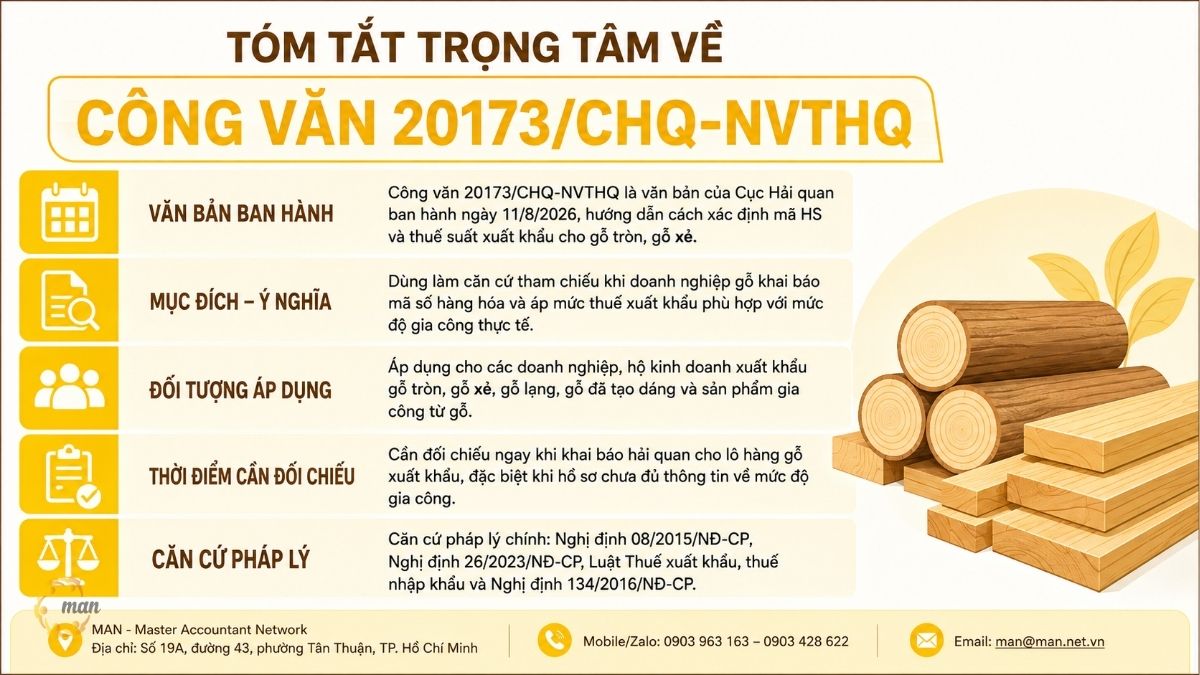
- Official document 20173/CHQ-NVTHQ is a document issued by the Customs Department on August 11, 2026, providing guidance on how to determine the HS code and export tax rate for round timber and sawn timber.
- This serves as a reference point when wood businesses declare commodity codes and apply export tax rates appropriate to the actual level of processing.
- This applies to businesses and households exporting round timber, sawn timber, veneer, shaped timber, and processed wood products.
- It is necessary to verify the information immediately when declaring exported timber shipments, especially when the documentation lacks sufficient information regarding the level of processing.
- Main legal basis: Decree 08/2015/ND-CP, Decree 26/2023/ND-CP, Law on Export and Import Taxes, and Decree 134/2016/ND-CP.
What is Official Document 20173/CHQ-NVTHQ? What is the context of its issuance?
Official document 20173/CHQ-NVTHQ was issued by the Customs Department to respond to a request from the Vietnam Wood and Forest Products Association regarding the application of export tax policies for round timber and sawn timber. This is an administrative document providing operational guidance, not a legal regulation, but it has high practical value because it directly reflects the customs authority's application viewpoint.
The issuance of this document stems from the fact that many wood businesses encounter difficulties when declaring HS codes for raw wood materials. The boundaries between HS codes 44.03, 44.07, 44.08, and 44.09 depend on the degree of processing, thickness, and surface treatment, factors that easily cause disputes between businesses and customs authorities during customs clearance.
Which agency issued this document, and what type is it?
The Customs Department (under the Ministry of Finance) is the agency that directly issued Official Letter 20173/CHQ-NVTHQ. Essentially, this letter addresses a problem and provides guidance on the uniform application of export tax policies for wood nationwide, helping to reduce the situation where each local customs office applies different codes and tax rates to the same type of goods.
What role does Official Document 20173/CHQ-NVTHQ play in tax administration and auditing of timber businesses?
In the financial management of wood export businesses, correctly identifying the HS code from the outset directly affects tax costs, customs clearance time, and the risk of retroactive tax collection after post-clearance inspection. A shipment incorrectly assigned a HS code can result in a tax rate difference ranging from 5% to 25%, a significant amount that can impact the profit margin of an entire export contract.
From this perspective MAN – Master Accountant Network, During the process of providing tax consulting services to numerous wood processing businesses in Binh Duong, Dong Nai, and Binh Dinh provinces, errors in HS codes are one of the most common causes leading to tax assessment decisions and administrative penalties in the customs field. Therefore, Circular 20173/CHQ-NVTHQ serves as a reference document to help tax and import/export accounting departments minimize disputes with customs authorities.
Besides compliance aspects, understanding the content of the official document also supports businesses in internal auditing. When reviewing export tax reports, auditors need to compare the technical documentation of each timber shipment with the classification criteria set by the Customs Department, thereby detecting potential tax discrepancies early on before tax and customs authorities conduct inspections.
Which entities are affected by Official Letter 20173/CHQ-NVTHQ?
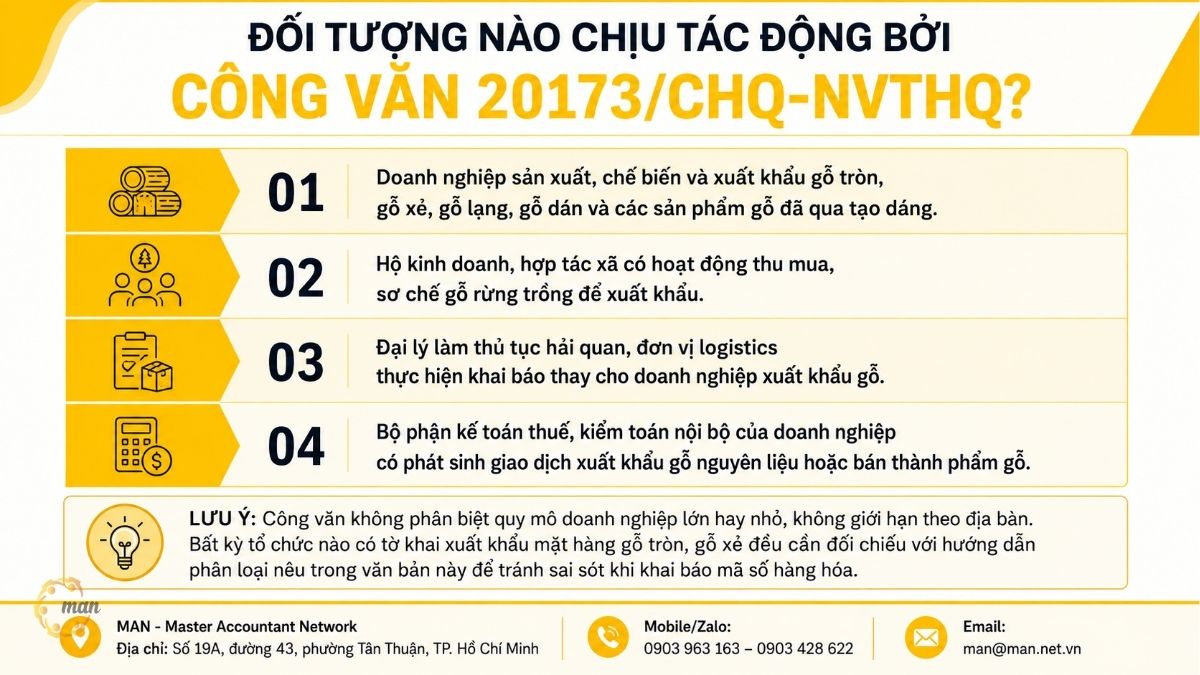
Official document 20173/CHQ-NVTHQ directly impacts the following groups of stakeholders in the timber supply and export chain:
- Businesses that manufacture, process, and export round timber, sawn timber, veneer, plywood, and other shaped wood products.
- Household businesses and cooperatives engaged in the purchase and preliminary processing of timber from planted forests for export.
- Customs brokers and logistics companies handle customs declarations on behalf of wood exporting businesses.
- The tax accounting and internal audit departments of the enterprise have transactions involving the export of raw timber or semi-finished timber products.
It is important to note that the document does not differentiate between large and small businesses, nor is it limited by geographical area. Any organization with export declarations for round timber or sawn timber needs to refer to the classification guidelines stated in this document to avoid errors when declaring the commodity code.
Legal basis for determining HS code and tariff rate for exported timber.
The content of Official Letter 20173/CHQ-NVTHQ is based on the current legal framework regarding goods classification and export tariff schedules. Understanding this framework helps businesses to independently compare and prepare complete technical documentation before declaration.
| Legal documents | Number / Date of Issue | Related content |
| Official document 20173/CHQ-NVTHQ | Customs Department, August 11, 2026 | Guidelines for determining HS codes, tax rates, and tax exemption conditions for exported round timber and sawn timber. |
| Decree 08/2015/ND-CP | Government, January 21, 2015 | Regulations on the classification of exported and imported goods are stipulated in Article 16. |
| Decree 26/2023/ND-CP | Government | Export tariff schedule, preferential import tariff schedule by category of taxable goods. |
| Customs Law 2014 | No. 54/2014/QH13 | Article 26 stipulates the principles and purposes of goods classification as the basis for calculating taxes and managing goods. |
| Law on Export and Import Taxes | Current | Regulations establishing the principle of tax exemption for imported raw materials used in processing goods for export. |
| Decree 134/2016/ND-CP (amended by Decree 18/2021/ND-CP) | Government | Conditions for tax exemption on imported raw materials and supplies used in processing goods for export. |
| Decree 252/2026/ND-CP | Government | Article 14 stipulates the exchange rate for calculating taxes on exported and imported goods according to customs law. |
Important Note: The Customs Department confirmed in a document that because the dossier from the Vietnam Wood and Forest Products Association only mentioned the general names of the goods as "round timber" and "sawn timber," and did not fully reflect the degree of processing (whether or not the bark has been removed, squared, planed, sanded, or end-jointed), the agency could not determine the specific HS code for each case. Businesses need to prepare more detailed technical documents when requesting a preliminary determination of the HS code.
The export tax rate for timber is as guided by Official Letter 20173/CHQ-NVTHQ.
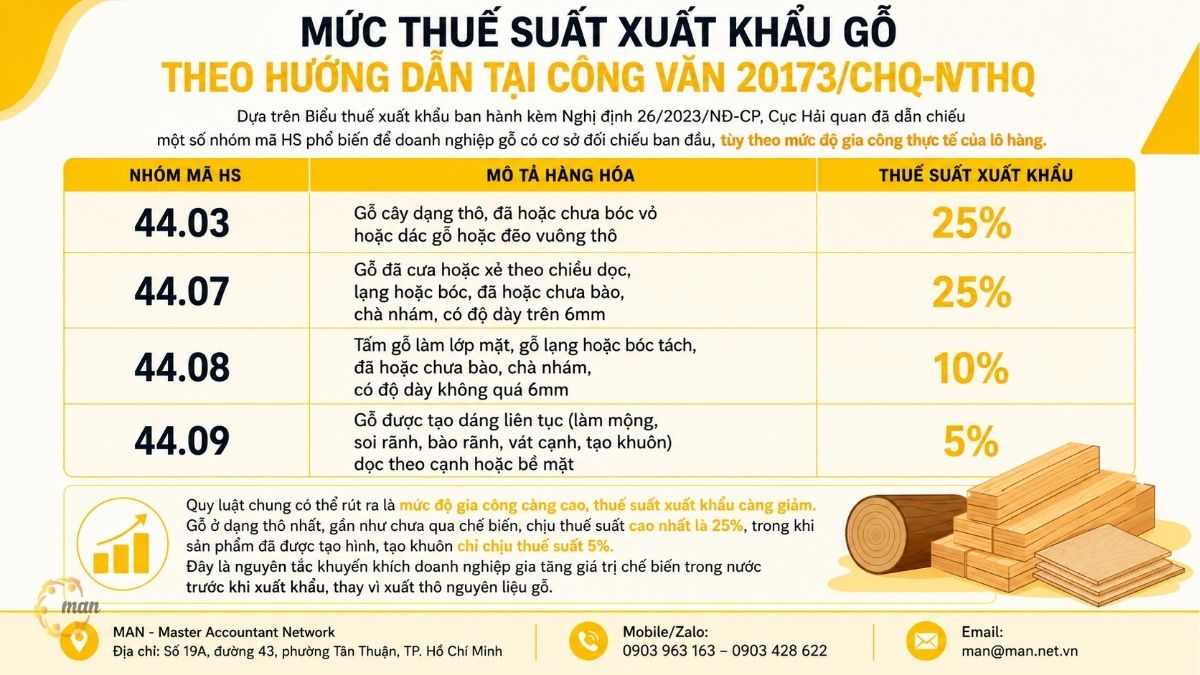
Based on the Export Tariff Schedule issued with Decree 26/2023/ND-CP, the Customs Department has referenced several common HS code groups to provide wood businesses with an initial basis for comparison, depending on the actual processing level of the shipment.
| HS code group | Product description | Export tax rate |
| 44.03 | Timber in rough form, with or without bark or sapwood, or roughly squared. | 25% |
| 44.07 | Sawn or longitudinally cut timber, sliced or peeled, whether or not planed or sanded, with a thickness exceeding 6 mm. | 25% |
| 44.08 | Wood veneer, veneer or peeled, whether or not planed or sanded, with a thickness not exceeding 6 mm. | 10% |
| 44.09 | Wood is continuously shaped (mortise, tenon, groove, planed, beveled, molded) along its edge or surface. | 5% |
A general rule is that the higher the level of processing, the lower the export tax rate. Wood in its rawst form, almost unprocessed, is subject to the highest tax rate of 25%, while shaped and molded products are only subject to a tax rate of 5%. This principle encourages businesses to increase the value of domestic processing before exporting, instead of exporting raw wood materials.
Tax exemption policy for processed wood products exported.
In addition to guidance on HS codes and tax rates, Official Letter 20173/CHQ-NVTHQ also reiterates the tax exemption policy applicable to export processing activities. According to the Law on Export and Import Taxes and Decree 134/2016/ND-CP (amended and supplemented by Decree 18/2021/ND-CP), imported raw materials and supplies for export processing are exempt from tax if they fully meet the prescribed conditions.
Businesses need to pay special attention to the following: for processed export products manufactured from domestically sourced raw materials and supplies subject to export tax, the value of the domestically sourced raw materials in the product will not be exempt from tax. In other words, the tax exemption policy only applies to the imported raw materials used for processing, not to the entire value of the exported product.
Conditions for eligibility for tax exemption on processing materials:
- Businesses with processing contracts or export contracts that clearly state the purpose of using imported raw materials.
- There are actual consumption norms for raw materials and supplies used in the production of export products, which are established and maintained in accordance with customs regulations.
- Submit a final report on the use of imported raw materials and supplies within the prescribed timeframe and format.
- The finished product must be exported, with an export declaration corresponding to the import declaration for the original raw materials.
What is the purpose of classifying goods for export and import?
According to Clause 1, Article 26 of the 2014 Customs Law, goods classification is the activity of determining the commodity code for two main purposes: as a basis for calculating taxes and for implementing policies on managing export and import goods. When classifying, customs authorities must rely on customs documents, technical documents, and other relevant information to determine the name and code of the goods according to the Vietnamese Export and Import Commodity List.
The Vietnamese export and import commodity catalog includes codes, names, descriptions, units of measurement, and explanatory content, and is developed based on the full application of the International Convention on the Harmonized System of Description and Coding of Goods. The Minister of Finance is authorized to issue this catalog uniformly nationwide, and also to issue unified commodity codes for the catalogs of goods prohibited from export, prohibited from import, goods subject to licensing, and goods subject to specialized inspection.
In accordance with Official Letter 20173/CHQ-NVTHQ, the Customs Department's request for the Vietnam Wood and Forest Products Association to supplement information on the degree of processing, dimensions, and thickness is a direct consequence of this classification principle. A lack of technical information means insufficient basis to determine the name and code of the goods according to the Vietnamese Export and Import Goods Classification List.
How is the exchange rate used for calculating taxes on exported timber determined?
Besides correctly identifying the HS code and tax rate, wood exporting businesses also need to pay attention to the exchange rate when converting the taxable value into Vietnamese Dong. According to Clause 4, Article 14. Decree 252/2026/ND-CP Regulations regarding the currency for tax declaration, other revenues, tax payments, and exchange rates for tax calculation: For exported and imported goods, the exchange rate for tax calculation shall be in accordance with the law on customs, and the general exchange rate for tax calculation as applied to other domestic revenues shall not be used.
Clause 5 of Article 14 of Decree 252/2026/ND-CP also stipulates that for fees and charges, the exchange rate for calculating fees and charges shall be in accordance with the law on fees and charges. Therefore, wood exporting businesses need to clearly distinguish between three groups: the exchange rate for calculating export tax according to customs law, the exchange rate for calculating fees and charges according to the law on fees and charges, and the exchange rate for declaring domestic tax according to other provisions of Article 14. Applying the wrong exchange rate is also a reason why the calculated export tax differs from the figures verified by the customs authorities.
Case Study: How do wood businesses in Binh Dinh handle HS code classification?
Background
Company Y, a limited liability company specializing in the processing and export of furniture in Binh Dinh province, regularly exports both raw sawn timber and refined wood products. Before clear guidelines were issued, the company's import-export department mistakenly declared a shipment of sawn timber with a thickness of 8mm under group 44.08 (tax rate 10%) instead of group 44.07 (tax rate 25%) due to a confusion regarding the thickness classification threshold.
Instructions on how to handle it
After reviewing in accordance with the spirit of Official Letter 20173/CHQ-NVTHQ, the consulting team from MAN – Master Accountant Network We have assisted the company in three steps: firstly, standardizing technical documentation for each shipment, including thickness, degree of planing, and sanding, which are measured and recorded specifically; secondly, developing an internal comparison table between tariff codes 44.03, 44.07, 44.08, and 44.09 associated with each finished product of the company; and thirdly, proactively seeking prior approval of the tariff code from the relevant customs office before signing large-scale export contracts.
The measured results
- The company avoided an estimated export tax difference of over 200 million VND for a shipment that was at risk of having its customs code reassigned.
- The average customs clearance time for timber shipments has decreased from 3 days to 1 day due to complete technical documentation from the outset.
- No tax assessment decisions or administrative penalties were issued during the most recent post-customs clearance inspection.
Expert opinion: Common risks in the timber business and how to avoid them.
Experts at MAN – Master Accountant Network With over 30 years of experience in tax consulting and auditing in Vietnam, we note four common risks that wood businesses often face when applying export tax policies.
- Risk 1: Declaring HS codes based on generic product names: Many businesses only declare "round timber" or "sawn timber" without detailing the level of processing, leading to customs documents lacking a basis for classification, similar to the situation the Vietnam Timber and Forest Products Association encountered in its petition. As a result, shipments may be held for physical inspection, prolonging customs clearance time.
- Risk 2: Confusion regarding thickness thresholds between code groups: The 6mm thickness difference between groups 44.07 and 44.08 is the most prone to errors in practice. The tax rate difference between these two groups is as much as 15 percentage points, so even a small technical measurement error can result in significant back taxes being collected from businesses.
- Risk 3: Incorrect application of tax exemption scope for domestic raw materials: Some export processing businesses mistakenly apply the tax exemption to the entire product value, while regulations only exempt the imported raw materials. The value added from domestically sourced wood, which is subject to export tax, must still be fully taxed.
- Risk 4: Lack of supporting documentation during post-clearance customs inspection: Customs authorities have the right to re-examine all classification documents within the prescribed timeframe. If a business fails to retain complete technical documentation, inspection results, or material consumption reference sheets, the tax difference may be subject to retroactive collection along with late payment penalties.
Conclude
Circular 20173/CHQ-NVTHQ is a practical reference document that helps wood businesses better understand the principles of HS code classification, the corresponding export tax rates for each level of processing, and the scope of application of the tax exemption policy for processed raw materials. Thoroughly understanding the content of this circular from the technical documentation stage will help businesses shorten customs clearance time, minimize the risk of tax arrears, and reduce administrative penalties in the customs field.
Tax services at MAN – Master Accountant Network
- Tax accounting services
- Tax consulting services
- Tax settlement services
- Tax reporting services
- VAT refund service
Service contact information at MAN – Master Accountant Network
- Address: No. 19A, Street 43, Tan Thuan Ward, Ho Chi Minh City
- Mobile/Zalo: 0903 963 163 – 0903 428 622
- E-mail: man@man.net.vn
- Google Business Profile: View MAN – Master Accountant Network's Google Business Profile
- LinkedIn Founder: View expert Le Hoang Tuyen's LinkedIn profile.
Responsible for production and professional content review by: Mr. Le Hoang Tuyen – Founder & CEO of MAN – Master Accountant Network, CPA Vietnam with over 30 years of experience in accounting, auditing, taxation, and corporate financial consulting.
Frequently Asked Questions about Official Letter 20173/CHQ-NVTHQ
Is Official Letter 20173/CHQ-NVTHQ a legal normative document?
No. This is an administrative document providing professional guidance and addressing specific issues raised by the Vietnam Wood and Forest Products Association; it is not a legal document and therefore does not replace existing decrees or laws.
Why hasn't the Customs Department specified the HS code in this document?
Because the association's application only listed the general names of the goods as round timber and sawn timber, it did not provide sufficient information on the level of processing, dimensions, and thickness to establish an accurate classification in accordance with Article 16 of Decree 08/2015/ND-CP.
What should businesses do to avoid applying the wrong HS code to exported timber?
Businesses should prepare complete technical documentation, clearly describing the level of processing, product thickness, and may request a preliminary determination of the commodity code from the customs office before signing large export contracts.
Are imported timber materials used for processing and export fully exempt from taxes?
Not entirely. Only the imported raw materials and supplies that meet the conditions under Decree 134/2016/ND-CP are exempt from tax. The value of domestically sourced materials in the product is still subject to export tax as prescribed.
Can the export tax rate on timber change over time?
Yes. Export tariffs are stipulated in government decrees and may be amended periodically. Businesses need to regularly update themselves on the latest guidance documents from the Ministry of Finance and the Customs Department to apply the correct current tariff rates.
Is the exchange rate used for calculating export tax on timber the same as the exchange rate used for domestic tax declaration?
No. According to Clause 4, Article 14 of Decree 252/2026/ND-CP, the exchange rate for calculating taxes on exported and imported goods is implemented according to the provisions of the law on customs, separate from the exchange rate used for declaring taxes on other domestic revenue.