
Do businesses need to issue invoices when giving mooncakes as gifts to customers? This is a crucial legal question that many businesses are concerned about during every holiday season. Managing invoices and receipts for gift-giving transactions requires strict compliance with current regulations on tax management and electronic invoicing.
As prescribed in Decree 254/2026/ND-CP, The export of goods as gifts for business production activities is directly regulated by tax laws. A thorough understanding of the legal basis helps businesses proactively declare goods, prevent risks of administrative penalties, and optimize operating costs.
Summary of key points regarding whether businesses need to issue invoices when giving mooncakes as gifts to customers:
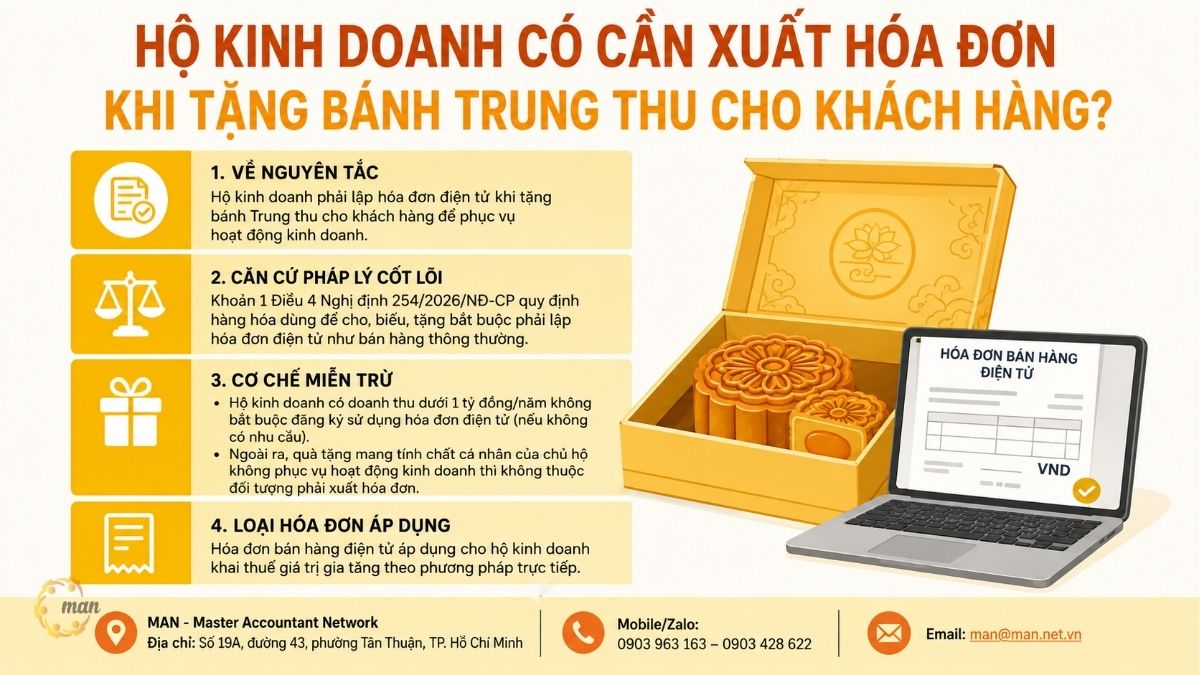
- Do sole proprietorships need to issue invoices when giving mooncakes as gifts to customers? YES, in principle, sole proprietorships must issue electronic invoices when giving mooncakes as gifts to customers to support their business operations.
- Core legal basis: Clause 1, Article 4 of Decree 254/2026/ND-CP stipulates that goods used for giving away or gifting must be invoiced electronically, just like regular sales.
- Exemption mechanism: Household businesses with annual revenue under 1 billion VND are not required to register for electronic invoices (unless they have a need to). Additionally, gifts of a personal nature from the household head that are not related to business activities are not subject to invoice requirements.
- Applicable invoice types: Electronic sales invoices are applicable to business households that declare value-added tax using the direct method.
According to the law, are business owners required to issue invoices when giving mooncakes as gifts to customers?
Based on the provisions of Clause 1, Article 4 of Decree 254/2026/ND-CP on the principles of establishing, managing, and using electronic invoices and documents, when selling goods or providing services, the seller is required to issue an electronic invoice to the buyer. This regulation applies to all cases of goods and services used for promotions, advertising, samples; goods and services used for giving, gifting, exchanging, paying as wages to employees, and internal consumption; goods exported in the form of loans and borrowings; and cases of invoice issuance as prescribed by the Minister of Finance, except for cases where electronic invoices are not required as stipulated in Article 7 of this Decree.
So, here's the detailed answer to the question. Do businesses need to issue invoices when giving mooncakes as gifts to customers? To be HAVE. The act of using mooncakes as gifts for customers to maintain business relationships, promote products, or show appreciation to partners is subject to the requirement of issuing electronic invoices, similar to regular sales activities.
However, in practical tax administration, it is necessary to clearly distinguish between the two natures of the transactions that arise:
- Case 1: Gifts intended to support the household's business operations. Mooncakes purchased using the business's own funds, recorded in the accounting books, and given as gifts to customers to boost sales require the issuance of an electronic sales invoice.
- Case 2: The gift is a personal gift from the head of the household. If a business owner uses personal funds to purchase mooncakes as gifts for relatives, friends, or neighbors, and this purchase is unrelated to the business's production and sales activities, it falls outside the scope of business invoices and receipts. Therefore, there is no obligation to issue an invoice in this case.
Experts at MAN, with 30 years of experience, note that during tax audits, authorities will check the consistency between purchase and sales invoices. If a business uses input invoices to purchase mooncakes but fails to issue output invoices when giving them away as gifts, the tax authorities may conclude that the business is committing fraud or omitting business assets from its accounting records. Classification of invoicing obligations for household businesses:
For cases where cakes are purchased as personal gifts (not for commercial purposes): Not subject to the regulations of business invoices, therefore no invoice needs to be issued.
For cases where cakes are purchased as gifts for customers (for business purposes): ISSUING ELECTRONIC INVOICES IS MANDATORY.
- Household businesses with annual revenue of 1 billion VND or more: Registration and issuance of electronic invoices with codes or invoices generated from cash registers are mandatory.
- Household businesses with annual revenue under 1 billion VND: You are exempt from the mandatory registration for electronic invoices if you do not need to use them.
The business households affected and the conditions for applying the regulations on issuing gift invoices.
The obligation to issue electronic invoices when giving mooncakes as gifts is applied differently depending on the scale of revenue and the form of invoice registration of each business household.
Household businesses are required to use electronic invoices.
For household businesses and individual business owners with annual revenue of 1 billion VND or more, or household businesses that have converted to using electronic invoices generated from cash registers, issuing invoices when giving gifts is mandatory.
When purchasing mooncakes from a supplier, the business household receives a sales invoice or input value-added tax invoice. When giving these mooncakes as gifts to customers, the business household must issue an electronic output invoice. The taxable price recorded on the invoice must be based on the selling price of similar or equivalent products on the market at the time of giving.
Household businesses with annual revenue under 1 billion VND.
Based on regulations on tax management for household businesses, household businesses with annual revenue under 1 billion VND are currently not required to register for the use of electronic invoices with tax authority codes or electronic invoices generated from cash registers (if they do not need to use them).
The specific handling method for this group is as follows:
- If a business household does not register to use electronic invoices: When giving mooncakes as gifts to customers, households are not required to request individual invoices from the tax authorities for each gift-giving transaction.
- If the business household has voluntarily registered to use electronic invoices: Households must fully comply with the principles of invoicing for gifts and donations as stipulated in Clause 1, Article 4 of Decree 254/2026/ND-CP.
The type of invoice applicable to household businesses when issuing gifts.
The majority of business households in Vietnam apply the direct method of declaring and calculating value-added tax based on revenue. According to point a, clause 2, Article 8 of Decree 254/2026/ND-CP, the type of invoice used by business households is... Sales invoice.
When issuing sales invoices to customers receiving mooncakes, business households must clearly state the product information, quantity, and unit price based on the market price of equivalent products and calculate the cost. VAT Directly according to the % ratio stipulated for the respective industry.
Detailed legal basis for electronic invoices and documents according to Decree 254/2026/ND-CP
To provide a comprehensive legal framework for tax administration, the following is a full text excerpt and in-depth analysis of the provisions directly governing this activity.
Detailed quotation from Article 4 of Decree 254/2026/ND-CP
Article 4. Principles for the creation, management, and use of electronic invoices and documents.
- When selling goods or providing services, sellers must issue electronic invoices to buyers (including cases where goods and services are used for promotions, advertising, samples; goods and services used for giving, gifting, exchanging, paying as wages to employees, and internal consumption; goods exported in the form of loans or borrowings) and cases where invoices are issued as prescribed by the Minister of Finance, except for cases where electronic invoices are not required as stipulated in Article 7 of this Decree.
Electronic invoices must conform to standard data formats and must contain all the information required by tax laws, accounting laws, and the provisions of Article 10 of this Decree, ensuring that they fully and truthfully reflect the economic transactions that have occurred. The seller is legally responsible for the accuracy of the issued invoice.
- When deducting personal income tax, collecting taxes, fees, and charges, the tax-deducting organization or individual, and the tax-collecting organization, must create electronic tax deduction certificates and electronic tax, fee, and charge receipts for the person whose income is subject to tax deduction, the taxpayer, or the fee/charge payer. These documents must contain all the information as prescribed in Article 23 of this Decree and in the standard data format.
Detailed quotation from Article 7 of Decree 254/2026/ND-CP regarding cases where electronic invoices are not required.
Article 7. Cases where electronic invoices are not required.
- Household businesses and individual businesses selling goods and services are required to prepare a list of purchased goods and services in accordance with the law on corporate income tax, except in cases where they register to use electronic invoices.
- Household businesses and individual businesses with income from real estate rental activities; income from providing digital content products and services related to entertainment, video games, digital films, digital photos, digital music, and digital advertising to organizations and individuals abroad.
- Household businesses and individual business owners acting as lottery agents, insurance agents, or multi-level marketing agents, where the lottery, insurance, or multi-level marketing companies have already deducted taxes in accordance with tax management laws.
- Fees and other income arising from reinsurance activities (including reinsurance cession, reinsurance cession commissions, and other income from reinsurance cession), receiving deposits, financing activities (issuing certificates of deposit, issuing primary securities, issuing securities), selling debt, foreign exchange transactions, and derivative products.
For foreign currency sales transactions, based on the unit's data management system, at the end of the month the unit shall prepare a detailed summary table of transactions occurring during the month, be responsible for the accuracy of the information content of each transaction, and provide the detailed summary table of foreign currency sales transactions when requested by the tax authorities or competent state agencies.
- Contributing assets of business organizations and individuals to economic organizations.
- Assets transferred from the parent company to dependent accounting units and vice versa, between dependent accounting units within a business; assets transferred during division, separation, merger, acquisition, or conversion of business type.
- The machinery and equipment lent are fixed assets and tools used for processing goods of the lender; no payment is collected, and no ownership is transferred.
- Cases as stipulated in points a and b of clause 1, Article 6, and point b of clause 1, Article 14. Decree No. 181/2025/ND-CP The Government's regulations detailing the implementation of certain articles of the Value Added Tax Law include:
- a) Goods and services used to continue the production and business process of a business establishment, such as goods exported for internal warehouse transfer, materials exported, and semi-finished products exported to continue the production and business process within a business establishment;
- b) Goods and services exported or provided by the business establishment for use in its production and business activities (including fixed assets built or produced by the business establishment itself);
- c) Income not related to the sale of goods or provision of services by the business establishment: income from monetary compensation (including compensation for land and assets on land when land is reclaimed according to a decision of a competent state agency), bonuses, third-party claims from insurance activities, amounts collected on behalf of others, fees from state agencies for performing collection and disbursement activities on behalf of state agencies, and financial income.
Legal review from MAN: Comparing all eight clauses in Article 7 of Decree 254/2026/ND-CP, the act of a business household giving mooncakes to customers does not fall under any exemption. Therefore, the obligation to issue electronic invoices as stipulated in Clause 1, Article 4 is mandatory.
Detailed quotation from Article 8 of Decree 254/2026/ND-CP regarding types of sales invoices.
Article 8. Types of invoices
The invoices stipulated in this Decree include the following types:
[…]
- A sales invoice is an invoice for economic organizations, business households, and individual businesses as follows:
- a) Economic organizations, business households, and individual businesses declare and calculate value-added tax using the direct method for the following activities:
a.1) Selling goods and providing services domestically;
a.2) International transport operations;
a.3) Export to free trade zones and cases considered as exports;
a.4) Exporting goods and providing services abroad.
- b) Economic organizations and individuals in the free trade zone, when selling goods or providing services domestically, and when selling goods or providing services between economic organizations and individuals within the free trade zone, or exporting goods or providing services abroad, must clearly state on the invoice "For organizations and individuals in the free trade zone".
Export processing enterprises that engage in other business activities (besides export processing activities as stipulated by law on industrial parks and export processing zones) and declare value-added tax using the direct method shall use invoices as prescribed in point a of this clause. Export processing enterprises that declare value-added tax using the deduction method shall use invoices as prescribed in clause 1 of this Article.
[…]
Application: Household businesses declaring VAT using the direct method shall issue electronic sales invoices for the activity of giving away mooncakes to domestic customers as stipulated in point a.1, clause 2, Article 8 above.
Detailed quotation from Article 9 of Decree 254/2026/ND-CP regarding the time of invoice issuance.
Based on Clause 1, Article 9 of Decree 254/2026/ND-CP, it is stipulated that:
- Timing of invoicing for the sale of goods: (Including the sale and transfer of public assets and the sale of national reserves) is the time when ownership or the right to use the goods is transferred to the buyer, regardless of whether payment has been received or not.
- For goods exports: (Including export processing), the time of issuing the electronic commercial invoice, electronic value-added tax invoice, or electronic sales invoice is determined by the seller, but no later than the next working day from the date the goods are cleared through customs as stipulated by customs law.
Compilation of the system of legal documents regulating
To fully understand the regulations on electronic invoices and tax obligations, businesses and household businesses need to be familiar with the following fundamental legal documents. Each document regulates a specific group of contents, from the principles of invoice creation and the timing of invoice issuance to tax management and declaration.
| Document number | Text type | Key regulations |
| Decree 254/2026/ND-CP | Government Decree | Regulations on the principles of issuing electronic invoices (Article 4), list of exemptions from electronic invoices (Article 7), types of invoices (Article 8), and time of issuance (Article 9). |
| Decree 181/2025/ND-CP | Government Decree | Regulations detailing the implementation of the Value Added Tax Law regarding goods exported for internal consumption and continued production. |
| Tax Administration Law No. 38/2019/QH14 | National Assembly Law | Regulations on the obligations of registration, declaration, and use of invoices and supporting documents, and violations of tax laws. |
| Circular 40/2021/TT-BTC | Circular of the Ministry of Finance | Guidelines on VAT, personal income tax, and tax management methods for household businesses and individual business owners. |
Procedures and methods for creating sales invoices when giving away mooncakes as gifts.
Properly documenting gifts and donations, ensuring timely and accurate value, helps businesses maintain transparency in their documentation before tax authorities.
Principles for determining the timing of invoice issuance.
Businesses must issue invoices immediately upon handing over mooncakes to customers or delivery units. Issuing invoices at the wrong time or accumulating them at the end of the accounting period may result in administrative fines ranging from 3,000,000 VND to 8,000,000 VND.
Principles for determining the taxable value
- The price stated on the invoice is the market price of a similar or equivalent product at the time the gift was given.
- Household businesses are not allowed to record prices at 0 VND on invoices (except for promotional programs legally registered with the Department of Industry and Trade under the Commercial Law).
- Value Added Tax (VAT) is calculated by multiplying the taxable price by the VAT rate (1% VAT) based on the business sector of the household.
Steps to follow on the electronic invoicing system
- Step 1: Create a list of customers who will receive gifts. Compile the names of the customers, their addresses, and the quantity and types of mooncakes donated.
- Step 2: Choose a Sales Invoice template. Log in to the electronic invoicing software and create a sales invoice.
- Step 3: Enter the information and the taxable value. Enter the recipient's name (or select "Customer not requesting an invoice"). The item name field should read: “Mooncakes [Product Name] – Free Gift”. The purchase price is based on the current listed selling price.
- Step 4: Digitally sign and issue the electronic contract. Verify the data, digitally sign the invoice, and submit it to the tax authority's system to receive the required code.
Real-life Case Study: Handling Invoices for Mooncake Gifts at Minh Tri Household Business
Analyzing a real-world case study of a household business helps clarify how tax regulations are implemented in practice.
Situational context
Minh Tri Household Business, trading in electronic equipment in Ho Chi Minh City, declares taxes using the direct method and applies electronic invoices with codes. Annual revenue reaches 3.5 billion VND (goods trading industry, VAT rate 11%, personal income tax rate 0.5%).
For the Mid-Autumn Festival, the household purchased 50 boxes of mooncakes from the manufacturer with a total invoice of 25,000,000 VND (including VAT) to show appreciation to 50 loyal customers.
Technical specifications of the HKD Minh Trí Case Study:
- Area of activity: Trading in electronic equipment.
- Average revenue: 3.5 billion VND/year.
- Tax calculation method: Directly based on revenue.
- Tax rate as stipulated: VAT 1% | Personal Income Tax 0.5%.
- Quantity of gift items: 50 boxes of mooncakes.
- Purchase value (with input invoices): 25,000,000 VND.
The correct legal procedure for handling this matter.
Following advice from MAN, Minh Tri Business Household took the following steps to ensure compliance with Decree 254/2026/ND-CP:
Store input invoices: Keep the electronic invoice for the purchase of 50 boxes of mooncakes along with the bank payment receipt.
Create a delivery list: Create a list of 50 customers who will receive gifts, with delivery confirmation or shipping documents.
Issue sales invoices:
- Create an electronic sales invoice with the following content: “"Mooncakes as a token of appreciation for our customers – Free gifts"”.
- Quantity: 50 boxes.
- Taxable price: 500,000 VND/box (based on market price).
- Total invoice value: 50 x 500,000 = 25,000,000 VND.
Tax declaration and payment:
- Value Added Tax payable: 25,000,000 x 1% = 250,000 VND.
- Personal Income Tax: This does not increase the taxable income of the household head; it is recorded according to the true nature of the transaction of giving away gifts.
Risk analysis if Minh Tri Household Business does not issue invoices.
If Minh Tri Household Business records an input invoice of 25,000,000 VND, but... No output invoices issued. When giving gifts:
- When comparing data from automated electronic invoices, the tax authorities discovered a discrepancy of 50 boxes of mooncakes in inventory with no sales.
- The tax authorities will conclude that the business owner has arbitrarily consumed or sold goods without issuing invoices.
- Consequence: The tax authorities will collect back VAT, impose administrative penalties ranging from 1 to 1.5 times the amount of tax evaded, plus late payment interest of 0.031 TP3T/day.
Comparison table of cases where invoices are required and cases where no invoice is required when giving gifts.
The summary table below helps to clearly define the invoicing obligations of business households for each specific gift-giving case:
| Transaction case | Invoice issuance obligation | Applicable VAT rate | Tax management notes |
| Giving mooncakes to customers/partners. | OBLIGATORY | % ratio by industry | Write "Gift, no charge," and the tax will be calculated based on the market price. |
| Giving mooncakes to employees | OBLIGATORY | % ratio by industry | This falls under the category of payment in lieu of salary/gifts to employees (Clause 1, Article 4). |
| These mooncakes are used as samples. | OBLIGATORY | % ratio by industry | The regulations for registering/notifying samples must be complied with under commercial law. |
| Mooncakes are offered as part of a promotional offer when purchased with a main product. | OBLIGATORY | % ratio by industry | The promotional program must be registered with the Department of Industry and Trade. The taxable price is 0 if valid. |
| The head of the household buys cakes as gifts for relatives and family. | ARE NOT | No issues arose. | Personal expenses, input invoices not recorded in the business's accounting. |
| Mooncakes that are spoiled or expired must be discarded. | ARE NOT | No issues arose. | A committee for the destruction of goods must be established, along with complete inventory records and destruction reports. |
Expert opinion from MAN: Common tax risks and optimal solutions for sole proprietorships.
Based on consultations with thousands of businesses nationwide, the holiday season is the time when document errors are most likely to occur. MAN's team of experts with over 30 years of experience has compiled a list of key risks and recommends control solutions.
Top 3 tax risks when giving gifts:
- Do not issue output invoices when input invoices have already been declared: This leads to inventory data discrepancies and suspicions of revenue concealment.
- The taxable price is recorded too low compared to the listed price: They are susceptible to having their tax assessment value reassessed by the tax authorities and being penalized for declaration violations.
- Invoices issued at the wrong time: Accumulating invoices at the end of the month or after the gift delivery date will result in a fine of 3 million to 8 million VND.
Details of common tax risks
- Incompatibility between input and output invoice data: Household businesses receive invoices for the purchase of mooncakes but do not issue sales invoices when giving them away as gifts. The tax authority's centralized data management system automatically scans and detects this discrepancy.
- Declaring taxable prices that do not reflect market prices: In order to reduce the amount of VAT payable (1%), some households intentionally record prices on invoices that are significantly lower than the purchase price. During inspections, the tax authorities have the right to reassess the taxable price according to the market price.
- Lack of documentation proving professional qualifications: The business issued invoices for gifts but did not create a list of customers who received the gifts. The lack of delivery and receipt documents resulted in the cost of the gifts being disallowed during an inspection.
The optimal solution from MAN – Master Accountant Network
To optimize processes and ensure strict compliance with tax laws, MAN proposes a 4-step management process:
- Step 1: Establish a Gift Policy. Issue detailed gift-giving guidelines for each group of partners and customers.
- Step 2: Verify the input invoices. Only buy mooncakes from suppliers that issue legitimate electronic invoices.
- Step 3: Issue sales invoices at the right time. Issue electronic sales invoices simultaneously with the delivery of gifts to customers.
- Step 4: Complete the record archiving process. The complete set of documents includes: Gift purchase approval form, Purchase invoice, Customer receipt list, and Electronic sales invoice.
With a deep understanding of the realities of tax risk management in Vietnam, MAN always accompanies businesses in building a safe and standardized documentation system right from the smallest transaction stage.
Conclude
The question of whether business households need to issue invoices when giving mooncakes as gifts to customers has been clearly addressed by law in Decree 254/2026/ND-CP. Understanding the obligation to issue electronic invoices for gifts helps business households ensure legal compliance, minimize the risk of tax arrears, and avoid administrative penalties during operation.
Tax services at MAN – Master Accountant Network
- Tax accounting services
- Tax consulting services
- Tax settlement services
- Tax reporting services
- VAT refund service
Service contact information at MAN – Master Accountant Network
- Address: No. 19A, Street 43, Tan Thuan Ward, Ho Chi Minh City
- Mobile/Zalo: 0903 963 163 – 0903 428 622
- E-mail: man@man.net.vn
- Google Business Profile: View MAN – Master Accountant Network's Google Business Profile
- LinkedIn Founder: View expert Le Hoang Tuyen's LinkedIn profile.
Responsible for production and professional content review by: Mr. Le Hoang Tuyen – Founder & CEO of MAN – Master Accountant Network, CPA Vietnam with over 30 years of experience in accounting, auditing, taxation, and corporate financial consulting.
Frequently Asked Questions about Invoicing for Gifted Mooncakes (FAQ)
Can a household business list the price as 0 VND on invoices for free mooncakes?
No. Businesses are not allowed to list a price of 0 VND on invoices for mooncake gifts. The price on the invoice must be the market price of a similar or equivalent product at the time of the gift. This excludes cases where the mooncake giveaway promotion has been legally registered with the Department of Industry and Trade in accordance with commercial law.
Is it necessary to issue an invoice when giving mooncakes as gifts to employees of a business household?
Yes. According to Clause 1, Article 4 of Decree 254/2026/ND-CP, goods used for giving, gifting, or as payment in lieu of salary to employees are subject to the requirement of issuing electronic invoices. Business households must issue sales invoices for the mooncakes given as rewards or gifts to employees.
Do businesses operating under a lump-sum tax system have to issue invoices when giving away mooncakes as gifts?
For household businesses paying taxes under the lump-sum method, since the tax is fixed based on the lump-sum revenue determined by the tax authority, they are not required to issue electronic invoices for each sales transaction or gift (except in cases where the customer requests a separate invoice and the household business applies to the tax authority for issuance). However, if the lump-sum household business uses electronic invoices, they must still comply with the principle of issuing invoices when giving gifts.
Do customers who receive mooncakes as gifts need to request a receipt?
For individual consumers, they usually don't need to receive gift vouchers. However, the business owner is still obligated to issue an electronic sales invoice (which can be labeled as "Customer not requesting an invoice"). For corporate or economic organizations, receiving gift vouchers provides them with documentation to record assets/income in accordance with accounting regulations.
How long is the electronic gift invoice kept on file?
Electronic gift invoices, along with all accompanying documents and records, must be securely stored on an electronic data system for a minimum of 10 years, as stipulated by the Accounting Law and the Tax Administration Law, to facilitate tax audits and inspections when required.