
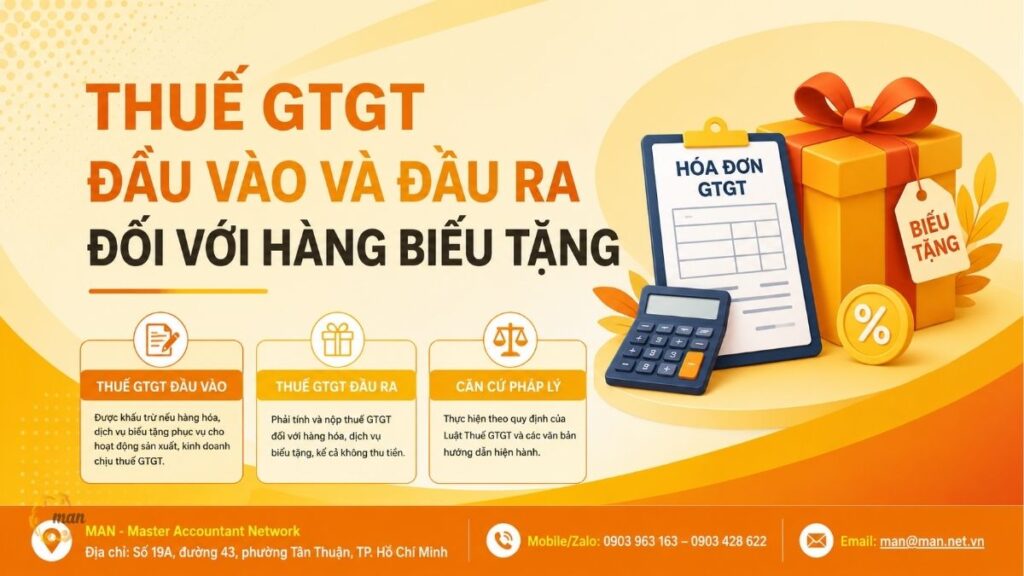
Input VAT and output VAT on gifts. This is a crucial tax management topic that every business needs to master when implementing customer, partner, or employee appreciation programs. Value Added Tax Law 2024 In the latest law (Law No. 48/2024/QH15), regulations related to invoices, tax base, time of supplementary declaration, and prohibited acts have been standardized to ensure transparency in business operations.
Failure to accurately determine the timing of invoice issuance, taxable value, and conditions for non-cash payment documents can easily lead to the risk of tax arrears and administrative penalties. To help management and accounting departments handle these issues correctly, this article analyzes all relevant legal regulations, supplementary solutions for errors, and practical management insights from experts.
Summary of key points regarding input and output VAT on gifts.
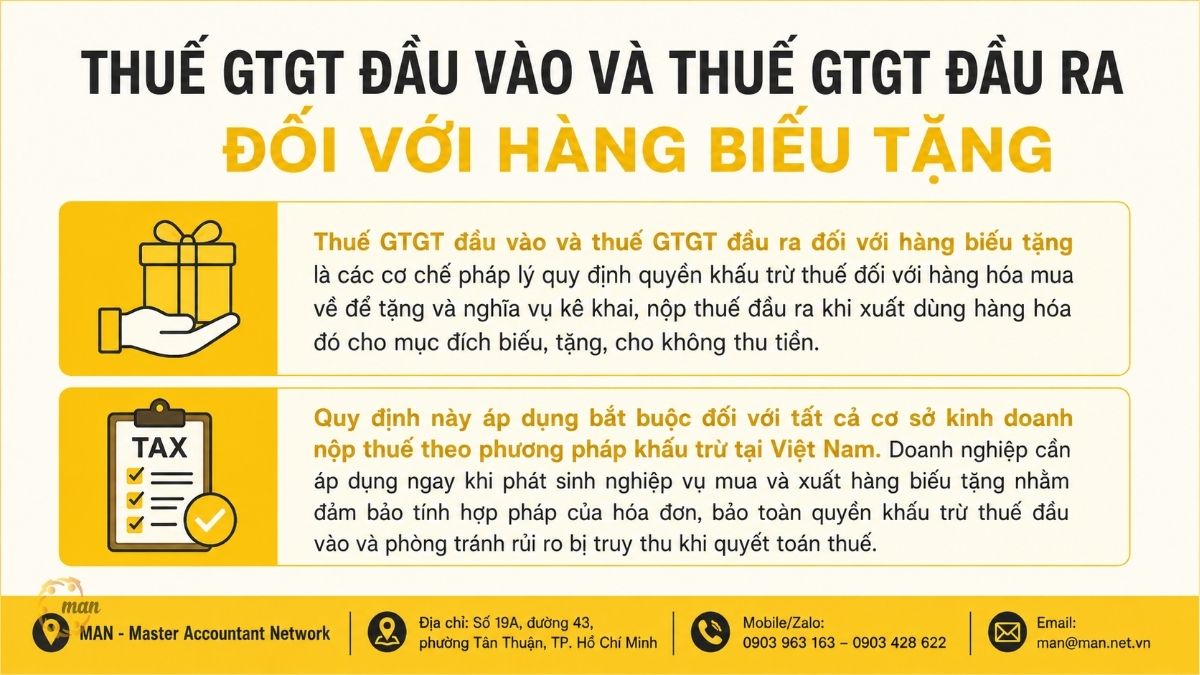
- Input VAT and output VAT on gifts are legal mechanisms that regulate the right to deduct tax on goods purchased for gifting purposes and the obligation to declare and pay output tax when those goods are used for gifting or giving away free of charge.
- This regulation is mandatory for all businesses paying taxes using the deduction method in Vietnam. Businesses need to apply it immediately when purchasing and exporting goods for gifts or donations to ensure the legality of invoices, protect their right to deduct input tax, and avoid the risk of being subject to retroactive tax collection during tax settlement.
The latest legal regulations on input VAT and output VAT for gifts.
Based on the legal framework of the Value Added Tax Law 2024, activities involving the giving or receiving of goods and services free of charge are subject to strict regulation in both directions: input VAT and output VAT. Businesses need to clearly define the operating mechanisms of each aspect in order to fulfill their tax obligations correctly.
Input VAT deduction for goods and services purchased for gifts.
According to Article 14 of the Value Added Tax Law 2024, businesses paying VAT using the deduction method are entitled to deduct the entire input VAT on goods and services purchased for use in the production and business of goods and services subject to VAT.
For goods purchased for giving as gifts to customers, partners, or employees, if this activity serves the business operations of the enterprise (such as sales promotion, customer appreciation, maintaining business relationships), then the input VAT on those gifted goods can still be declared and deducted in full.
However, businesses must fully comply with the formal and substantive requirements for invoices and payment documents as stipulated by law. If the gifted goods do not serve the purpose of production and business activities, the corresponding input VAT will not be accepted for deduction.
Regulations on taxable value and declaration of output VAT for gifts and presents.
Point c, Clause 1, Article 7 of the 2024 Value Added Tax Law specifically stipulates the tax base for goods and services used for giving away or gifting. When a business gives away or gifts goods or services (without receiving payment), the business is required to prepare a tax base. VAT invoice and declare, calculate, and pay output VAT.
Calculation VAT For goods and services used for internal exchange, consumption, gifts, or donations, the value-added tax base is the price of similar or equivalent goods and services at the time these activities occur.
In the case of goods and services used for promotion in accordance with the law on commerce, the taxable price is determined to be zero (0). In the case of giving, gifting, or donating without registering a promotional program, the price of goods and services of the same or equivalent type must be applied to calculate output VAT according to the current tax rate of that item (for example, tax rate 8% or 10%).
What are the conditions for deducting input VAT on gifts?
Input VAT deduction is a right of taxpayers, but this right is subject to strict compliance conditions. Understanding these conditions helps businesses protect their deductible expenses and tax amounts during tax audits and inspections.
Invoice documents and non-cash payment conditions according to the VAT Law 2024
According to Clause 2, Article 14 of the Value Added Tax Law 2024, the conditions for a business to be eligible to deduct input VAT include:
- Have a value-added tax invoice for the purchase of goods and services. Legal or documentary evidence of value-added tax payment at the import stage or documentation of value-added tax payment on behalf of the foreign party as stipulated in Clauses 3 and 4 of Article 4 of this Law.
- There is a non-cash payment receipt. This applies to purchased goods and services, except in certain specific cases as stipulated by the Government.
- For goods and services exported as gifts to foreign countries, in addition to the above conditions, a contract, sales invoice for goods/services, non-cash payment documents, customs declaration for exported goods, and related transport documents are also required.
Experts at MAN, with 30 years of experience, note that Clause b, Point 2, Article 14 of the 2024 Value Added Tax Law standardizes the requirement for cashless payment for all purchase invoices. The new regulation does not limit the invoice value to above or below 20 million VND. Therefore, businesses need to make payments via bank transfer from their company account for all gift purchases to ensure eligibility for tax deduction.
Distinguishing between gifts and donations that serve and do not serve business operations.
For input VAT to be accepted as deductible, businesses must demonstrate a link between the gift-giving and their business operations.
- For cases serving production and business purposes: Purchasing gifts for customers on holidays, company anniversaries, customer conferences, and employees is regulated by the financial regulations or collective labor agreement. These expenses have established regulations, recipient lists, and approval decisions. Input VAT is fully deductible.
- Cases not related to production or business activities: Purchasing gifts for individuals or organizations unrelated to the company's business operations, without regulations or management approval, will not be deductible for input VAT.
What should be done if errors are discovered when declaring input VAT for gifts?
In practice, the omission of invoices for gift purchases or the incorrect calculation of VAT is quite common. Point d, Clause 1, Article 14 of the Value Added Tax Law 2024 clearly states the time and method for handling these cases.
The time for filing supplementary tax returns is before a tax audit or inspection decision is made.
Input value-added tax (VAT) incurred in a given month or quarter is declared and deducted when determining the tax payable for that month or quarter. Any input VAT not fully deducted in a given month or quarter can be carried forward to the following month or quarter for deduction.
If a business discovers errors or omissions in the declared and deducted input value-added tax, it may file a tax return before the tax authorities or competent agencies announce a tax audit or inspection decision.
The regulations for submitting supplementary declarations are implemented as follows:
- Taxpayers must file supplementary tax returns in the month or quarter in which the input value-added tax (VAT) amount is incorrect or omitted if the incorrect or omitted VAT declaration in that month or quarter results in an increase in the amount of tax payable or a decrease in the amount of tax refundable.
- Taxpayers must pay the full amount of additional tax due or have the corresponding tax refunded recovered, and pay late payment penalties to the state budget as prescribed.
Financial obligations arise when adjusting input VAT downwards.
When a business discovers an overdeclaration of input VAT on gifts and proceeds to file an adjustment to reduce it, the determination of the financial obligation depends on the VAT balance in the period in which the error occurred.
- Cases that increase the amount of tax payable: Businesses must pay the full amount of the additional tax difference and late payment penalties calculated from the tax payment deadline of the period in which the error occurred until the date the money is paid into the state budget.
- In cases where only the amount of deductible tax is reduced: If the reduction in input VAT only reduces the amount of VAT that can be carried forward to the next period (no tax payable or refund has yet occurred), the business should make the adjustment on the supplementary tax return for the period in which the error occurred and will not be required to pay late payment penalties.
How many prohibited behaviors should businesses avoid when claiming VAT deductions and refunds?
To ensure financial discipline and prevent tax fraud, Article 13 of the 2024 Value Added Tax Law specifically stipulates eight prohibited acts related to invoices, documents, and tax deductions.
Details of 8 prohibited acts under Article 13 of the Value Added Tax Law 2024
Businesses and taxpayers must absolutely not violate the following 8 actions:
- Buying, giving, selling, organizing advertising, brokering the buying and selling of invoices.
- Creating transactions for the purchase or sale of goods or provision of services that do not exist, or transactions that are not in accordance with the law.
- Issuing invoices for the sale of goods and provision of services during the period of temporary business suspension, except for issuing invoices to customers to fulfill contracts signed before the date of notification of temporary business suspension.
- Using illegal invoices or documents, or using invoices or documents illegally as stipulated by the Government.
- Failure to transfer electronic invoice data to the tax authorities as required.
- Falsifying, misusing, unauthorized access to, or destroying information systems related to invoices and documents.
- Giving, receiving, or brokering bribes, or engaging in other acts related to invoices and documents to obtain tax deductions, tax refunds, misappropriate tax money, or evade value-added tax.
- Collusion and cover-up; connivance between tax officials, tax authorities, and businesses/importers; and between businesses/importers in the use of illegal invoices and documents; the illegal use of invoices and documents to obtain tax deductions, tax refunds, misappropriate tax money, and evade value-added tax.
Legal consequences of violating regulations on invoices and VAT deductions.
Based on Clause 3, Article 14 of the Value Added Tax Law 2024, businesses that do not meet the tax deduction requirements in Clauses 1 and 2 of Article 14, and whose invoices and documents are issued from the prohibited acts mentioned above, will be subject to penalties. Value added tax is not deductible..
In addition to having their input VAT tax disallowed, violating businesses also face administrative tax penalties such as: fines ranging from 1 to 3 times the amount of tax evaded for tax evasion, fines for incorrect declarations leading to underpayment of tax, and criminal prosecution for large-scale invoice fraud and VAT tax misappropriation as stipulated in the Penal Code.
The latest legal documents and guiding documents on VAT for gifts.
To facilitate your business's reference and application, MAN has compiled the following system of legal regulations and tax guidance documents regarding gifts and donations.
| STT | Document / Official Letter | Issuing authority | Date of issuance | Main content summary |
| 1 | Value Added Tax Law 2024 (Law No. 48/2024/QH15) | National Assembly | 26/11/2024 | The overall regulations on the tax base for gifts (Article 7), 8 prohibited acts (Article 13), and conditions for deducting input VAT (Article 14). |
| 2 | Decree 123/2020/ND-CP | Government | 19/10/2020 | Regulations regarding invoices and supporting documents; mandatory issuance of VAT invoices when giving, gifting, or donating goods or services. |
| 3 | Circular 219/2013/TT-BTC | Ministry of Finance | 31/12/2013 | Guidelines for the implementation of the Value Added Tax Law (contents that do not contradict the 2024 Value Added Tax Law continue to be referenced). |
| 4 | Official Document 4003/TCT-CS | General Department of Taxation | 18/09/2020 | Guidelines on VAT for goods used as gifts or presents to customers for business production activities. |
| 5 | Gia Lai Province Tax Guidelines | Gia Lai Tax Department | Recent update | Guidelines on input and output VAT policies for goods given as gifts free of charge within the locality. |
Practical Case Study: Analysis of the Declaration and Accounting Procedures for Value Added Tax (VAT) on Gift Items in Vietnam
To help accountants visualize the practical operation, MAN – Master Accountant Network presents a typical scenario derived from a business's operations in Vietnam.
Real life situation
In September 2025, ABC Trading Co., Ltd. (paying VAT using the deduction method) purchased 100 sets of porcelain teacups from a manufacturer at a purchase price of VND 500,000 per set (excluding VAT), with a VAT rate of 10% (VAT amount of VND 50,000 per set). The total payment was VND 55,000,000 (including tax).
ABC Company paid in full via bank transfer and received a valid VAT invoice. The purpose of purchasing these goods was to give them as thank-you gifts to customers during the Mid-Autumn Festival.
When ABC Company sends out 100 tea sets as gifts to customers, the listed commercial price of similar items on the market is 600,000 VND/set (excluding VAT).
Methods for determining tax obligations and detailed accounting entries.
- Determine input VAT:
- Since the goods were purchased as gifts for customers to support business operations and there is non-cash payment documentation through the bank, ABC Company is entitled to deduct the full input VAT.
- Input VAT amount to be deducted: 100 x 50,000 = 5,000,000 VND.
- Determine the output VAT when giving gifts:
- When giving away gifts, ABC Company is required to issue a VAT invoice. The output VAT taxable price is the price of similar or equivalent goods at the time of giving (600,000 VND/set).
- Total VAT payable on output: 100 x 600,000 = 60,000,000 VND.
- Output VAT payable (tax rate 10%): 60,000,000 x 10% = 6,000,000 VND.
- Summary of accounting and declaration records:
| Business | Value before tax (VND) | VAT rate | VAT amount (VND) | Accounting entries |
| Buy gift items | 50.000.000 | 10% | 5.000.000 | Debit Account 156: 50,000,000
Debit Account 1331: 5,000,000 Account 112 has: 55,000,000 |
| Sending gifts | 60.000.000 | 10% | 6.000.000 | Debit Account 641: 56,000,000
Account 156 has: 50,000,000 Account 33311 has: 6,000,000 |
Note: The value of the gift included in the cost of goods sold (Account 641) includes the cost of goods given as a gift (50,000,000 VND) plus the output VAT payable due to the gift being given free of charge (6,000,000 VND).
Expert opinion from MAN on managing input and output VAT risks for gifts.
From the perspective of MAN – Master Accountant Network, tax risk management for gift transactions requires close coordination between the business and accounting departments. In practice, consulting for hundreds of businesses in Vietnam shows that many companies encounter regrettable errors due to a lack of standardized procedures.
Common tax risks that Vietnamese businesses often face include:
- Do not issue VAT invoices when giving away gifts: Many businesses mistakenly believe that giving away goods for free doesn't require an invoice. When tax authorities conduct inspections, these businesses are subject to back taxes on output VAT, administrative penalties for failing to issue invoices, and are found to have evaded taxes.
- Incorrect determination of the output VAT taxable price: Many accountants record the output tax value at the cost of goods purchased instead of applying the selling price of similar or equivalent goods at the time of the gift.
- Lack of documentation proving the purpose is for production and business purposes: Businesses purchase gifts but fail to create a list of customers receiving the gifts, and there is no submission or approval decision for the customer appreciation program. This results in the tax authorities disallowing all input VAT and the expenses from being deductible when calculating corporate income tax.
- Payment by cash: Purchasing gifts and paying with cash instead of bank transfer results in ineligibility for input VAT deduction under the Value Added Tax Law 2024.
Experts at MAN, with 30 years of experience, note that businesses need to issue regulations. Internal financial regulations or Regulations regarding gifts for customers and employees.. Each gift distribution must include a complete approval request form, a list of customers/employees receiving the gifts with confirmation of delivery, purchase invoices with non-cash payment documents, and output VAT invoices issued at the time of gift distribution.
Conclude
Understanding and correctly implementing regulations on input and output VAT for gifts helps businesses comply with the law, protect their tax deduction rights, and optimize operating costs. A thorough understanding of deduction conditions, rules for determining the taxable output price, and deadlines for supplementary declarations under the 2024 Value Added Tax Law will protect businesses from legal risks and tax settlement periods.
Tax services at MAN – Master Accountant Network
- Tax accounting services
- Tax consulting services
- Tax settlement services
- Tax reporting services
- VAT refund service
Service contact information at MAN – Master Accountant Network
- Address: No. 19A, Street 43, Tan Thuan Ward, Ho Chi Minh City
- Mobile/Zalo: 0903 963 163 – 0903 428 622
- E-mail: man@man.net.vn
- Google Business Profile: View MAN – Master Accountant Network's Google Business Profile
- LinkedIn Founder: View expert Le Hoang Tuyen's LinkedIn profile.
Responsible for production and professional content review by: Mr. Le Hoang Tuyen – Founder & CEO of MAN – Master Accountant Network, CPA Vietnam with over 30 years of experience in accounting, auditing, taxation, and corporate financial consulting.
Frequently Asked Questions about Input VAT and Output VAT on Gift Items (FAQ)
Do gifts given to employees require a VAT output invoice?
Yes. Goods and services purchased for gifts to employees (holiday gifts, birthday gifts) are still subject to the requirement of issuing output VAT invoices and declaring and paying VAT based on the taxable price of similar or equivalent goods at the time of the gift.
Which price should be used to calculate the output VAT for gifts?
The output VAT taxable value of gifted goods is determined based on the selling price of similar or equivalent goods or services at the time the gifting or donation occurs.
Are invoices for gifts purchased and paid for in cash eligible for VAT deduction?
According to Point b, Clause 2, Article 14 of the Value Added Tax Law 2024, the condition for deducting input VAT requires non-cash payment documentation for purchased goods and services. Therefore, cash payments will not qualify for input VAT deduction.
What happens if a business forgets to declare the input invoice for goods given as gifts?
According to Point d, Clause 1, Article 14 of the Value Added Tax Law 2024, businesses are allowed to declare supplementary input VAT amounts that are incorrect or erroneous before the tax authority or competent authority announces a tax audit or inspection decision at the taxpayer's premises.
Can the output VAT on goods given as gifts to businesses be included as a deductible expense when calculating corporate income tax?
Yes. The output VAT that a business has to pay on behalf of the recipient of a gift is considered a deductible expense when determining taxable corporate income, provided that the gifting activity meets the conditions of serving business operations and is supported by complete and legitimate invoices and documents.