


Filing and settling corporate income tax returns for real estate transfer activities. This is one of the notable amendments in Circular 89/2026/TT-BTC, effective concurrently with Tax Administration Law 2025 and Decree 252/2026/ND-CP Effective from July 1, 2026, the new regulations require a clear separation between the obligation to make quarterly provisional tax payments in each province where the real estate is located and the obligation to settle the entire tax at the head office. This has prompted many real estate companies operating across multiple provinces to review their internal tax declaration procedures.
With many real estate corporations expanding their projects across multiple locations, correctly identifying the tax filing location, filing period, and calculation method is becoming a key tax risk management challenge. This article, compiled from a professional perspective, presents the following insights. MAN – Master Accountant Network, a tax and auditing consulting firm with over 30 years of practical experience in Vietnam, will provide a comprehensive analysis of legal regulations, implementation processes, and risks that businesses need to be aware of.
Summary of key points regarding corporate income tax declaration and settlement for real estate transfer activities.
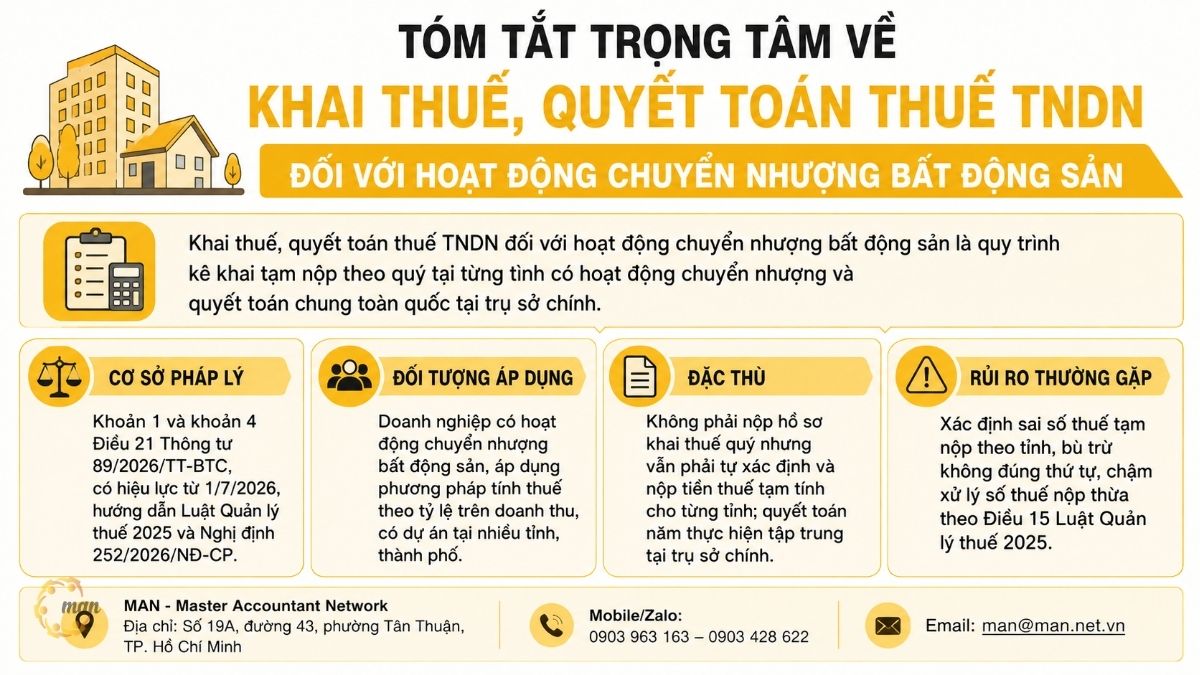
- The process of filing and settling corporate income tax for real estate transfer activities involves quarterly provisional tax payments in each province where the transfer takes place, and a nationwide final settlement at the head office.
- Legal basis: Clauses 1 and 4 of Article 21 of Circular 89/2026/TT-BTC, effective from July 1, 2026, guiding the 2025 Law on Tax Administration and Decree 252/2026/ND-CP.
- Applicable entities: businesses engaged in real estate transfer activities, applying the tax calculation method based on a percentage of revenue, and having projects in multiple provinces and cities.
- Specifics: no quarterly tax returns are required, but taxpayers must still determine and pay provisional tax for each province; annual tax settlement is done centrally at the head office.
- Common risks include: incorrect determination of provisional tax payments by province, incorrect offsetting order, and delays in processing overpaid taxes as per Article 15 of the 2025 Tax Administration Law.
What is the process of filing and settling corporate income tax for real estate transfer activities?
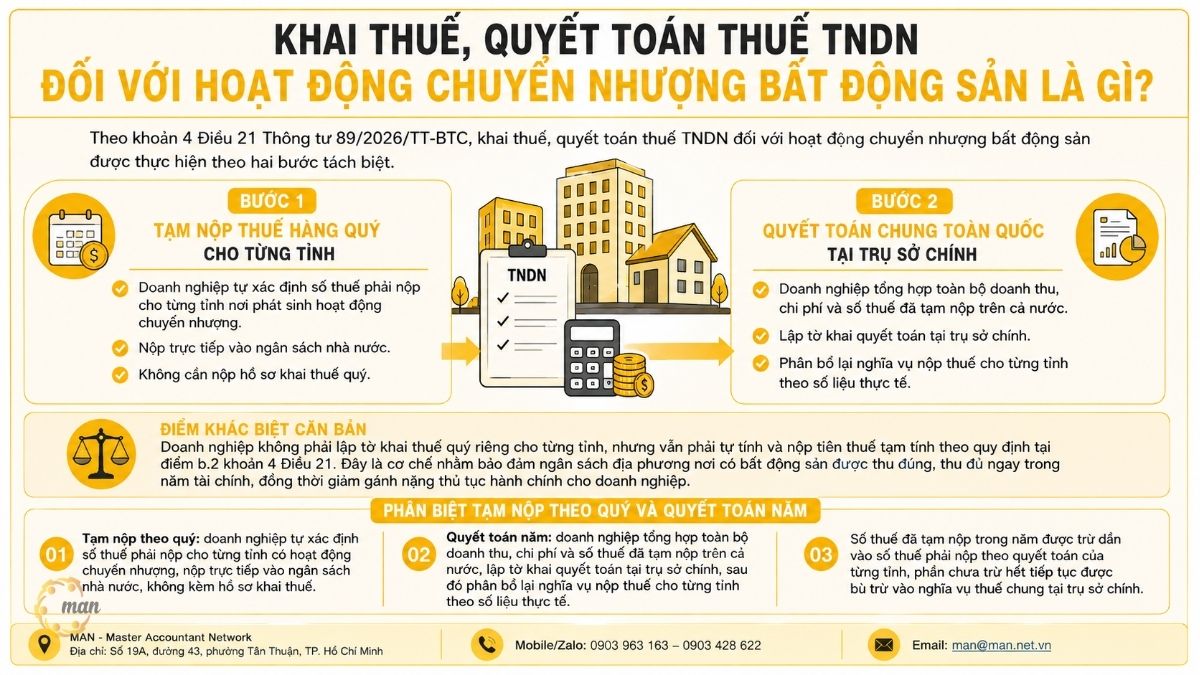
According to Clause 4, Article 21 of Circular 89/2026/TT-BTC, the declaration and settlement of corporate income tax for real estate transfer activities are carried out in two separate steps. Step one is to make quarterly provisional tax payments for each province where the transfer activity occurs, without the need to submit quarterly tax declarations. Step two is to settle the entire real estate transfer activity nationwide, carried out at the enterprise's head office.
The fundamental difference compared to other taxes lies in the fact that businesses are not required to file separate quarterly tax returns for each province, but they must still calculate and pay provisional tax as stipulated in point b.2, clause 4, Article 21. This mechanism aims to ensure that the local budget where the real estate is located receives the correct and full amount of tax revenue within the fiscal year, while simultaneously reducing the administrative burden on businesses.
Distinguishing between quarterly provisional payments and annual final settlements:
- Quarterly provisional payment: Businesses determine the amount of tax payable for each province where they conduct transfer activities and pay it directly into the state budget, without submitting tax declarations.
- Annual settlement: The enterprise compiles all revenue, expenses, and provisional taxes paid nationwide, prepares a final settlement declaration at its head office, and then reallocates tax obligations to each province based on actual figures.
- The amount of tax provisionally paid during the year is gradually deducted from the tax payable according to the final settlement of each province; any remaining amount is further offset against the general tax obligations at the head office.
Why do real estate businesses need to understand this regulation?
Real estate transfer activities are often geographically dispersed; a company might be developing a project in Binh Duong, selling it in Dong Nai, and settling accounts at its headquarters in Ho Chi Minh City. Without a thorough understanding of the tax declaration and settlement mechanisms for corporate income tax on real estate transfers, businesses risk underpaying in the province where the project is located or overpaying without timely processing of tax refunds.
From this perspective MAN – Master Accountant Network, Based on practical experience advising numerous investors with multi-province projects, the most common mistake lies not in miscalculating tax rates but in the allocation of provisional tax payments among provinces during final settlement. An opaque allocation record can lead local tax authorities to request additional explanations, prolonging the settlement process beyond the expectations of the company's management.
Which entities are required to file and settle corporate income tax returns for real estate transfer activities?

Article 21 of Circular 89/2026/TT-BTC applies to businesses that generate income from real estate transfers and calculate tax using the percentage-based method on revenue. Specifically, cases requiring declaration on a transaction-by-transaction or quarterly basis include:
- Businesses engaged in real estate transfer activities apply the corporate income tax calculation method based on a percentage of revenue.
- Businesses with infrequent corporate income tax liabilities apply the percentage-based method as stipulated by corporate income tax laws; if liabilities arise multiple times within a month, they may combine their tax returns monthly instead of filing separately.
- The competent agencies and organizations authorized to deduct, declare, and pay corporate income tax from the sale and auction of real estate and other assets used as collateral, as stipulated in point c, clause 1 and points c.1, d, and k, clause 2 of Article 22 of Decree 252/2026/ND-CP, include two groups:
- Assets pledged as collateral for enforcement of judgments are auctioned off by the enforcement agency or authorized organization.
- Collateral assets used to settle debts of credit institutions, branches of foreign banks, or state-owned organizations with charter capital that have the function of buying, selling, and settling debts. If transactions occur multiple times in a month, they are declared together monthly.
- Foreign businesses that engage in capital transfer activities are subject to corporate income tax arising in Vietnam.
- The business sells its entire wholly-owned limited liability company through a capital transfer involving real estate.
- Securities investment funds distribute dividends to investment organizations, regardless of whether they are domestic or foreign.
Point to note: if a business has already filed tax returns on a transaction-by-transaction basis for real estate transfers, it does not need to file a separate annual tax return for the income already declared on each transaction, thus avoiding duplication of declaration obligations.
What is the corporate income tax filing period for real estate transfer activities?
According to Clause 1, Article 21 of Circular 89/2026/TT-BTC, corporate income tax in general is a type of tax that is provisionally paid quarterly and settled annually. However, real estate transfer activities using the percentage-based method on revenue fall under the category of taxes that are declared on a transaction-by-transaction basis, unlike the quarterly declaration mechanism applied to most normal business activities.
Cases requiring corporate income tax final settlement.
- Filing a tax return at the end of the calendar year or fiscal year, including cases where the business temporarily ceases operations or does not conduct business for a full year.
- The final settlement report must be filed up to the time of dissolution, bankruptcy, cessation of operations, termination of contracts, privatization of state-owned enterprises, or the time of division, merger, or consolidation of the organization.
- If a business has filed taxes on a transaction-by-transaction basis, it is not required to file an annual tax return for the activities that have been filed on a transaction-by-transaction basis. However, the nationwide real estate transfer activities still require a general tax return at the head office, as stipulated in Clause 4.
Key dates businesses need to remember.
From July 1st, 2026, all real estate transfer activities will be subject to the quarterly provisional payment and annual settlement mechanism as stipulated in Circular 89/2026/TT-BTC. Businesses with projects transitioning beyond this date need to review their revenue and expense figures before and after the effective date to avoid errors when preparing their 2026 year-end settlement documents.
Legal documents related to tax declaration and corporate income tax settlement for real estate transfer activities.
Important Note: Experts at MAN recommend that businesses closely monitor supplementary guidance documents from the Ministry of Finance and local tax authorities, as the allocation of tax by province in the initial implementation phase often gives rise to practical problems requiring more specific guidance.
| Legal documents | Number / Validity | Related content |
| Circular 89/2026/TT-BTC | The Ministry of Finance provides guidance on the Law on Tax Administration and Decree 252/2026/ND-CP. | Article 21 stipulates the tax filing period, quarterly provisional payment method, and annual settlement for real estate transfers. |
| Tax Administration Law 2025 | No. 108/2025/QH15 | Article 15 stipulates the handling of overpaid tax amounts, serving as the basis for resolving the difference between the provisional payment and the final settlement amount. |
| Decree 252/2026/ND-CP | Guidelines for the Law on Tax Administration | Article 22, specifically point c of clause 1 and points c.1, d, and k of clause 2, stipulates the cases for withholding, declaring on behalf of, and paying corporate income tax on the sale and auction of real estate used as collateral. |
| Appendix II, Circular 89/2026/TT-BTC | Issued together with Circular 89/2026/TT-BTC | Instructions on how to handle adjustments to increase or decrease the deductible VAT amount, applicable to both business operations and real estate investment projects. |
| The 2019 Tax Administration Law and previous guiding documents | Reference | The old regulations on corporate income tax declaration and payment will be replaced according to a roadmap from July 1, 2026, with regard to the contents of Circular 89/2026/TT-BTC. |
How should the VAT on deductible real estate projects be handled?
Besides the obligation to declare and settle corporate income tax on real estate transfer activities, many investors also simultaneously implement investment projects, thus creating a need to adjust input VAT. Appendix II issued with Circular 89/2026/TT-BTC specifies the handling procedures for each adjustment situation; businesses need to clearly distinguish this to avoid confusion with the corporate income tax adjustment process.
This case only increases the amount of VAT that can be deducted and carried forward to the next period.
If the supplementary declaration only increases the amount of uncredited VAT carried over to the next period, the business prepares a supplementary declaration for the tax period with the error, and simultaneously declares the increased tax amount in the "Adjustment increasing the amount of VAT still deductible from previous periods" item on the VAT declaration for the period in which the error is discovered.
Cases that reduce the amount of deductible VAT carried forward to the next period.
- If a tax refund has not yet been requested: prepare a supplementary tax return and declare the adjusted tax reduction in the corresponding item on the tax return for the period in which the error was discovered.
- If a tax refund has been requested but not yet received, and the refund application is cancelled, the business must send a written request to the tax authority to cancel the refund application and simultaneously declare a reduction in the requested refund amount in the supplementary tax return.
- For businesses that have already received a tax refund under the advance refund scheme: they must file an amended tax return reducing the requested refund amount, increasing the amount of tax to be recovered, and simultaneously repay the recovered tax amount and late payment penalties as prescribed.
Cases that change the amount of VAT payable
If the adjustment reduces the number VAT If the adjustment results in a decrease in VAT payable and an increase in the amount deductible carried forward to the next period, the business must file an amended tax return and pay the additional tax along with late payment penalties as prescribed. Conversely, if the adjustment reduces the VAT payable and increases the amount deductible carried forward to the next period, the overpaid tax will be offset or refunded as prescribed.
Cases where both forms 01/GTGT and 02/GTGT are affected simultaneously.
For ongoing investment projects, supplementary declarations that change tax obligations on both Form 01/GTGT (business activities) and Form 02/GTGT (investment projects) are regulated by Circular 89/2026/TT-BTC, which specifies how to make adjustments corresponding to each specific situation. This includes adjusting down the VAT payable on business activities, leading to adjustments in the offsetting items of the investment project, and adjusting down the input VAT of the investment project, resulting in additional tax and late payment penalties.
In cases where errors are discovered on form 02/GTGT after the investment project has been completed, the enterprise does not need to submit a supplementary declaration using form 02/GTGT, but instead makes direct adjustments on form 01/GTGT for the period in which the error was discovered, according to the instructions provided.
Cases where supplementary VAT tax return filing is not required.
Not all adjustments require supplementary declaration. According to Circular 89/2026/TT-BTC, if a business inherits deductible VAT from a subsidiary due to a change in business type, division, separation, merger, consolidation, or termination of operations, it does not need to file a supplementary declaration. It only needs to be declared in the "Deductible VAT received from transfer in the period" section of Form 01/GTGT for the tax period in which the notification is received, based on the tax authority's notice of transfer of tax obligations.
According to experts at MAN – Master Accountant Network, real estate developers with projects under construction need to pay special attention to distinguishing between indicators 28a, 28b, 32, 40a, and 40b on forms 01/GTGT and 02/GTGT, as confusion between these indicators is a common cause of problems. VAT refund application The project's processing time has been prolonged.
How to handle discrepancies between provisional tax payments and final tax settlements.
This is a point of confusion for many real estate company accountants when filing and settling corporate income tax for real estate transfer activities. In principle, the amount of tax provisionally paid during the year in each province is deducted from the tax payable according to the final settlement of each province. The remaining amount is then deducted from the tax liability according to the final settlement at the head office.
Case of underpayment
If the quarterly provisional tax payments are less than the tax payable according to the final tax return at the head office, the enterprise must pay the remaining amount to the province where the head office is located, and not pay it in installments to each province where there are projects.
Case of overpayment
If the amount of tax provisionally paid quarterly is greater than the amount of tax payable upon final settlement, the difference is determined as overpaid tax and handled according to Article 15 of the 2025 Tax Administration Law and Article 42 of Circular 89/2026/TT-BTC. Businesses may be able to offset this amount against their tax obligations in the next period or receive a refund as prescribed.
| Situation | How to handle it | Submission/Reception Location |
| Provisional payment based on final settlement amount. | No additional obligations arise. | Not applicable |
| The provisional payment is less than the final settlement amount. | Submit the remaining amount. | The province where the headquarters are located |
| The provisional payment is greater than the final settlement amount. | Determine the amount of overpaid tax and handle it according to Article 15 of the 2025 Tax Administration Law. | According to regulations on tax refunds or offsetting. |
Case Study: How do real estate companies handle projects implemented in three provinces?
Background
Y Real Estate Joint Stock Company, headquartered in Ho Chi Minh City, will simultaneously implement three apartment and land transfer projects in Binh Duong, Dong Nai, and Long An provinces during the 2026 fiscal year. Prior to July 1, 2026, the company will file taxes according to the old regulations, with separate quarterly tax returns for each location.
Processed according to Circular 89/2026/TT-BTC
Starting in Q3 2026, following advice from MAN – Master Accountant Network, the company will implement three steps: firstly, stop preparing quarterly tax returns for each province, and instead determine the provisional tax amount based on actual revenue generated at each project; secondly, build a centralized tracking table to record the provisional tax amount paid by province on a quarterly basis; and thirdly, prepare a consolidated tax settlement file at the head office in Ho Chi Minh City at the beginning of 2027, including a table allocating the tax payable to each province based on actual taxable revenue.
The measured results
- The company determined that the provisional tax payment in Long An was lower than the amount due according to the final tax return, due to a sudden surge in revenue in the fourth quarter. The company had to make the supplementary payment at its head office in accordance with regulations, thus avoiding late payment penalties thanks to a proactive review before the final tax return deadline.
- In Dong Nai, the amount of provisional tax paid exceeded the amount due according to the final settlement because the project was behind schedule. The company prepared documentation to determine the overpayment and requested that it be offset against the corporate income tax liability arising in the next period.
- The entire settlement process was completed within three weeks thanks to a centralized tracking system, instead of the previous manual reconciliation between branches.
Expert opinion: Common business risks and how to avoid them.
Experts at MAN – Master Accountant Network With over 30 years of experience in tax consulting and auditing in Vietnam, we note four main risks when businesses file and settle corporate income tax related to real estate transfer activities.
- Risk 1: Confusion between provisional tax payment obligations and tax declaration obligations: Many accountants still adhere to the old practice, believing that not having to file quarterly tax returns means they don't have to calculate and pay provisional tax. In reality, businesses must still determine the provisional tax payable for each province according to the regulations in point b.2, clause 4, Article 21. Late payments will still incur penalties even without accompanying tax returns.
- Risk 2: Incorrect allocation of provisional tax payments during final settlement: When a business has projects in multiple provinces, determining which provisional tax payments are deductible from which province's tax obligations must be based on the actual revenue generated in each locality, and not on arbitrary allocation. Errors at this stage can easily lead to data disputes with local tax authorities during reconciliation.
- Risk 3: Missing revenue from payments made in installments that do not meet the recognition criteria: Taxes provisionally paid on revenue collected in installments but not yet included in the calculated revenue. corporate income tax Tax deductions are not allowed during the year and are not included in the tax payable as per the final tax return. Many businesses overlook this exclusion, leading to incorrect calculations of the tax to be offset and requiring adjustments after inspection.
- Risk 4: Delays in processing overpaid taxes: When overpayments of taxes arise, many businesses do not proactively file requests for processing in accordance with Article 15 of the 2025 Tax Administration Law and Article 42 of Circular 89/2026/TT-BTC, causing unnecessary cash flow to be tied up for extended periods, affecting the businesses' financial plans.
Conclude
File your tax return., corporate income tax settlement Regarding real estate transfer activities, Circular 89/2026/TT-BTC establishes a new operating mechanism, requiring businesses to closely monitor revenue figures and provisional tax payments in each province and proactively handle discrepancies during final settlement. Understanding this process not only helps businesses comply with the law but also optimizes cash flow, avoiding late payment penalties or unnecessary capital tie-up due to delays in processing overpaid taxes.
Tax services at MAN – Master Accountant Network
- Tax accounting services
- Tax consulting services
- Tax settlement services
- Tax reporting services
- VAT refund service
Service contact information at MAN – Master Accountant Network
- Address: No. 19A, Street 43, Tan Thuan Ward, Ho Chi Minh City
- Mobile/Zalo: 0903 963 163 – 0903 428 622
- E-mail: man@man.net.vn
- Google Business Profile: View MAN – Master Accountant Network's Google Business Profile
- LinkedIn Founder: View expert Le Hoang Tuyen's LinkedIn profile.
Responsible for production and professional content review by: Mr. Le Hoang Tuyen – Founder & CEO of MAN – Master Accountant Network, CPA Vietnam with over 30 years of experience in accounting, auditing, taxation, and corporate financial consulting.
Frequently Asked Questions about filing and settling corporate income tax for real estate transfer activities.
Is it mandatory for businesses to file quarterly tax returns for real estate transfer activities?
No. According to Clause 4, Article 21 of Circular 89/2026/TT-BTC, businesses are not required to submit quarterly tax returns but must still determine and pay quarterly provisional tax for each province where real estate transfer activities take place.
Where is the corporate income tax settlement for real estate transfers carried out?
Businesses file a consolidated tax return for all real estate transfer activities nationwide at their head office, and then pay the allocated tax amount to each province where the transfer activity takes place.
What happens if the provisional payment is less than the final settlement amount?
Businesses must pay the outstanding tax amount to the province where their head office is located, and are not required to make separate supplementary payments to each province where real estate transfer projects are located.
Can the provisional tax payments on revenue collected in installments be deducted during the final tax settlement?
No, if that revenue has not yet been included in the taxable corporate income for the year, the corresponding provisional tax payment cannot be deducted from the tax payable upon final settlement. This needs to be tracked separately to avoid confusion.
What regulations govern the handling of overpaid taxes after tax settlement?
Any overpaid taxes are handled according to Article 15 of the 2025 Tax Administration Law and Article 42 of Circular 89/2026/TT-BTC. Businesses can request to offset the amount against their tax obligations in the next period or receive a refund as prescribed.
If a real estate project discovers VAT errors after completion, where should the supplementary tax return be filed?
Businesses no longer need to submit supplementary declaration form No. 02/GTGT for the investment project, but instead directly adjust the declaration form No. 01/GTGT for the period in which the error was discovered, declaring the increase or decrease in the deductible VAT amount from previous periods in accordance with the instructions in Appendix II of Circular 89/2026/TT-BTC.




