


Deadline for filing tax returns and paying taxes for July 2026. This is a crucial timeframe that hundreds of thousands of businesses and households nationwide are closely monitoring during a period of significant changes in tax laws. (According to Article 10) Decree 252/2026/ND-CP According to the Tax Administration Law, monthly taxes such as VAT, special consumption tax, and environmental and resource protection tax all have unified deadlines. Understanding these deadlines precisely helps businesses avoid administrative penalties and establish a systematic tax compliance process.
In this context Circular 89/2026/TT-BTC With the recent issuance of new tax declaration forms and the simultaneous implementation of numerous tax extension decrees, many accountants and business owners are confused about determining the correct deadlines for each group of entities. This article, compiled from a professional perspective, will address this issue. MAN – Master Accountant Network, With over 30 years of practical experience in Vietnam, our tax, accounting, and auditing consulting firm will provide readers with a comprehensive and accurate understanding that can be immediately applied to their tax declarations for July 2026.
Summary of key points regarding the July 2026 tax return and payment deadline.

- The deadline for filing tax returns and paying taxes for July 2026 is the final time for businesses to complete and submit tax returns and pay taxes incurred during the July 2026 tax period using the monthly tax filing method.
- Legal basis: Article 10 of Decree 252/2026/ND-CP guiding the Law on Tax Administration.
- General deadline: no later than August 20, 2026 for taxes declared monthly.
- Special case: Businesses eligible for VAT payment extension under Decree 245/2026/ND-CP have a deadline for paying VAT for the July 2026 period of no later than December 21, 2026.
- Applicable entities: businesses, organizations, and household businesses that incur VAT, special consumption tax, environmental protection tax, and resource tax obligations and declare them monthly.
What is the deadline for filing tax returns and paying taxes for July 2026?
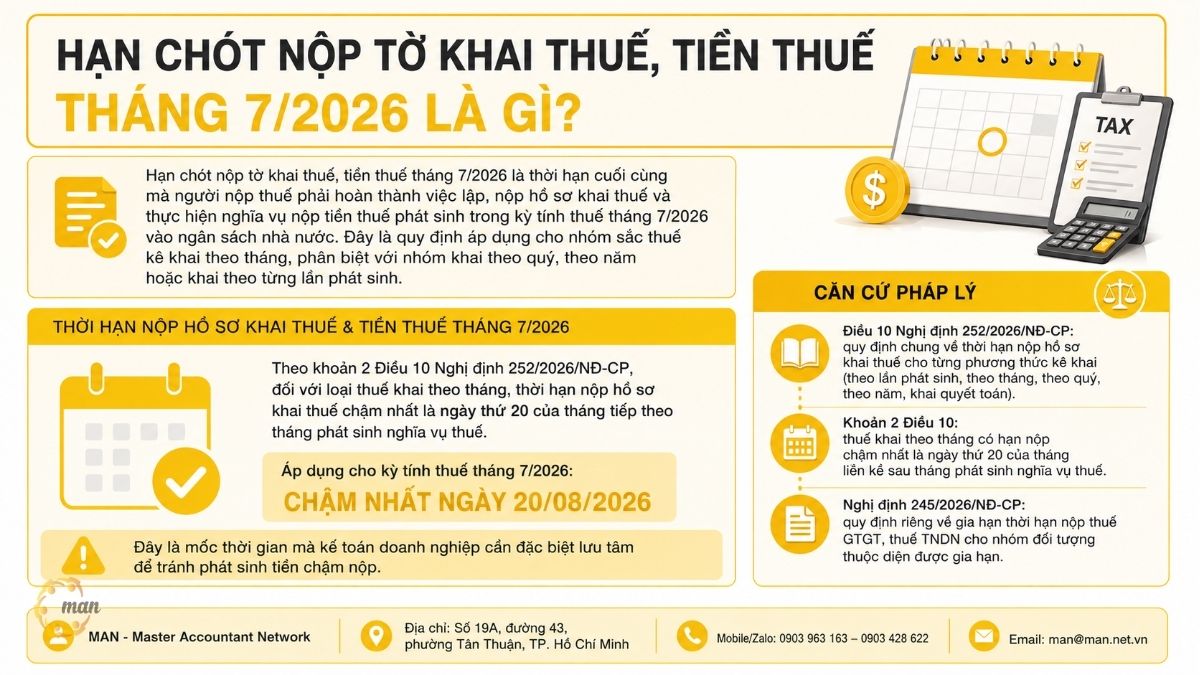
The deadline for filing tax returns and paying taxes for July 2026 is understood as the final deadline by which taxpayers must complete the preparation and submission of tax returns and fulfill their tax payment obligations for the tax period of July 2026 into the state budget. This regulation applies to taxes declared monthly, distinguishing them from those declared quarterly, annually, or on a transaction-by-transaction basis.
According to Clause 2, Article 10 Decree 252/2026/ND-CP, For monthly tax filings, the deadline for submitting tax returns is no later than the 20th day of the month following the month in which the tax liability arises. Applying this regulation to the tax period of July 2026, the deadline for submitting the tax return and payment falls on August 20, 2026. This is a crucial deadline that business accountants need to pay special attention to in order to avoid late payment penalties.
Legal basis for determining the monthly tax return filing deadline:
- Article 10 of Decree 252/2026/ND-CP: general regulations on the deadline for submitting tax declaration documents for each declaration method (on a case-by-case basis, monthly, quarterly, annually, or final settlement declaration).
- Clause 2, Article 10: Monthly tax declarations must be paid no later than the 20th day of the month immediately following the month in which the tax liability arises.
- Decree 245/2026/ND-CP: specifies regulations on extending the deadline for paying VAT and corporate income tax for eligible entities.
Why do businesses need to know the exact deadline for filing tax returns and paying taxes for July 2026?
Late filing of tax returns or late payment of taxes both have specific legal consequences: administrative penalties for tax violations and late payment interest on the overdue tax amount. For businesses with large transaction volumes, even a delay of just a few days can result in cumulative late payment penalties of tens of millions of dong, not to mention the impact on tax compliance records when tax authorities assess the business's risk level.
From this perspective MAN – Master Accountant Network, Over the years, in assisting manufacturing, trading, and service businesses with tax settlements, we have observed that the majority of late payments do not stem from intentional violations but rather from confusion between deadlines when multiple new decrees and circulars are issued simultaneously. Proactively scheduling tax payments for each type of tax, linked to specific legal documents, is a key solution to help businesses avoid this risk.
Which entities will be affected by the July 2026 tax return and tax payment deadline?
Regulations regarding the deadline for filing tax returns and paying taxes for July 2026 apply to organizations, businesses, and household businesses with tax obligations that fall under the category of monthly tax filing. Specifically, the types of taxes that are filed monthly include:
- Value Added Tax (VAT).
- Excise tax.
- Environmental protection tax.
- Resource tax.
Businesses eligible for an extension of the deadline for paying VAT and corporate income tax under Article 1 of Decree 245/2026/ND-CP will be subject to a separate tax payment deadline, different from the regular tax return filing deadline.
Points to note: Extensions only apply to the term. pay taxes, without changing the deadline submit tax return. Businesses must still submit their tax returns by August 20, 2026, even if the deadline for payment has been extended.
How do the deadlines for filing tax returns and paying taxes for July 2026 differ between regular businesses and businesses that have been granted an extension?
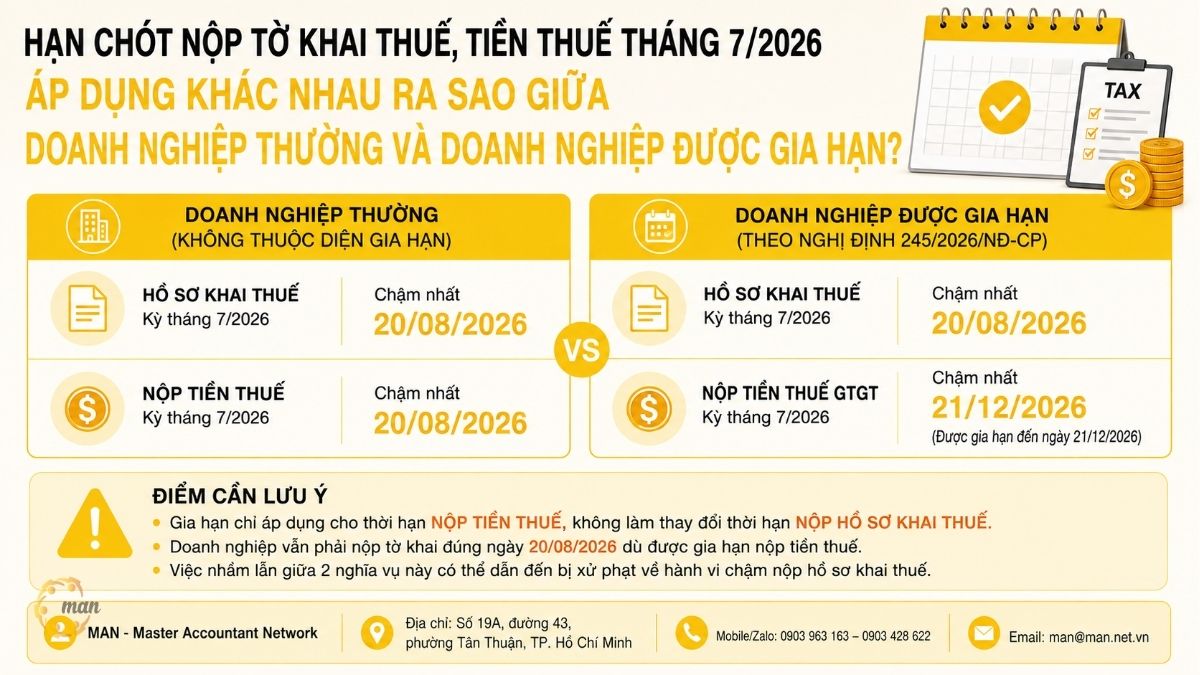
For businesses not eligible for the extension, both tax returns and tax payments for the July 2026 period must be completed no later than August 20, 2026. For businesses eligible for the extension under Decree 245/2026/ND-CP, tax returns must still be submitted on the August 20, 2026 deadline, but the payment deadline will be different. VAT The deadline for the tax period of July 2026 has been postponed to no later than December 21, 2026.
The distinction between the two obligations, filing tax returns and paying taxes, is the most confusing aspect in practice. Many businesses believe that an extension of the tax payment deadline also means they can postpone the deadline for filing tax returns, leading to penalties for late filing of tax returns even though they are not late in paying taxes.
Legal documents related to the deadline for filing tax returns and paying taxes for July 2026.
Important Note: Businesses need to clearly distinguish between the deadline for filing tax returns and the deadline for paying taxes, as these two obligations may differ if extensions are applied. Experts at MAN Businesses are advised to regularly update themselves on annual tax extension decrees, as the scope of eligible entities and extension periods may change periodically.
| Legal documents | Number / Date of Issue | Related content |
| Decree 252/2026/ND-CP | Government guidelines for the Law on Tax Administration | Article 10 stipulates the deadlines for submitting tax returns according to each filing method (once a transaction occurs, monthly, quarterly, annually, or final settlement). |
| Decree 245/2026/ND-CP | Government | Article 1 stipulates the extension of the deadline for paying VAT and corporate income tax for eligible entities. |
| Circular 89/2026/TT-BTC | Ministry of Finance | New VAT declaration form 01/GTGT issued, instructions on how to fill in the fields on the form. |
| Article 26 of the Law on Tax Administration | National Assembly | Regulations regarding the deadline for filing and paying taxes in cases where electronic invoices with codes must be issued for each transaction. |
| Circular 91/2026/TT-BTC | Ministry of Finance, June 30, 2026 | Instructions on handling adjustment invoices and replacement invoices related to the declaration of input VAT. |
How to determine the deadline for filing tax returns and paying taxes for July 2026 – A practical example.
This is where many accountants make the biggest mistake when calculating the tax filing deadline. It's not that there are 30 days to file taxes simply because it's the end of July 2026; the law stipulates that the deadline is calculated from the 20th day of the month immediately following the month in which the tax liability arises.
Here's a specific example calculation:
Company A generated taxable VAT revenue in July 2026. According to Article 10 of Decree 252/2026/ND-CP, the deadline for submitting VAT tax returns for the July 2026 tax period is no later than the 20th day of August 2026, i.e., August 20, 2026. If Company A is not eligible for an extension, the VAT must be paid at the same time as submitting the tax return, no later than August 20, 2026.
Company B also has VAT tax obligations for the July 2026 period but is eligible for an extension under Decree 245/2026/ND-CP. Company B must still submit its tax return on August 20, 2026, like Company A, but is granted an extension of approximately 4 months to pay VAT tax.
| Type of obligation | Applicable objects | Deadline | Legal basis |
| Submit tax returns (VAT, Special Consumption Tax, Environmental Protection Tax, Resource Tax). | All taxpayers file monthly. | 20/08/2026 | Article 10 of Decree 252/2026/ND-CP |
| Pay VAT (no extension) | Businesses not eligible for extension | 20/08/2026 | Article 10 of Decree 252/2026/ND-CP |
| VAT payment (extended deadline) | Businesses eligible for extension | 21/12/2026 | Article 1 of Decree 245/2026/ND-CP |
| Submit the declaration form each time a transaction occurs. | Cases where tax obligations arise on a transaction-by-transaction basis. | No later than the 10th day from the day following the date the obligation arises. | Clause 1, Article 10 of Decree 252/2026/ND-CP |
Case Study: How are trading businesses in Binh Duong handling the July 2026 tax payment deadline?
Background
Company Y (a trading and distribution company of construction materials) in Binh Duong generated approximately VND 12 billion in VAT-taxable revenue in July 2026. The company is eligible for an extension of the VAT payment deadline under Decree 245/2026/ND-CP, but the newly hired accountant is unclear about the difference between the deadline for filing the tax return and the deadline for paying the tax.
Practical handling
According to advice from MAN – Master Accountant Network, the company takes three steps: (1) prepare the VAT declaration form 01/GTGT according to Circular 89/2026/TT-BTC and submit it on time by August 20, 2026 on the electronic tax system; (2) determine the VAT payable in the period, compare it with the list of industries eligible for extension according to Decree 245/2026/ND-CP; (3) prepare a cash flow plan to pay the full amount of tax no later than December 21, 2026, to avoid accumulating financial pressure at the end of the year.
The measured results
- The company avoided a late filing penalty for its tax return because it filed it on time, August 20, 2026, despite being granted an extension for tax payment.
- Clearly separating the two deadlines allows the company to proactively utilize its working capital for approximately four months before having to pay VAT.
- Transparent and properly formatted tax declaration forms facilitate a smooth reconciliation process with tax authorities, avoiding the need for further explanations.
Expert opinion: Common business risks when determining the deadline for filing tax returns and paying taxes for July 2026.
Experts at MAN – Master Accountant Network With over 30 years of experience in auditing and tax consulting in Vietnam, we note four main risks that businesses often face during the July 2026 tax filing period.
- Risk 1: Confusion between the deadline for filing tax returns and the deadline for paying taxes: Many accountants believe that the extension of the tax payment deadline also includes the extension of the tax return filing deadline. In reality, Decree 245/2026/ND-CP only extends the deadline for tax payment, not the deadline for filing tax returns. If a business files its tax return late after August 20, 2026, it will still be subject to administrative penalties for late filing of tax returns according to current regulations.
- Risk 2: Using the wrong declaration form after Circular 89/2026/TT-BTC has come into effect: Some businesses are still accustomed to using the old declaration form according to Circular 80/2021/TT-BTC, leading to the rejection of the application on the electronic tax system. Updating to the correct form 01/GTGT according to Circular 89/2026/TT-BTC, especially the newly added indicators such as [32b], [37], [38], [39a], [40b], is a mandatory requirement for the declaration to be accepted on time.
- Risk 3: Incorrect identification of entities eligible for tax extension: Not all businesses are eligible for the extension under Decree 245/2026/ND-CP. Incorrectly applying the extension policy to industries not included in the regulations may lead to late payment of taxes, resulting in late payment penalties calculated from August 21, 2026, instead of being granted until December 21, 2026.
- Risk 4: Lack of a cash flow plan when granted an extension for tax payment: Tax payment extensions offer cash flow advantages, but many businesses lack clear financial planning, leading to insufficient funds to pay the extended taxes by the December 21, 2026 deadline, resulting in late payment penalties immediately after the extension expires.
How to fill out Form 01/GTGT according to Circular 89/2026/TT-BTC?
In addition to meeting the deadline for filing tax returns and paying taxes for July 2026, businesses need to accurately fill in all the fields on the new tax return form so that the electronic tax system accepts the application on the first submission. Form 01/GTGT, issued as an appendix to Circular 89/2026/TT-BTC of the Ministry of Finance, replaces the previously used form. Below is a detailed guide to each field.
Criterion [01a]: Selection of activity type
Taxpayers choose one of the following activities to declare the correct item [01a]:
- Normal business operations.
- Traditional lottery and computerized lottery operations.
- Oil and gas extraction activities.
- Infrastructure investment projects and properties for sale are located outside the province where the head office is headquartered.
- The power plant is located in a different province from where its main office is situated.
Indicators [09], [10], [11]: Information on subsidiary units, business locations in other areas
These three indicators are used to declare information about subsidiary units and business locations situated in provinces other than the head office. If there are multiple subsidiary units or business locations located in different communes, wards, or special zones managed by the provincial or city tax authority, the enterprise selects one representative unit to declare. If these units are managed by the local tax authority, the enterprise also selects a representative unit for the corresponding commune, ward, or special zone to declare in this indicator.
Criterion [32b]: Value of goods and services not included in the tax base
Indicator [32b] is used to declare the value of goods and services that are not included in the taxable value of value added tax according to the provisions of current value added tax law.
Indicators [37] and [38]: Adjustment of deductible input VAT
This is the most complex set of indicators on the declaration form, applicable to many different adjustment situations:
- In the case of goods and services purchased on deferred payment or installment with a value of 5 million VND or more, the business establishment shall declare an adjustment to reduce the deductible input VAT for the value without non-cash payment documents in item [37] of the period in which the payment obligation arises according to the contract, without having to file an additional tax return. After adjustment, if there are non-cash payment documents, the business establishment may deduct this value in item [38] of the period in which the documents are available.
- In the event that the taxpayer discovers the number input VAT When there are errors in declaration and deduction, the declaration in item [37] or [38] is made in the month or quarter in which the error is discovered. If the tax declaration is made in the same month or quarter in which the error occurs, reducing the amount of tax payable or only increasing or decreasing the amount of VAT that can be deducted and carried forward to the next period, then no supplementary tax declaration is required.
- In cases where the buyer receives an adjustment invoice or replacement invoice under the circumstances specified in Clause 5, Article 10 of Circular No. 91/2026/TT-BTC dated June 30, 2026 of the Ministry of Finance, the declaration in item [37] or [38] is made in the tax period in which the adjustment invoice or replacement invoice is received, and no supplementary tax declaration is required.
- In the case where taxpayers change the tax calculation method from the deduction method to the direct method on revenue, the declaration of adjustment to reduce the amount of VAT not yet fully deducted in item [37] is made in the last tax period before changing the tax calculation method.
- Other cases shall be implemented in accordance with the provisions of Article 12 of Government Decree 252/2026/ND-CP dated June 30, 2026 and Appendix II of Circular 89/2026/TT-BTC.
Indicator [39a]: VAT that is still deductible transferred from investment projects or subsidiaries
This indicator is used to declare the remaining deductible VAT amount for investment projects that has not yet been requested for refund. This amount is transferred to the taxpayer, either the investor or another taxpayer assigned by the investor, for continued deduction. This is the amount of tax that is not eligible for refund and has been separately declared on the investment project declaration form, applicable when the project becomes operational. This indicator also applies to the remaining deductible tax of a subsidiary unit upon cessation of operations, or of a taxpayer that is divided, separated, merged, or consolidated.
Indicator [40b]: Summary of tax declared on form 02/GTGT
Indicator [40b] is used to declare the total value-added tax declared in indicators [28a] and [28b] of tax return form No. 02/GTGT.
Correctly filling in the above-mentioned fields is directly related to the deadline for submitting tax returns and paying taxes for July 2026. Incorrect or missing required fields may be rejected by the electronic tax system, forcing businesses to resubmit and risking missing the deadline even if completed before August 20, 2026.
How is the timing of value-added tax determination regulated?
Besides correctly identifying the deadline for filing tax returns and paying taxes for July 2026, businesses need to clearly distinguish the time of determining VAT, as this is the basis for determining which tax period a transaction belongs to. According to Article 8 of the Value Added Tax Law 2024, the time of determining value added tax is stipulated as follows.
Time of determining VAT for ordinary goods and services
- For goods: the time of determining VAT is the time of transferring ownership or the right to use the goods to the buyer, or the time of issuing the invoice, regardless of whether payment has been received or not.
- For services: the time of determining VAT is the time when the service is completed, or the time when the invoice for the service is issued, regardless of whether payment has been received or not.
The time of determining VAT for specific goods and services.
Clause 2, Article 8 of the Value Added Tax Law 2024 assigns the Government the authority to separately regulate the time of determining VAT for the following groups of goods and services:
- Exported goods, imported goods.
- Telecommunications services.
- Insurance business services.
- Electricity supply, electricity generation, and clean water supply.
- Real estate business activities.
- Construction, installation, and oil and gas operations.
Determining the correct timing of VAT liability is crucial in deciding whether a business should include transactions in the July 2026 or August 2026 tax period. Based on our consulting experience... MAN – Master Accountant Network, This is also a common cause of discrepancies in year-end tax settlements, especially for transactions occurring at the end of the month, when the invoice date and the delivery date do not coincide.
Conclude
The deadline for filing tax returns and paying taxes for July 2026 is a crucial milestone that businesses need to proactively understand to ensure legal compliance and avoid unnecessary costs from late payment penalties and administrative fines. Clearly distinguishing between the deadline for filing tax returns and the deadline for paying taxes, especially in the context of multiple extension policies, is a key factor in helping businesses effectively manage tax risks.
Tax services at MAN – Master Accountant Network
- Tax accounting services
- Tax consulting services
- Tax settlement services
- Tax reporting services
- VAT refund service
Service contact information at MAN – Master Accountant Network
- Address: No. 19A, Street 43, Tan Thuan Ward, Ho Chi Minh City
- Mobile/Zalo: 0903 963 163 – 0903 428 622
- E-mail: man@man.net.vn
- Google Business Profile: View MAN – Master Accountant Network's Google Business Profile
- LinkedIn Founder: View expert Le Hoang Tuyen's LinkedIn profile.
Responsible for production and professional content review by: Mr. Le Hoang Tuyen – Founder & CEO of MAN – Master Accountant Network, CPA Vietnam with over 30 years of experience in accounting, auditing, taxation, and corporate financial consulting.
Frequently Asked Questions about the deadline for filing tax returns and paying taxes for July 2026
What is the deadline for filing tax returns and paying taxes for July 2026?
The deadline for submitting tax returns and tax payments for monthly taxes such as VAT, special consumption tax, environmental protection tax, and resource tax, as stipulated in Article 10 of Decree 252/2026/ND-CP, is August 20, 2026.
Do businesses that have been granted an extension for VAT payment have to submit their tax returns on August 20, 2026?
Yes. The extension under Decree 245/2026/ND-CP only applies to the deadline for paying taxes, not to the deadline for submitting tax returns. Businesses must still submit their tax returns on the usual deadline.
If a business generates no revenue in July 2026, is it still required to file a tax return?
Yes. According to current tax regulations, taxpayers are still required to file tax returns on time even if they do not have any tax liability during the period, except in cases where they are exempt according to specific regulations.
Is it acceptable to submit the VAT tax return for July 2026 using the old form from Circular 80/2021?
No. Since Circular 89/2026/TT-BTC came into effect, businesses must use the new VAT declaration form 01/GTGT as attached to this circular for their documents to be accepted by the electronic tax system.
What are the consequences for late filing of the July 2026 tax return?
Businesses that are late in submitting tax returns will be subject to administrative penalties in accordance with tax management regulations, and any overdue tax (if applicable) will be subject to late payment interest calculated daily, except for cases exempt from late payment interest as stipulated in Clause 3, Article 26 of Decree 252/2026/ND-CP.




