
When is the excise tax determined? This is a question that almost every accountant in charge of excise tax has struggled with, especially when transactions involving unpaid fees or services spanning multiple periods occur. According to Article 7 of the Law... Excise tax 2025, This regulation is clearly divided into three categories: goods, services, and imports.
In practice, many manufacturing and importing businesses still confuse the time of invoice issuance with the time of tax liability arising, leading to incorrect declaration of the tax period. This article provides a detailed analysis of the regulations in Article 7 of the 2025 Special Consumption Tax Law, while also sharing practical perspectives. MAN – Master Accountant Network, a tax consulting firm with over 30 years of experience in Vietnam.
Summary of key points regarding the timing of determining excise tax
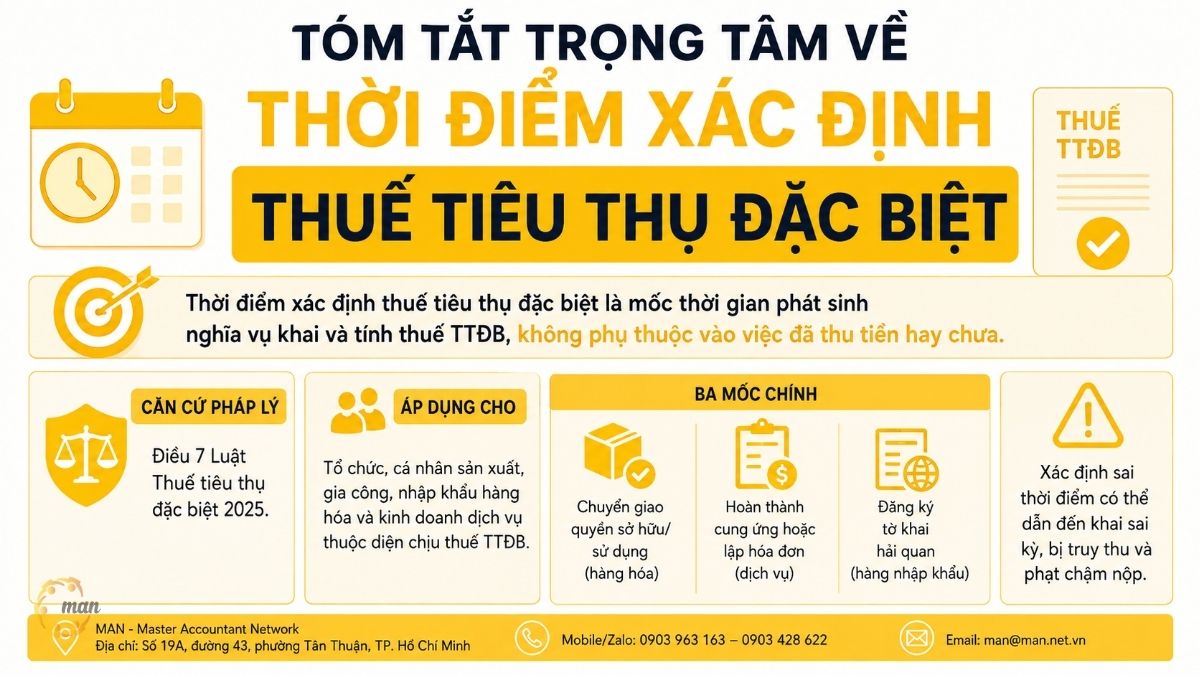
- The time of determining excise tax is the point in time when the obligation to declare and calculate excise tax arises, regardless of whether the money has been collected or not.
- Legal basis: Article 7 of the Law on Special Consumption Tax 2025.
- Applicable to: organizations and individuals producing, processing, importing goods and providing services subject to excise tax.
- Three key milestones: transfer of ownership/use (goods), completion of supply or invoicing (services), and registration of customs declaration (imported goods).
- Incorrectly determining the deadline can lead to incorrect reporting of the period, resulting in back taxes and late payment penalties.
According to the law, when is the excise tax determined?
According to Article 7 of the 2025 Special Consumption Tax Law, the time of determining special consumption tax is the legally prescribed timeframe for determining the obligation to declare and calculate the tax, linked to the act of producing, supplying, or importing goods and services subject to tax. This is not the time of payment, but the time when the transaction legally occurs.
The key point to note is that the law clearly stipulates "no distinction between whether payment has been received or not" for both goods and services. This means that businesses selling goods on credit, allowing customers to pay later, or not yet issuing invoices for payment, must still determine their tax obligations according to the legally prescribed deadlines; they cannot postpone the declaration date based on actual cash flow.
Why should we not confuse "issuing invoices" with "the time of tax calculation"?
Many accountants are accustomed to assuming that the tax calculation date coincides with the date the value-added tax invoice is issued. However, for services, the law allows for two parallel milestones: completion of service provision or invoicing for service provision, whichever comes first. For goods, the determination of the tax date is linked to the time of transfer of ownership or right of use, which can occur before or after the invoice date depending on the contract agreement.
Why is it important to determine the correct time to calculate excise tax?
Determining the correct time to calculate excise tax directly influences which tax period a business should file its tax return for, thereby affecting the amount of tax payable that month, the deadline for filing the return, and even the calculation of late payment interest if there are discrepancies. For monthly tax returns, a transaction incorrectly determined at the time of filing may be pushed back to another period, leading to supplementary filings and the risk of audits.
From this perspective MAN – Master Accountant Network, Over the years, reviewing tax settlement records for automobile, alcoholic beverage, and tobacco manufacturing companies in Vietnam, the most common error is not in calculating the tax rate incorrectly, but in recording the period in which the tax liability arises. This may seem like a minor error, but when accumulated over the entire fiscal year, the amount of late payment penalties and fines can reach hundreds of millions of dong.
Who needs to be aware of the regulations regarding the timing of excise tax assessment?
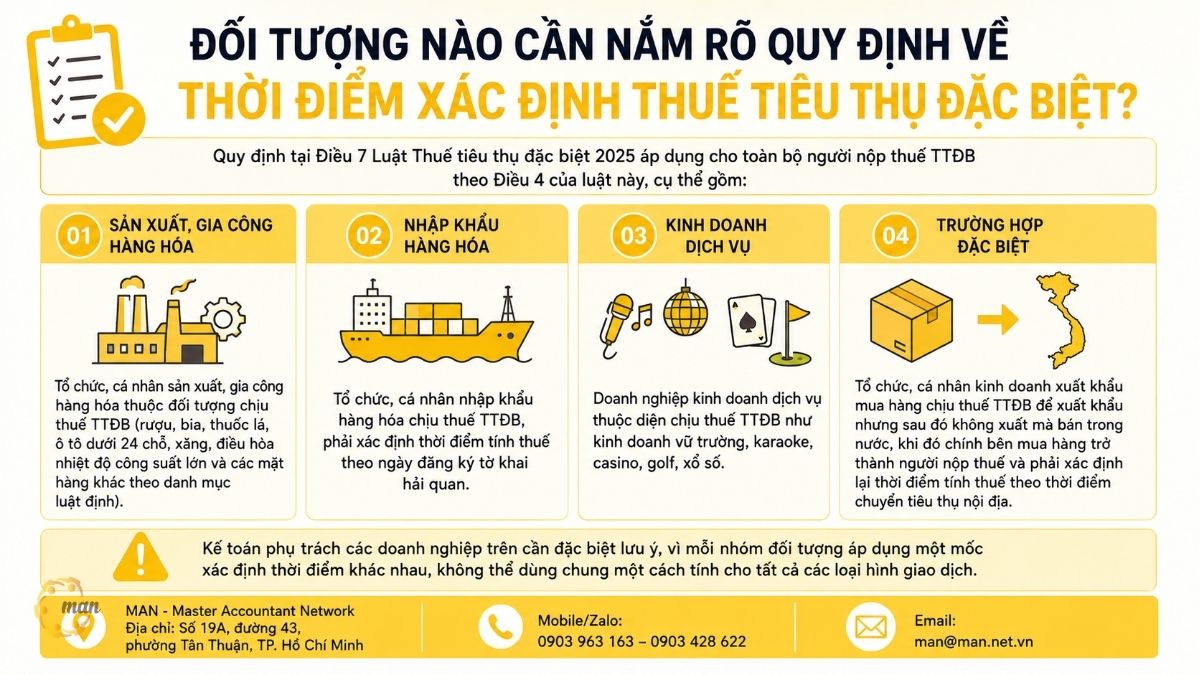
The provisions of Article 7 of the 2025 Special Consumption Tax Law apply to all special consumption tax payers as defined in Article 4 of this law, specifically including:
- Organizations and individuals manufacturing and processing of goods Items subject to excise tax (alcohol, beer, tobacco, cars with fewer than 24 seats, gasoline, high-capacity air conditioners, and other items as listed by law).
- Organizations and individuals import goods Subject to excise tax, the tax calculation date must be determined based on the date of customs declaration registration.
- Business service business Businesses subject to excise tax include nightclubs, karaoke bars, casinos, golf courses, and lottery operations.
- Special case: If an organization or individual engaged in export business purchases goods subject to excise tax for export but then sells them domestically instead of exporting, the buyer becomes the taxpayer and the tax calculation period must be recalculated based on the time of conversion to domestic consumption.
Accountants in charge of these businesses need to pay special attention, as each group of entities applies a different timeframe for determining transactions; a single calculation method cannot be used for all types of transactions.
When is the excise tax determined, depending on the specific circumstances?
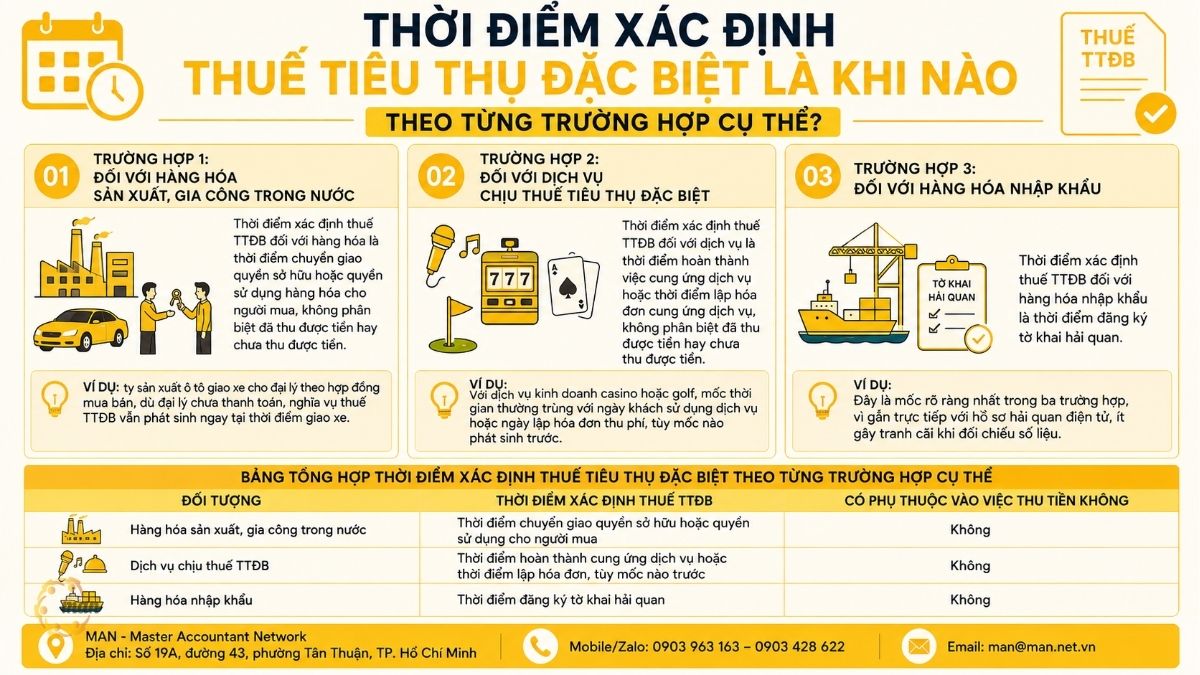
This is the core issue that businesses need to understand precisely. According to Article 7 of the 2025 Special Consumption Tax Law, the time of determining special consumption tax is stipulated in three distinct cases.
Case 1: For goods manufactured or processed domestically
The time for determining excise tax on goods is the time of transferring ownership or the right to use the goods to the buyer, regardless of whether payment has been received or not. For example, if an automobile manufacturer delivers vehicles to a dealer under a sales contract, even if the dealer has not yet paid, the excise tax liability arises immediately at the time of delivery.
Case 2: For services subject to excise tax
The time for determining excise tax on services is the time when the service is completed or the time when the invoice for the service is issued, regardless of whether payment has been received or not. For casino or golf business services, the timeframe usually coincides with the date the customer uses the service or the date the invoice is issued, whichever comes first.
Case 3: For imported goods
The time of determining the excise tax on imported goods is the time of customs declaration registration. This is the clearest point in the three cases, as it is directly linked to the electronic customs record and is less likely to cause disputes when comparing data.
The table below summarizes three cases for businesses to quickly refer to:
| Object | Time of determining excise tax | Does it depend on collecting the money? |
| Goods manufactured and processed domestically | The time of transfer of ownership or right of use to the buyer. | Are not |
| Services subject to excise tax | The time of completion of service provision or the time of invoice issuance, whichever comes first. | Are not |
| Imported goods | Time of customs declaration registration | Are not |
What are the regulations regarding the tax period and the deadline for filing excise tax returns?
Determining the correct time to calculate excise tax is only the first step. Businesses also need to know which tax period the transaction falls under and the deadline for filing the tax return, to avoid late payment penalties even if the tax obligation has been correctly recorded.
Tax period as per Article 20 of Circular 89/2026/TT-BTC
According to Clause 1, Article 20 Circular 89/2026/TT-BTC, In principle, excise tax is a tax declared on a monthly basis. However, the law stipulates two exceptions where declarations must be made each time a transaction occurs instead of being consolidated monthly:
- Case a: For taxpayers engaged in export business who have purchased goods without paying excise tax at the production stage, but subsequently sell them domestically instead of exporting them abroad, the exact moment of conversion to domestic consumption serves as the basis for declaration on a case-by-case basis.
- Case b: Special consumption tax for organizations and individuals trading in domestically produced aircraft, helicopters, gliders, yachts, and passenger cars, which were previously exempt from special consumption tax under Clauses 5 and 6 of Article 4 of Decree 360/2025/ND-CP, but subsequently changed to taxable purposes. This change in purpose of use gives rise to new tax obligations, which must be declared separately for each instance.
Apart from the two cases mentioned above, all other transactions subject to excise tax are aggregated and declared jointly for the monthly tax period.
The deadline for filing tax returns is stipulated in Article 10 of Decree 252/2026/ND-CP.
Article 10 Decree 252/2026/ND-CP The regulations stipulate two deadlines corresponding to the two tax filing methods mentioned above:
- For taxes that are declared on a transaction-by-transaction basis. (Clause 1): The deadline for submitting documents is no later than the 10th day following the date the tax liability arises. However, in cases where tax declaration and payment must be made before the issuance of electronic invoices with codes as stipulated in point b, clause 3, Article 26 of the Law on Tax Administration, businesses must fulfill their obligations before the invoices are issued, without waiting until the 10-day deadline.
- For taxes that are filed monthly. (Clause 2): The deadline for submitting tax returns is no later than the 20th day of the month following the month in which the tax liability arises.
Specifically applicable to the tax period of July 2026: the deadline for submitting the special consumption tax return for July 2026 is August 20, 2026 (Thursday). If the last day of the deadline for filing tax returns, the deadline for paying taxes, or the deadline for the tax authority to process the application coincides with a statutory holiday, the last day of the deadline shall be the next working day immediately following that holiday, in accordance with Clause 7, Article 3. Decree 252/2026/ND-CP.
The table below summarizes the two methods of tax filing and their corresponding deadlines for businesses to easily compare:
| Tax filing methods | Basis for application | Deadline for filing declaration |
| Monthly filing | This applies generally to most transactions subject to excise tax. | No later than the 20th day of the following month |
| Declare on a case-by-case basis. | Cases a and b mentioned in Clause 1, Article 20 of Circular 89/2026/TT-BTC | No later than the 10th day from the day following the date the tax liability arises. |
Legal documents related to the timing of determining excise tax.
To accurately determine the tax assessment date and accompanying filing deadline, businesses need to compare multiple documents simultaneously. Below are the most important legal grounds as of now.
| Legal documents | Number / Date of Issue | Related content |
| Law on Special Consumption Tax 2025 | National Assembly issued | Article 7 specifies the time of tax determination; Article 4 specifies the taxpayer. |
| Decree 360/2025/ND-CP | Regulations detailing the implementation of the Special Consumption Tax Law | Clauses 5 and 6 of Article 4 stipulate the subjects not subject to tax and cases of change of land use purpose. |
| Circular 89/2026/TT-BTC | Ministry of Finance | Article 20 stipulates the tax period on a monthly basis and two cases of declaration based on each transaction. |
| Decree 252/2026/ND-CP | Government issued | Article 10 stipulates the deadline for submitting tax returns; Clause 7 of Article 3 specifies the handling of cases where the filing date coincides with a holiday. |
| Law on Tax Administration | Point b, Clause 3, Article 26 | Regulations stipulate the obligation to declare and pay taxes before being issued electronic invoices with codes for each transaction. |
Case Study: Wine importer in Ho Chi Minh City incorrectly determined the tax calculation period.
Background
Company Y, a limited liability company specializing in importing wine from Europe, has a bonded warehouse in Ho Chi Minh City. In the third quarter of 2026, the company received a shipment at the port but did not immediately open the customs declaration, waiting for the necessary Certificate of Origin (CO) to qualify for preferential import tax rates. The accountant recorded revenue and excise tax based on the date the goods arrived at the port, instead of the date the customs declaration was registered.
Problem arises
When customs authorities checked the records, the actual declaration registration date differed by 12 days from the date the goods arrived at the port, which the accountant used to calculate the tax. This resulted in an incorrect tax period, leading to a discrepancy between the provisional excise tax amount and the official customs declaration.
The solution as advised by MAN.
According to guidance from experts at MAN – Master Accountant Network, The company implemented three corrective steps: reviewing the customs declarations for the quarter to verify the correct registration date; adjusting the Special Consumption Tax declaration form to reflect the correct date of customs declaration registration instead of the date of goods receipt; and establishing a process requiring the import-export department to report immediately upon declaration registration, as a basis for recording tax obligations in the correct period.
Result
After making the adjustments, the company avoided an estimated late payment penalty of approximately 45 million VND for the incorrect declaration period, and also shortened the time for data reconciliation between the accounting department and the import-export department from 5 days to just 1 working day per settlement period.
Expert opinion: Common business risks when determining the timing of excise tax calculation.
Experts at MAN – Master Accountant Network With over 30 years of experience in auditing and tax consulting in Vietnam, we have identified four common business risk groups.
- Risk 1: Confusion between the invoice date and the tax liability date: Many businesses default to using the date of the value-added tax invoice as the time for calculating excise tax for all transactions. However, for goods, if ownership has been transferred before the invoice is issued, the tax obligation must be recorded from the time of transfer, not waiting until the invoice date.
- Risk 2: Missing transactions for deferred payments or unpaid goods: Because the law clearly stipulates that tax obligations do not depend on whether payment has been received or not, some businesses have a habit of only declaring taxes when customers pay, leading to the omission of tax obligations for long-term credit orders.
- Risk 3: Incorrectly determining the date of registration of the customs declaration for imported goods: For imported goods, many accountants use the date the goods arrive at the port or the date the shipping documents are received instead of the date the official customs declaration is registered, causing a discrepancy in the tax calculation period, as illustrated in the case study above.
- Risk 4: Failure to update the deadline for filing tax returns according to the new regulations: Since Decree 252/2026/ND-CP came into effect, the deadline for submitting tax returns has been specifically set as the 20th day of the following month for monthly tax returns. Businesses that haven't updated to the new regulations may mistakenly apply the old deadline, leading to late submissions and late payment penalties even if they filed their returns at the correct time.
Conclude
Understanding when excise tax is determined helps businesses file their tax returns correctly, avoiding retroactive tax collection or late payment penalties due to discrepancies in the timing of tax liability recognition. Three important milestones to remember are the time of transfer of ownership or use of goods, the time of completion of service provision or invoice issuance, and the time of customs declaration registration for imported goods.
Tax services at MAN – Master Accountant Network
- Tax accounting services
- Tax consulting services
- Tax settlement services
- Tax reporting services
- VAT refund service
Service contact information at MAN – Master Accountant Network
- Address: No. 19A, Street 43, Tan Thuan Ward, Ho Chi Minh City
- Mobile/Zalo: 0903 963 163 – 0903 428 622
- E-mail: man@man.net.vn
- Google Business Profile: View MAN – Master Accountant Network's Google Business Profile
- LinkedIn Founder: View expert Le Hoang Tuyen's LinkedIn profile.
Responsible for production and professional content review by: Mr. Le Hoang Tuyen – Founder & CEO of MAN – Master Accountant Network, CPA Vietnam with over 30 years of experience in accounting, auditing, taxation, and corporate financial consulting.
Frequently Asked Questions about the timing of excise tax determination
When is the excise tax on goods determined?
This refers to the point at which ownership or the right to use goods is transferred to the buyer, regardless of whether payment has been received or not, as stipulated in Clause 1, Article 7 of the 2025 Special Consumption Tax Law.
If a service is not yet completed but an invoice has already been issued, which tax bracket should be used for calculation?
The law stipulates that the tax calculation time is either the time the service is completed or the time the invoice is issued, whichever comes first. If the invoice has been issued before the service is completed, the date of invoice issuance is used as the basis for tax calculation.
Are imported goods that have not yet been cleared through customs subject to excise tax?
The time of determining excise tax on imported goods is the time of customs declaration registration, not the time the goods arrive at the port or the time customs clearance is completed.
If a business purchases goods for export but sells them domestically, how is the tax calculation point determined?
In this case, the buyer becomes the excise tax payer and must determine the tax calculation time based on the time the goods are transferred for domestic consumption, declaring each transaction within 10 days from the date the tax liability arises.
What are the penalties for incorrectly determining the time of calculating excise tax?
Businesses may be required to amend their tax returns, pay back any outstanding taxes, and incur late payment penalties based on the number of days the return is delayed beyond the actual date the tax liability arises.
What is the deadline for submitting the excise tax return for July 2026?
According to Clause 2, Article 10 of Decree 252/2026/ND-CP, the deadline for submitting the Special Consumption Tax return for July 2026 is August 20, 2026 (Thursday). If this date falls on a holiday, the deadline will be moved to the next working day.