


When will I be subject to retroactive collection of personal income tax in 2026? This is a question that many individuals and corporate accounting departments are asking during the 2026 tax policy transition period, as a series of new documents such as Personal Income Tax Law 2025, Tax Administration Law 2025 and Decree 310/2025/ND-CP These regulations take effect one after another. Many people think that simply "forgetting" to declare a small amount of income will go undetected, but in reality, the tax authorities have the right to collect back taxes for up to ten years, or even indefinitely if the individual has never registered for tax.
This article is compiled from the professional perspective of our tax consulting team. MAN – Master Accountant Network, This will comprehensively answer questions surrounding the timing of tax collection, the statute of limitations for penalties, the underlying legal documents, and the practical risks that individuals and businesses need to be aware of to avoid incurring unexpected financial obligations in 2026 and subsequent years.
Summary of key points regarding the collection of personal income tax
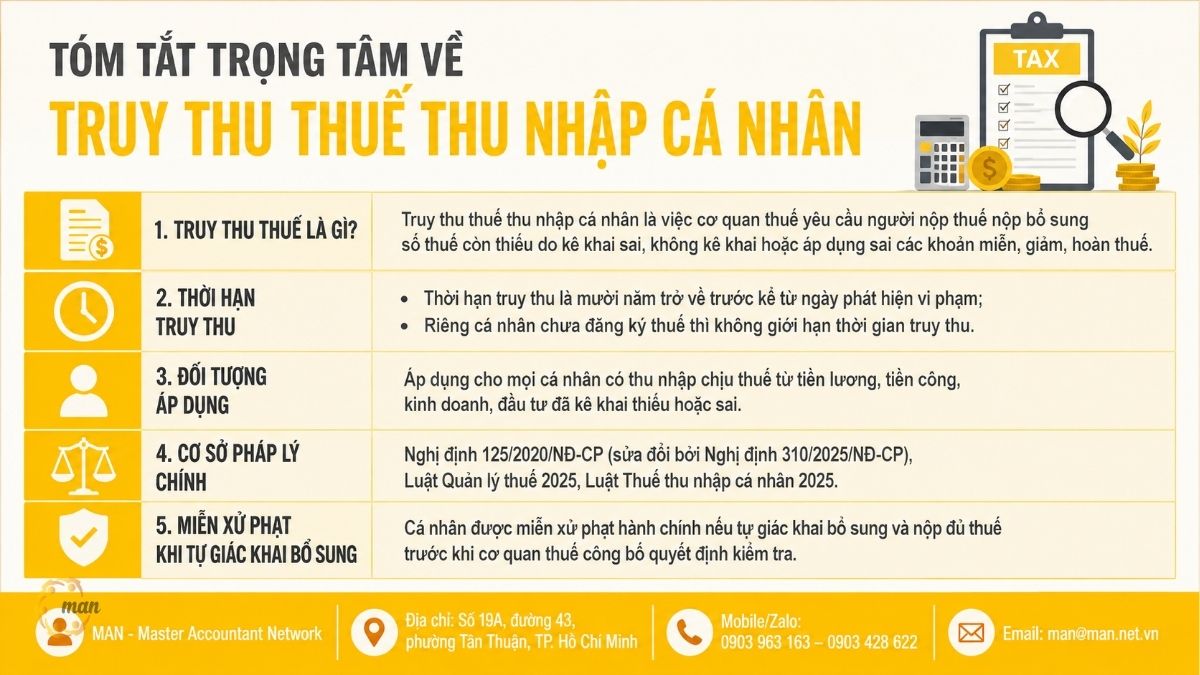
- The collection of back taxes on personal income is when the tax authorities require taxpayers to pay additional tax amounts that are still outstanding due to incorrect declarations, failure to declare, or incorrect application of tax exemptions, reductions, or refunds.
- The deadline for retroactive tax collection is ten years prior to the date the violation was discovered; however, there is no time limit for retroactive collection for individuals who have not registered for tax.
- This applies to all individuals whose taxable income from salaries, wages, business, or investments has been under-declared or incorrectly declared.
- Main legal basis: Decree 125/2020/ND-CP (amended by Decree 310/2025/ND-CP), Law on Tax Administration 2025, Law on Personal Income Tax 2025.
- Individuals are exempt from administrative penalties if they voluntarily submit supplementary tax returns and pay all taxes in full before the tax authorities announce a tax audit decision.
What is retroactive personal income tax collection?
Tax arrears collection is the process by which tax authorities require taxpayers to pay additional tax amounts owed from previous tax periods. This is not a form of punishment, but rather a management measure aimed at ensuring state budget revenue and fairness in tax payment obligations among individuals and organizations.
Unlike administrative penalties, which have a statute of limitations and may be waived in some cases, the obligation to pay the full amount of back taxes is almost without exception. Even after the statute of limitations for penalties has expired, taxpayers are still required to fully repay the outstanding tax, evaded tax, or any amount that was exempted, reduced, or refunded in excess of the regulations.
When is personal income tax collected retrospectively according to current regulations?
This is a crucial aspect that any individual or accountant needs to understand before filing their 2026 tax return.
Legal basis for determining the time of retroactive collection.
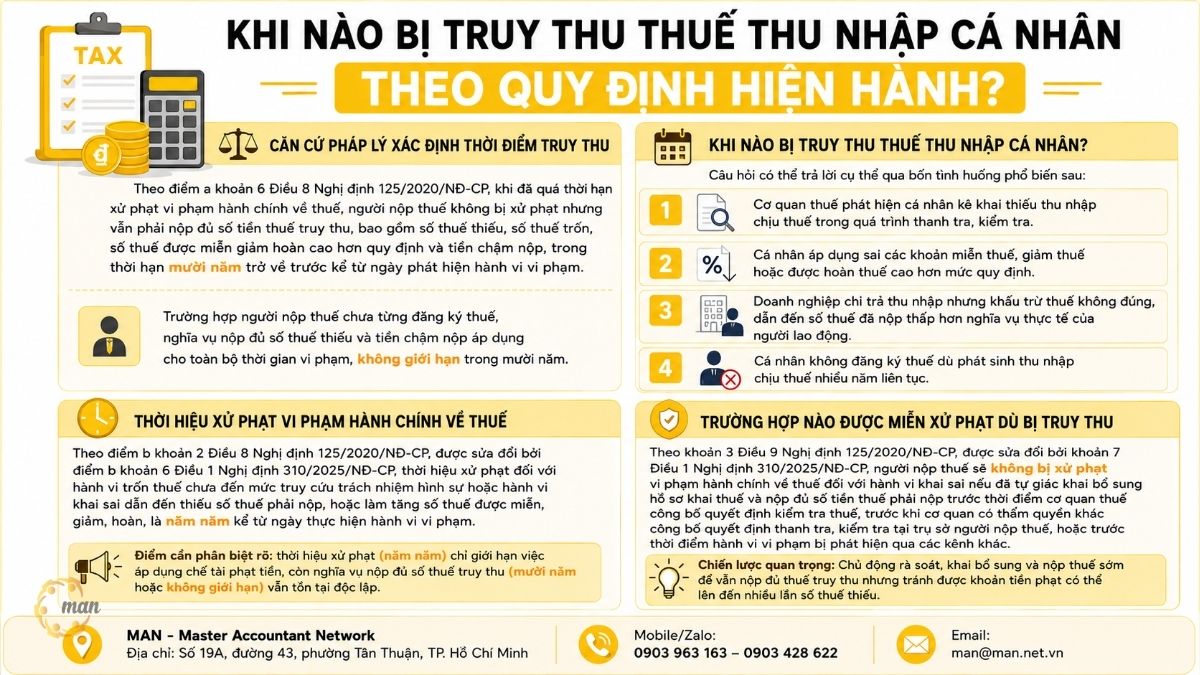
According to point a, clause 6, Article 8 of Decree 125/2020/ND-CP, when the statute of limitations for administrative penalties for tax violations has expired, taxpayers are not subject to penalties but are still required to pay the full amount of back taxes, including the amount of tax owed, the amount of tax evaded, the amount of tax exempted, reduced, or refunded in excess of regulations, and late payment penalties, for the period of ten years prior to the date of discovery of the violation. In cases where the taxpayer has never registered for tax, the obligation to pay the full amount of tax owed and late payment penalties applies to the entire period of the violation, not limited to ten years.
Therefore, the question of when personal income tax is collected retrospectively can be answered specifically through the following four common situations:
- Tax authorities discover individuals underreporting their taxable income during inspections and audits.
- Individuals who misuse tax exemptions, tax reductions, or receive tax refunds exceeding the prescribed limits.
- Businesses pay income but deduct taxes incorrectly, resulting in employees paying less tax than they actually owe.
- Individuals who do not register for tax purposes despite generating taxable income for many consecutive years.
What is the statute of limitations for imposing administrative penalties for tax violations?
According to point b, clause 2, Article 8 of Decree 125/2020/ND-CP, as amended by point b, clause 6, Article 1 of Decree 310/2025/ND-CP, the statute of limitations for penalties for tax evasion that does not reach the level of criminal liability or for false declarations leading to a shortfall in tax payable, or an increase in tax exemptions, reductions, or refunds, is five years from the date the violation was committed.
It's important to distinguish between the two: the statute of limitations (five years) only applies to monetary penalties, while the obligation to pay the full amount of back taxes (ten years or unlimited) remains independent. Many individuals confuse these two concepts, leading them to mistakenly believe that after five years they no longer have any responsibility to the tax authorities.
In what cases are penalties waived even if back taxes are collected?
According to Clause 3, Article 9 of Decree 125/2020/ND-CP, as amended by Clause 7, Article 1 of Decree 310/2025/ND-CP, taxpayers will not be subject to administrative penalties for tax violations for incorrect declarations if they have voluntarily submitted supplementary tax returns and paid the full amount of tax due before the tax authority announces a tax audit decision, before another competent authority announces an inspection or audit decision at the taxpayer's premises, or before the violation is detected through other channels.
This is the mechanism that MAN – Master Accountant Network We often advise clients to proactively review, file supplementary tax returns, and pay taxes early, instead of waiting until the tax authorities discover the discrepancy. This strategy helps individuals and businesses still pay the full amount of back taxes, but avoid penalties that could be many times the amount of tax owed.
The role of understanding tax collection regulations correctly in financial management.
Understanding when and under what conditions personal income tax arrears can be collected not only helps individuals avoid unexpected financial risks, but also forms the foundation for businesses to build a rigorous tax deduction and declaration process from the outset. A small error in deduction can have serious consequences. personal income tax An employee's actions can be repeated over many years and become a significant amount of back taxes when audited.
From MAN's perspective, the majority of tax audits at small and medium-sized enterprises (SMEs) in Vietnam reveal errors related to the declaration of taxable income, especially allowances, bonuses, and commissions that have not been correctly included in taxable income. Proactive periodic reviews, instead of only addressing issues when an audit team arrives, are the most effective tax risk management approach recommended by auditing experts.
Which entities are affected by the regulations on retroactive collection of personal income tax?
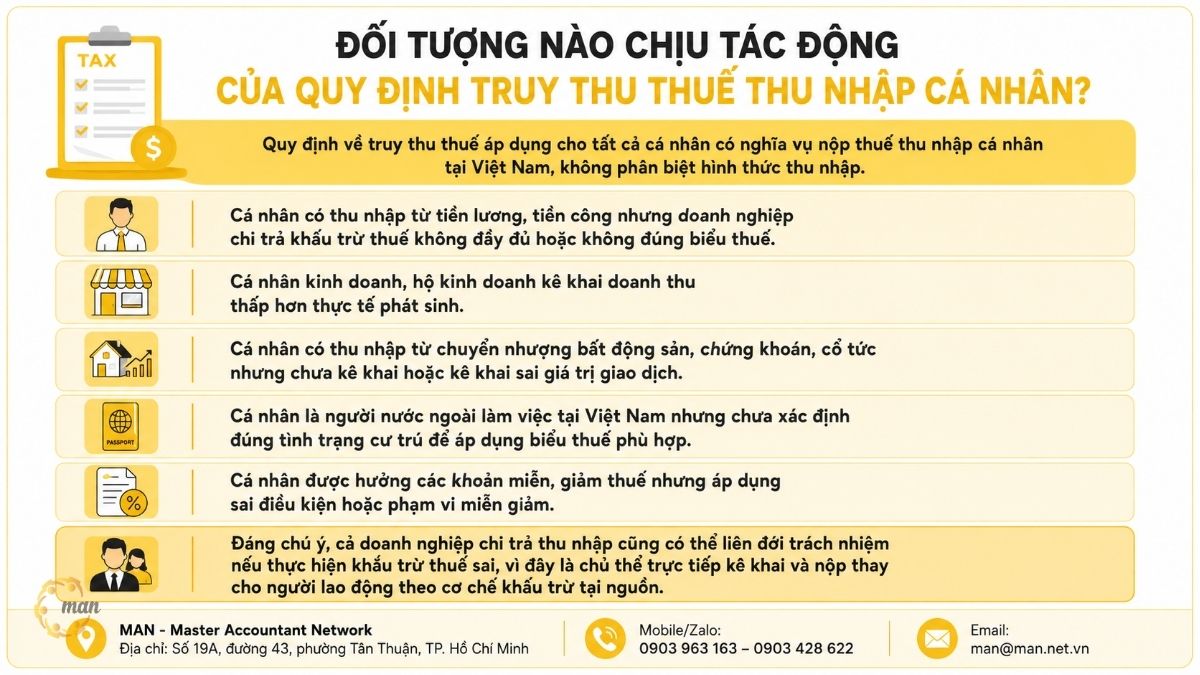
Regulations on tax arrears apply to all individuals obligated to pay personal income tax in Vietnam, regardless of income type. Specifically, the groups most at risk of being subject to tax arrears include:
- Individuals who receive income from salaries and wages but whose employers do not deduct taxes fully or correctly according to the tax schedule.
- Individuals and household businesses declare lower revenue than the actual revenue generated.
- Individuals who have income from the transfer of real estate, securities, or dividends but have not declared or have incorrectly declared the transaction value.
- Foreign individuals working in Vietnam whose residency status has not been correctly determined to apply the appropriate tax rate.
- Individuals are entitled to tax exemptions or reductions but apply the wrong conditions or scope of exemption or reduction.
Notably, the income-paying business may also be held liable if it makes incorrect tax deductions, as it is the entity directly responsible for declaring and paying taxes on behalf of employees under the withholding tax mechanism.
Key timelines and practical conditions to note for 2026
2026 marks a period of significant changes in personal income tax policy, bringing with it numerous new provisions related to tax arrears that individuals and businesses need to stay updated on.
When do the new tax laws take effect?
The Personal Income Tax Law 2025 will take effect from July 1, 2026. However, regulations related to income from business activities, salaries, and wages of resident individuals will apply from the 2026 tax year, i.e., January 1, 2026. Therefore, the new personal allowance and related declaration regulations have come into effect before the law fully takes effect, creating a transitional period where accountants need to be cautious when determining the applicable tax period.
Personal allowance rates will be applied from 2026.
According to Resolution 110/2025/UBTVQH15 Regarding adjustments to personal deductions, the deduction for taxpayers is VND 15.5 million per month, equivalent to VND 186 million per year, and the deduction for each dependent is VND 6.2 million per month. This resolution takes effect from January 1, 2026, and applies immediately from the 2026 tax year.
The incorrect application of outdated personal deduction rates, not updated according to Resolution 110/2025/UBTVQH15, is one of the common causes of under- or over-declaration of taxes payable, and this is the basis for tax authorities to collect back taxes or refunds during final settlement.
According to Clauses 1 and 2 of Article 29 of the 2025 Personal Income Tax Law regarding implementation provisions, the law takes effect from July 1, 2026. However, the provisions on income from business activities, salaries, and wages of resident individuals apply immediately from the 2026 tax year. In other words, the new personal allowance has already been applied to income generated from January 1, 2026, not just July 1. Many accountants misunderstand this point, leading to incorrect calculation of withholding tax in the first half of the year and the risk of being subject to retroactive tax collection during final tax settlement.
What income level will be subject to personal income tax in 2026?
This question is directly related to the topic of tax arrears collection, as incorrectly determining the taxable income threshold is a common reason why individuals are subject to tax arrears collection during tax settlement.
Taxable income threshold based on the number of dependents
With a personal allowance of VND 15.5 million per month for the taxpayer and VND 6.2 million per month for each dependent, individuals with income from salaries and wages only have to pay personal income tax when their total income exceeds the following thresholds:
| Number of dependents | Income level at which personal income tax begins to apply. |
| 0 people | From 15.5 million VND/month onwards |
| 1 person | From 21.7 million VND/month onwards |
| 2 people | From 27.9 million VND/month onwards |
| 3 people | From 34.1 million VND/month onwards |
The income level mentioned above is income from salaries and wages after deducting mandatory insurance contributions, voluntary pension funds, charitable contributions, educational and humanitarian contributions, as well as tax-exempt income and amounts not included in taxable income such as certain allowances, subsidies, and lunch money.
Example of calculating the actual tax threshold.
Because taxable income is further reduced by mandatory social insurance contributions, the actual gross income threshold on labor contracts is higher than the aforementioned figure of 15.5 million VND. According to the current mandatory social insurance contribution structure, employees contribute a total of 10.5% of their salary as the basis for insurance contributions, including 8% for social insurance, 1.5% for health insurance, and 1% for unemployment insurance.
For example: an individual with no dependents earns 17 million VND per month. The amount of insurance contributions payable is 17 million VND multiplied by 10.5%, equivalent to 1.785 million VND. Adding this amount to the personal deduction of 15.5 million VND, the total deductions are 17.285 million VND, which is greater than the income of 17 million VND, so this individual does not have to pay personal income tax.
Therefore, individuals without dependents only actually have to pay tax when their income exceeds VND 17.285 million per month, not immediately at VND 15.5 million as many people mistakenly believe. Similarly, for one dependent, the actual tax threshold increases to approximately VND 24.22 million per month, and for two dependents to approximately VND 31.155 million per month.
Accurately calculating these two deductions, including personal allowances and mandatory insurance deductions, is crucial for businesses to deduct taxes correctly from the outset, avoiding negative or positive discrepancies during tax settlement, which are the direct cause of the common personal income tax arrears collection efforts today.
Compilation of legal documents related to the collection of personal income tax.
Important note: The decrees providing detailed guidance on the implementation of the Personal Income Tax Law 2025 and the Tax Administration Law 2025 are still being finalized. Experts at MAN recommend that individuals and businesses closely monitor the Ministry of Finance's guiding circulars expected to be issued in 2026 to stay updated on how to accurately determine the amount of back taxes to be collected in each period.
| Legal documents | Number / Date of Issue | Related content |
| Decree 125/2020/ND-CP | Issued in 2020 | Regulations on administrative penalties for tax and invoice violations; basis for determining the ten-year period for retroactive tax collection. |
| Decree 310/2025/ND-CP | Issued in 2025 | Amendments and additions to Decree 125/2020/ND-CP on the statute of limitations for penalties and cases of exemption from penalties. |
| Tax Administration Law 2025 | Effective from July 1, 2026 | Clause 4 of Article 45 stipulates 10 acts considered as tax evasion. |
| Personal Income Tax Law 2025 | Effective from July 1, 2026, except for salary and wage income, which will be applied from the 2026 tax year. | Regulations on taxable income, tax exemptions, and enforcement provisions. |
| Resolution 110/2025/UBTVQH15 | Effective from January 1, 2026 | The personal allowance has been adjusted to 15.5 million VND/month and 6.2 million VND/month for dependents. |
| Decree 253/2026/ND-CP | Issued in 2026 | Guidelines for implementing regulations related to personal income tax management. |
Case study: Individual subject to back taxes due to false declaration of income from share transfers.
Real-world context
An individual in Ho Chi Minh City transferred a stake in a limited liability company in 2022, with the actual transfer value being approximately 1.8 billion VND higher than the declared price in the contract. This individual only declared and paid personal income tax on the value stated in the notarized contract, which was significantly lower than the actual amount received according to the private agreement between the two parties.
Detection and handling process
By 2026, during a review of capital transfer data between the tax authorities and the business registration agency, the tax authorities discovered a discrepancy between the actual transfer value and the declared value. According to advice from MAN – Master Accountant Network, this individual was advised to proactively work with the tax authorities, provide explanations, and voluntarily submit supplementary declarations before an official audit decision is made.
The measured results
- The amount of back taxes due is approximately 360 million VND, calculated on the difference in the undeclared transfer value.
- Because this individual proactively submitted supplementary declarations before the inspection decision was announced, they were exempted from administrative penalties under Clause 3, Article 9 of Decree 125/2020/ND-CP, and only had to pay the outstanding tax amount and late payment interest.
- If you wait until the tax authorities announce the inspection decision, the penalty could be one to three times the amount of tax evaded, according to the penalty framework for tax evasion, plus late payment interest calculated on a daily basis.
This case study clearly demonstrates the value of proactively reviewing tax obligations periodically, rather than waiting until violations are discovered before taking action.
Comparison Table: Tax Collection and Administrative Penalties for Tax Violations
Many businesses often confuse the two Tax collection and administrative penalties for tax violations, This can lead to misjudging the level of risk when being audited by the tax authorities. In reality, these are two measures with different natures, application periods, and legal consequences. The table below helps businesses clearly distinguish each item to proactively comply and limit unnecessary expenses.
| Criteria | Tax collection | Imposing administrative penalties for violations. |
| Nature | Request to pay the remaining tax amount. | Imposing monetary penalties for violations. |
| Validity period | Ten years prior, or indefinitely if not yet registered for tax. | Five years from the date the violation was committed. |
| Is it possible to be exempted? | No exemptions are granted; full payment is always required. | Exemption may be granted if the applicant voluntarily provides additional information before being discovered. |
| Legal basis | Article 8 of Decree 125/2020/ND-CP | Articles 8 and 9 of Decree 125/2020/ND-CP, amended by Decree 310/2025/ND-CP |
| Late payment penalty | It has accompanying features. | Not applicable in isolation, usually accompanied by retroactive collection. |
Expert opinion: Common risks faced by Vietnamese businesses and individuals.
Experts at MAN – Master Accountant Network, with over thirty years of practical experience in auditing and tax consulting in Vietnam, have identified four of the most common risk groups related to the collection of personal income tax.
Risk number one: Confusion between the statute of limitations for penalties and the deadline for debt collection.
Many individuals believe that after five years, all related tax obligations automatically cease. In reality, the five-year statute of limitations only applies to penalties, while the obligation to pay back taxes extends up to ten years. This misconception leads many people to be complacent, failing to proactively review and amend their tax returns when errors are discovered.
Second risk: Delays in voluntarily submitting supplementary declarations.
The penalty exemption mechanism only applies if individuals file supplementary tax returns and pay all taxes before the tax authorities announce the audit decision. In reality, many individuals and corporate accountants discover errors but delay addressing them, only hastily filing supplementary returns when an audit notice is issued, at which point they are no longer eligible for the penalty exemption policy.
Third risk: Lack of supporting documentation during an audit.
When tax authorities request explanations of income, exemptions, or deductions, the lack of contracts, payment documents, or detailed payroll records puts individuals and businesses at a disadvantage in proving the reasonableness of the declared figures, easily leading to conclusions that the tax collection will be higher than the actual amount.
Fourth risk: Failure to keep up-to-date with changes in deductions and tax exemptions.
The period of 2026 will see many simultaneous changes regarding personal deductions, new tax-exempt income categories, and regulations on tax evasion. Businesses applying the old regulations, due to not having updated to Resolution 110/2025/UBTVQH15 or the Personal Income Tax Law 2025, risk incorrectly deducting taxes for all employees for many consecutive months, resulting in significant accumulated tax arrears at the end of the year.
The solution from MAN – Master Accountant Network for these risks is to establish a quarterly tax review process, combining declared data with original documents and updating new legal regulations as soon as they are issued, instead of only processing them once at the end of the year. This proactive approach helps businesses significantly reduce costs arising from late payment penalties and fines compared to waiting for the tax authorities to detect violations.
Conclude
Understanding when personal income tax arrears can be collected helps individuals and businesses be more proactive in tax declaration, deduction, and settlement, avoiding unexpected expenses that could seriously affect personal cash flow or business reputation during tax audits. With significant changes to the tax legal system expected in 2026, timely updating of new regulations and regular review of tax records is no longer an option, but a mandatory requirement for anyone with taxable income.
Tax services at MAN – Master Accountant Network
- Tax accounting services
- Tax consulting services
- Tax settlement services
- Tax reporting services
- VAT refund service
Service contact information at MAN – Master Accountant Network
- Address: No. 19A, Street 43, Tan Thuan Ward, Ho Chi Minh City
- Mobile/Zalo: 0903 963 163 – 0903 428 622
- E-mail: man@man.net.vn
- Google Business Profile: View MAN – Master Accountant Network's Google Business Profile
- LinkedIn Founder: View expert Le Hoang Tuyen's LinkedIn profile.
Responsible for production and professional content review by: Mr. Le Hoang Tuyen – Founder & CEO of MAN – Master Accountant Network, CPA Vietnam with over 30 years of experience in accounting, auditing, taxation, and corporate financial consulting.
Frequently Asked Questions about Personal Income Tax Collection
If I am charged back taxes on my personal income, will I have to pay a penalty?
Not necessarily. If the five-year statute of limitations for penalties has expired, or if the individual voluntarily submits supplementary declarations and pays all taxes before the inspection decision is announced, the taxpayer only has to pay the back taxes and late payment penalties, and will not be subject to administrative penalties.
What is the maximum period for collecting back taxes on personal income?
The maximum period of time for tax violations is ten years prior to the date the tax authorities discovered the violation. However, individuals who have never registered for tax will be subject to retroactive tax collection for the entire period during which income was generated, without the ten-year limit.
Is the company liable if an employee is subject to back taxes?
Yes. Businesses that pay income are responsible for withholding tax at source. If they withhold tax incorrectly or insufficiently, they may be subject to retroactive collection and penalties, in addition to the individual employee's obligations.
If you discover an error yourself, should you file an amended return immediately or wait until the annual tax settlement?
You should file a supplementary tax return as soon as you discover any discrepancies. Proactively filing a supplementary tax return and paying all taxes before an inspection or audit is decided is a mandatory condition for exemption from administrative penalties under current regulations.
Will the new personal allowance affect the possibility of being subject to back taxes?
Yes. If a business or individual incorrectly applies the personal allowance deduction under Resolution 110/2025/UBTVQH15, resulting in an underestimation of the tax payable, this serves as grounds for the tax authorities to collect the outstanding tax during review or final settlement.




