

Official document No. 4573/CT-CS This is a response to the corporate income tax policy issued by the Tax Department on July 6, 2026, addressing the concerns of Jones & Vining (Vietnam) Co., Ltd. regarding the application of tax incentives for its industrial support product manufacturing project in Dong Nai. This is one of the important individual documents that helps foreign-invested enterprises correctly determine the timing and extent of tax incentives they are entitled to under the new legal framework, including the Corporate Income Tax Law and Decree 320/2025/ND-CP.
For supporting industrial manufacturing businesses, incorrectly determining the start date for tax incentives or overlooking transitional conditions can result in the loss of billions of dong in tax exemptions or reductions, or conversely, lead to retroactive tax collection if applied incorrectly. The following article, from the perspective of... MAN – Master Accountant Network, With over 30 years of practical experience in Vietnam, our tax, accounting, and auditing consulting firm provides detailed analysis of official documents, relevant legal grounds, and practical lessons for businesses.
Summary of key points in Official Letter No. 4573/CT-CS
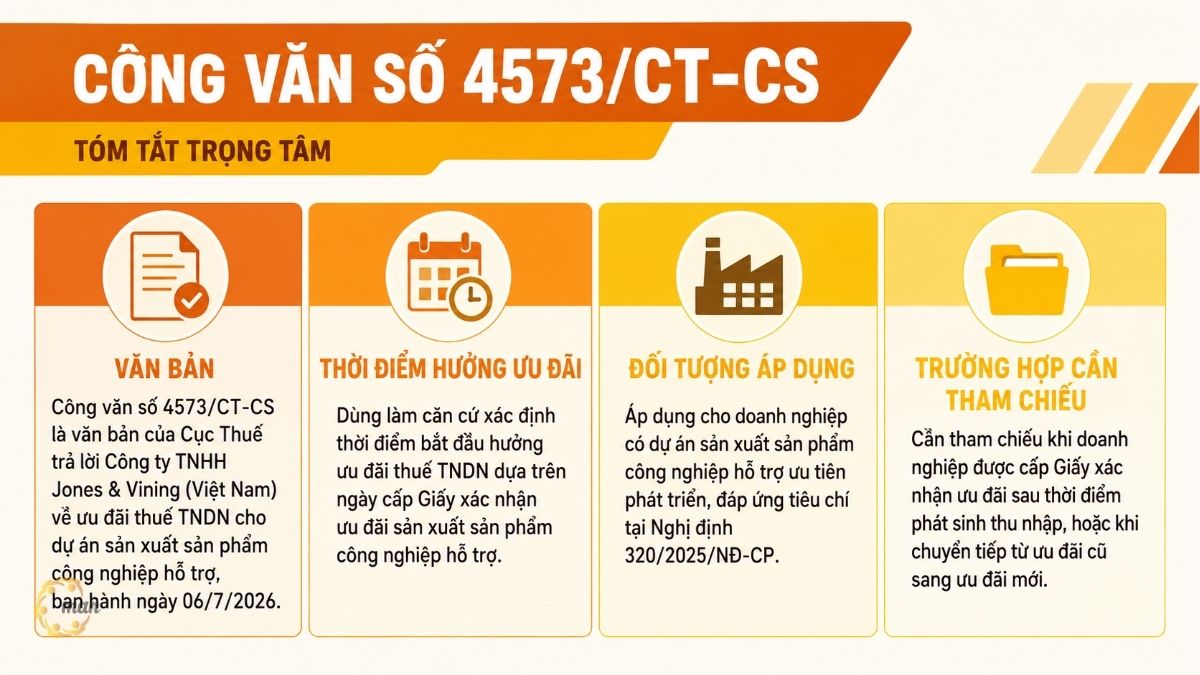
- Official Letter No. 4573/CT-CS is a document from the Tax Department responding to Jones & Vining (Vietnam) Co., Ltd. regarding corporate income tax incentives for projects producing supporting industrial products, issued on July 6, 2026.
- This is used as the basis for determining the start date of corporate income tax incentives based on the date of issuance of the Certificate of Incentives for Production of Supporting Industrial Products.
- This applies to businesses with projects producing priority industrial support products that meet the criteria in Decree 320/2025/ND-CP.
- References are needed when a business is granted a Certificate of Incentive after the income has been generated, or when transitioning from an old incentive program to a new one.
What is Official Document No. 4573/CT-CS and in what cases does it apply?
Official Letter No. 4573/CT-CS issued by the Tax Department on July 6, 2026, is in response to Official Letter No. 001/CV-JV/2026 dated March 30, 2026, from Jones & Vining (Vietnam) Co., Ltd., located at Road No. 3, Giang Dien Industrial Park, Trang Bom Commune, Dong Nai Province. The letter clarifies whether the enterprise is eligible for corporate income tax incentives for its project producing supporting industrial products, and if so, when the incentives will begin to apply.
This is a type of official document providing guidance on the application of law for a specific case, but it has high reference value for businesses in the same industry and with similar project types. For companies manufacturing components and parts for the textile, footwear, electronics, automotive, or mechanical engineering industries, document 4573/CT-CS is a document that needs to be referenced when preparing tax incentive applications.
The legal basis cited in the document.
The Tax Department based its response to Jones & Vining Co., Ltd. on three main sets of documents. Firstly, Article 4 of Circular 21/2016/TT-BTC, guiding corporate income tax incentives under Decree 111/2015/ND-CP on the development of supporting industries, stipulates that incentives apply from January 1, 2015, provided the enterprise is granted a Certificate of Incentive for the Production of Supporting Industry Products.
Secondly Decree 320/2025/ND-CP On December 15, 2025, the latest guiding document for the implementation of the Corporate Income Tax Law provided detailed regulations on the subjects, tax rates, and periods of tax exemption and reduction. Thirdly, it outlined the principles for selecting the most advantageous incentives when a business simultaneously qualifies for multiple types of incentives within the same period.
An important date to note is the effective date of the Corporate Income Tax Law, October 1, 2025. According to Point c, Clause 2, Article 18 of Decree 320/2025/ND-CP, the criterion "not yet produced domestically or produced but not meeting European technical standards" is only considered up to this point, i.e., based on the domestic production situation as of October 1, 2025, not the date the enterprise submits the application or the date the preferential treatment certificate is issued.
The role of Official Letter No. 4573/CT-CS in corporate tax administration.
For supporting industrial manufacturing businesses, correctly identifying the timing of tax incentives directly impacts cash flow and medium-term financial planning. A tax incentive under the 10% scheme for 15 years, plus a 4-year tax exemption and a 50% reduction in tax payable for the following 9 years, represents a significant financial benefit if businesses apply it correctly from the outset.
From this perspective MAN – Master Accountant Network, Many FDI enterprises in industrial zones in the South are facing difficulties not because they lack eligibility for tax incentives, but because they incorrectly determine the start year for tax exemptions, leading to under-declaration or over-declaration of the tax amount eligible for incentives. Circular 4573/CT-CS clarifies this principle with a real-life case study that can be applied as a reference to many other businesses in similar circumstances.
Having an official written response from the tax authorities is also an important legal basis for businesses to defend their declarations when subjected to tax audits and inspections later on. This is the core value that a specific document like 4573/CT-CS brings to tax risk management in businesses.
Which entities are affected by Official Letter No. 4573/CT-CS?
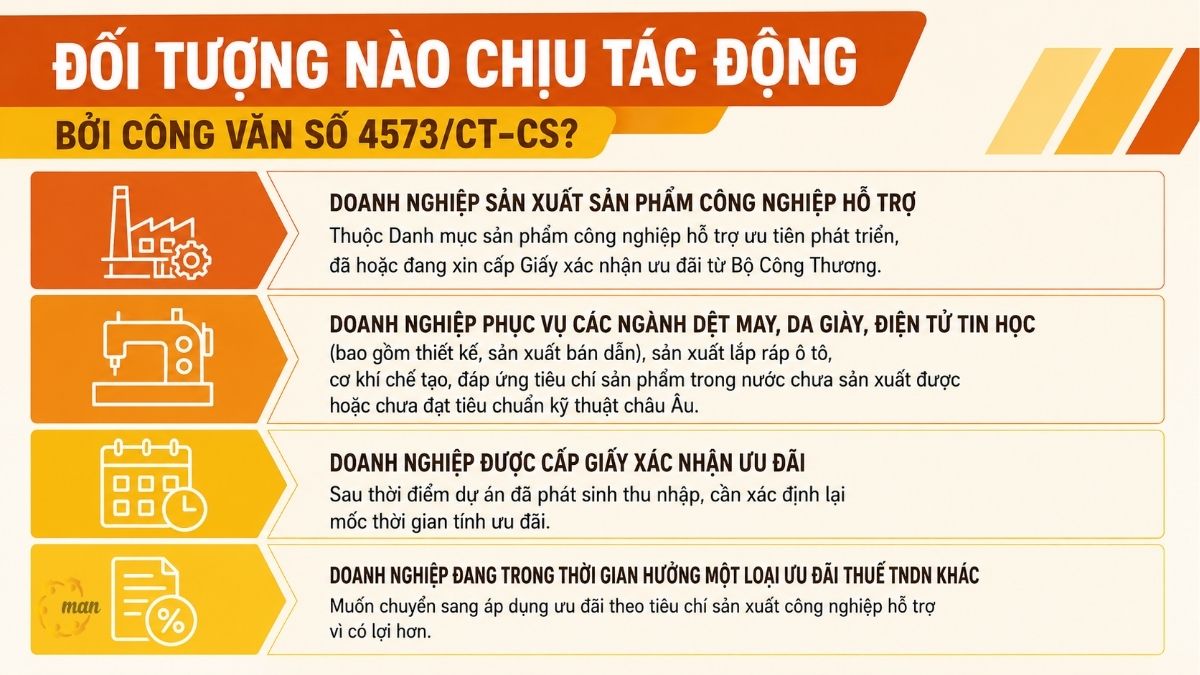
Official document 4573/CT-CS directly addresses the case of Jones & Vining Co., Ltd., but the principles applied therein can be referenced for the following groups of businesses:
- Businesses producing supporting industrial products included in the List of Priority Supporting Industrial Products for Development, and which have applied or are in the process of applying for preferential treatment certificates from the Ministry of Industry and Trade.
- Businesses serving the textile, footwear, electronics and information technology (including semiconductor design and manufacturing), automotive manufacturing and assembly, and mechanical engineering industries must meet the criteria of products that are not yet produced domestically or do not meet European technical standards.
- Businesses that receive a Certificate of Incentive after the project has already generated income need to have the incentive calculation period re-determined.
- Businesses currently enjoying another type of corporate income tax incentive may want to switch to applying for incentives based on the criteria for supporting industrial production because it is more advantageous.
Timeline and applicable conditions to note
According to the official document, the tax exemption and reduction period is calculated from the year the enterprise is granted the Certificate or Confirmation of Preferential Treatment, if this certificate is issued after the project has generated income. If the enterprise has not yet generated income in the year the certificate is issued, the exemption and reduction period is calculated from the first year of taxable income generation.
One point to note is that if, within the first three years from the date of issuance of the preferential treatment certificate, the business has not generated any taxable income, the tax exemption period will begin from the fourth year after the certificate is issued, regardless of whether the business generates any income in that year. This is a time-bound regulation, and businesses need to monitor it closely to avoid missing out on preferential benefits.
In the specific case mentioned in the document, Jones & Vining Co., Ltd. was granted a Certificate of Preferential Treatment by the Ministry of Industry and Trade on December 29, 2025. According to the above principle, the company is entitled to corporate income tax incentives from the year the Certificate of Preferential Treatment was granted, i.e., 2025, provided that it fully meets the investment incentive conditions as stipulated.
Tax exemptions and reductions may vary depending on the investment location.
In addition to the standard 4-year tax exemption and a 50% reduction in tax payable for the following 9 years applicable to income from new investment projects as stipulated in Clause 1, Article 19, and Point b, Clause 1, Article 20 of Decree 320/2025/ND-CP, there are also separate regulations for enterprise income as specified in Point r, Clause 2, Article 18. If the project is located in an investment incentive area as stipulated in Points a and b, Clause 3, Article 18, the enterprise is still entitled to the 4-year exemption and a 50% reduction for the following 9 years as usual.
Conversely, if the project under Point r, Clause 2, Article 18 does not fall within the aforementioned preferential areas, the level of incentives will be lower: a maximum tax exemption of 4 years and a maximum reduction of the tax payable for no more than 5 subsequent years, instead of 9 years. This is a point that businesses need to carefully consider regarding the project's location before determining the level of incentives they are entitled to, to avoid confusion between the two different tax reduction timeframes.
Compilation of legal documents related to Official Letter No. 4573/CT-CS
Important Note: Businesses need to compare both Circular 21/2016/TT-BTC (the original document on supporting industries) and Decree 320/2025/ND-CP (the guiding document for the new Corporate Income Tax Law) because these two documents complement each other in terms of conditions and incentive levels. Experts at MAN Businesses are advised to retain all original documents, including the Certificate of Incentive, investment project documents, and annual financial statements, for verification purposes during tax settlement.
| Legal documents | Number / Date of Issue | Related content |
| Official Document 4573/CT-CS | Tax Department, July 6, 2026 | Answer regarding the application of corporate income tax incentives for projects producing supporting industrial products. |
| Circular 21/2016/TT-BTC | Ministry of Finance, February 5, 2016 | Guidelines on corporate income tax incentives under Decree 111/2015/ND-CP on supporting industries. |
| Decree 111/2015/ND-CP | Government, November 3, 2015 | Regulations on the development of supporting industries |
| Circular 55/2015/TT-BCT | Ministry of Industry and Trade, December 30, 2015 | Sequence and procedures for confirming incentives and post-audit of supporting industrial production projects. |
| Law No. 71/2014/QH13 | National Assembly, November 26, 2014 | Based on the conditions for preferential treatment of supporting industries |
| Decree 320/2025/ND-CP | Government, December 15, 2025 | Detailed guidelines for implementing the Corporate Income Tax Law, specifying eligible subjects, tax rates, and periods of exemption and reduction. |
Case Study: How does Jones & Vining Co., Ltd. handle corporate income tax incentives?
Background
Jones & Vining (Vietnam) Co., Ltd., located in Giang Dien Industrial Park, Dong Nai Province, is implementing a project to manufacture supporting industrial products. On March 30, 2026, the company sent official letter No. 001/CV-JV/2026 requesting the Tax Department to confirm the application of corporate income tax incentives for this project, as the company was granted a Certificate of Incentive by the Ministry of Industry and Trade on December 29, 2025, which is after the project has commenced operations.
How the Tax Department handles it.
The Tax Department, based on Clause 4, Article 20 of Decree 320/2025/ND-CP, determined that: since the Certificate of Incentive was issued after the project's income was generated, the tax exemption and reduction period is calculated from the year the company was granted the Certificate of Incentive, i.e., from 2025. The accompanying condition is that the company must fully meet the investment incentive conditions in practice, not just based on having the Certificate.
Lessons learned
This case shows that businesses don't need to wait until they receive the Certificate of Preferential Treatment before starting a project, but should proactively submit the application for the certificate as early as possible to avoid losing the preferential benefits in the early years. At the same time, businesses need to keep complete documentation proving income generated each year to facilitate recalculating the preferential treatment period when necessary.
The Tax Department also noted that the company should determine its tax obligations based on legal regulations and the actual situation at the enterprise, and suggested that the company contact the tax authority in Dong Nai directly if there are any difficulties in the application process. This is a common approach of the tax authority when responding to individual letters: stating general principles of application, but assigning the enterprise and the local tax authority to coordinate in verifying the actual conditions before official declaration.
Comparison table of corporate income tax incentives related to supporting industries according to Official Letter No. 4573/CT-CS
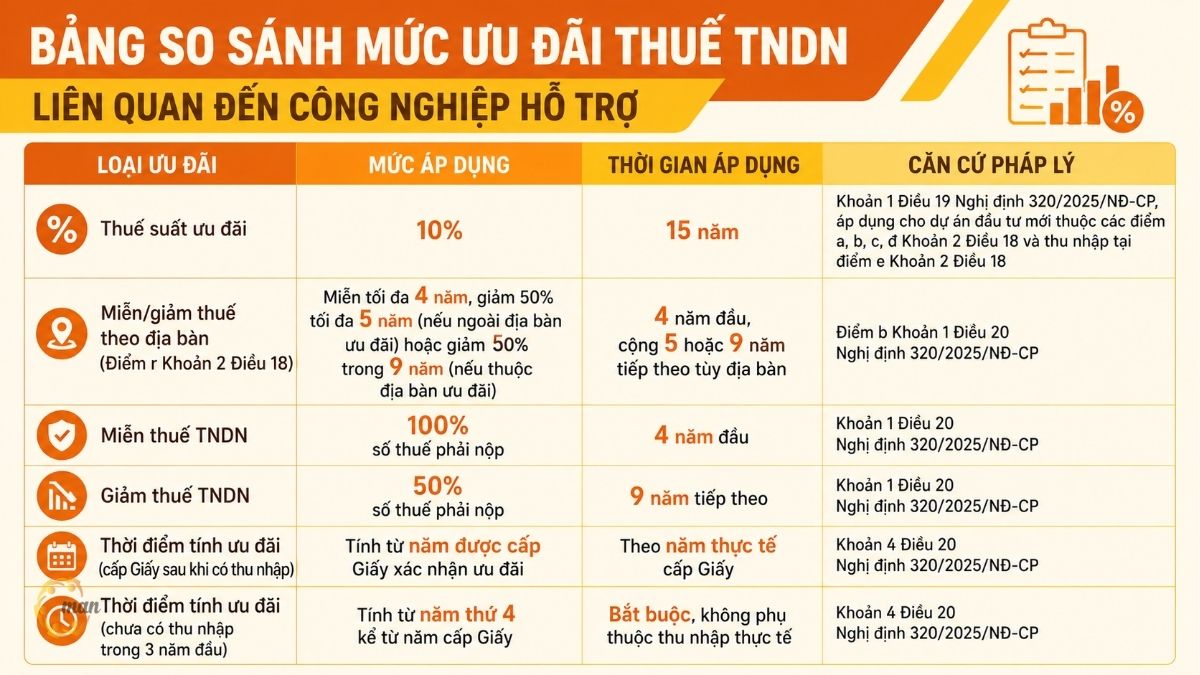
To determine the correct tax benefits, businesses need to understand each level of corporate income tax incentives for projects producing supporting industrial products. The table below summarizes the preferential tax rates, tax exemption and reduction periods, and the start dates of these incentives as stipulated in Decree 320/2025/ND-CP, helping businesses easily compare and apply them.
| Type of offer | Applicable level | Time of application | Legal basis |
| Preferential tax rate | 10% | 15 years | Clause 1 of Article 19 of Decree 320/2025/ND-CP applies to new investment projects under points a, b, c, and d of Clause 2, Article 18 and income under point e of Clause 2, Article 18. |
| Tax exemptions/reductions based on geographical area (Point r, Clause 2, Article 18) | Maximum 4 years of exemption, maximum 5 years of reduction in 50% (if outside the preferential area) or 9 years of reduction in 50% (if within the preferential area). | The first 4 years, plus 5 or 9 years thereafter, depending on the location. | Point b, Clause 1, Article 20 of Decree 320/2025/ND-CP |
| Corporate income tax exemption | 100% Tax payable | first 4 years | Clause 1, Article 20 of Decree 320/2025/ND-CP |
| Corporate income tax reduction | 50% Tax payable | The next 9 years | Clause 1, Article 20 of Decree 320/2025/ND-CP |
| Time of calculating benefits (issuing the Certificate after income is earned) | Starting from the year the Certificate of Preferential Treatment was issued | According to the actual year the Certificate was issued | Clause 4, Article 20 of Decree 320/2025/ND-CP |
| The incentive period begins when there is no income earned during the first 3 years. | Starting from the 4th year after the certificate was issued. | Mandatory, regardless of actual income. | Clause 4, Article 20 of Decree 320/2025/ND-CP |
Expert opinion: Common business risks when applying tax incentives for supporting industries.
Experts at MAN – Master Accountant Network With over 30 years of experience in auditing and tax consulting in Vietnam, we note several common risks faced by supporting industrial manufacturing businesses, especially FDI enterprises.
- Risk 1: Submitting the application for the Certificate of Preferential Treatment too late: Many businesses wait until their projects are fully operational before applying for tax incentives, resulting in the tax exemption period being calculated from the year the certificate is issued, missing out on the early years when high profits may have been generated. This is based on practical experience. MAN This shows that businesses that prepare their documentation in parallel with the factory construction investment process will significantly optimize their tax costs in Vietnam.
- Risk 2: Confusion between different types of offers when multiple criteria qualify: A project may qualify for both incentives based on investment location and incentives based on supporting industries. If accountants apply both types of incentives together instead of choosing the most favorable level as per the principle in Article 23 of Decree 320/2025/ND-CP, the enterprise risks being subject to retroactive tax collection during final settlement.
- Risk 3: Lack of documentation proving when income was generated: The tax authorities require businesses to clearly demonstrate which years had taxable income and which did not, in order to accurately determine the starting point for calculating tax exemptions and reductions. If accounting records are not clearly separated by fiscal year, businesses will find it difficult to defend their position regarding the application of tax incentives during a tax audit.
- Risk 4: Failure to update to the latest guidance documents: Decree 320/2025/ND-CP, effective from December 15, 2025, replaces many old regulations on corporate income tax incentives. Businesses applying under the old, expired regulations may incorrectly calculate the incentive level or application period. Solutions from MAN – Master Accountant Network This involves periodically reviewing all applicable legal grounds for each preferential project, avoiding tax risks arising from the use of outdated documents.
Conclude
Official document No. 4573/CT-CS is concrete evidence of how the tax authorities apply Decree 320/2025/ND-CP to business practices, especially the principle of determining the start date for calculating tax incentives. corporate income tax When the Certificate of Incentive is issued after the project has generated income, it serves as a useful reference document for supporting industrial manufacturing businesses that are in the process of applying for incentive permits or reviewing their tax records.
Tax services at MAN – Master Accountant Network
- Tax accounting services
- Tax consulting services
- Tax settlement services
- Tax reporting services
- VAT refund service
Service contact information at MAN – Master Accountant Network
- Address: No. 19A, Street 43, Tan Thuan Ward, Ho Chi Minh City
- Mobile/Zalo: 0903 963 163 – 0903 428 622
- E-mail: man@man.net.vn
- Google Business Profile: View MAN – Master Accountant Network's Google Business Profile
- LinkedIn Founder: View expert Le Hoang Tuyen's LinkedIn profile.
Responsible for production and professional content review by: Mr. Le Hoang Tuyen – Founder & CEO of MAN – Master Accountant Network, CPA Vietnam with over 30 years of experience in accounting, auditing, taxation, and corporate financial consulting.
Frequently Asked Questions about Official Letter No. 4573/CT-CS
Official Letter No. 4573/CT-CS issued by the Tax Department on July 6, 2026, directly responds to Jones & Vining (Vietnam) Co., Ltd. regarding corporate income tax policy for projects producing supporting industrial products.
This document is a specific response to a particular business and does not have the general effect of a law or decree. However, the legal principles contained herein may be useful for businesses in similar situations, and further consultation with the directly supervising tax authority is recommended.
According to Clause 4, Article 20 of Decree 320/2025/ND-CP, the tax exemption and reduction period is calculated from the year the enterprise is granted the Certificate or Confirmation of Preferential Treatment, not from the year it begins to generate income.
According to Decree 320/2025/ND-CP, businesses are entitled to apply the 10% tax rate for 15 years, be exempt from tax for 4 years, and receive a 50% reduction in the tax payable for the following 9 years, provided they meet all the prescribed conditions.
Businesses have the right to choose the most favorable incentive for the same income. If switching from the current incentive to a more favorable one, the number of years the previous incentive was applied must be deducted, according to the principle in Article 23 of Decree 320/2025/ND-CP. Which agency issued Official Document No. 4573/CT-CS?
Can other businesses apply the content of official letter 4573/CT-CS to their own cases?
How is the timing for calculating corporate income tax incentives determined if the incentive certificate is issued after income has already been generated?
What is the corporate income tax incentive rate for supporting industrial production projects?
What should a business do if it qualifies for multiple tax incentives?




