
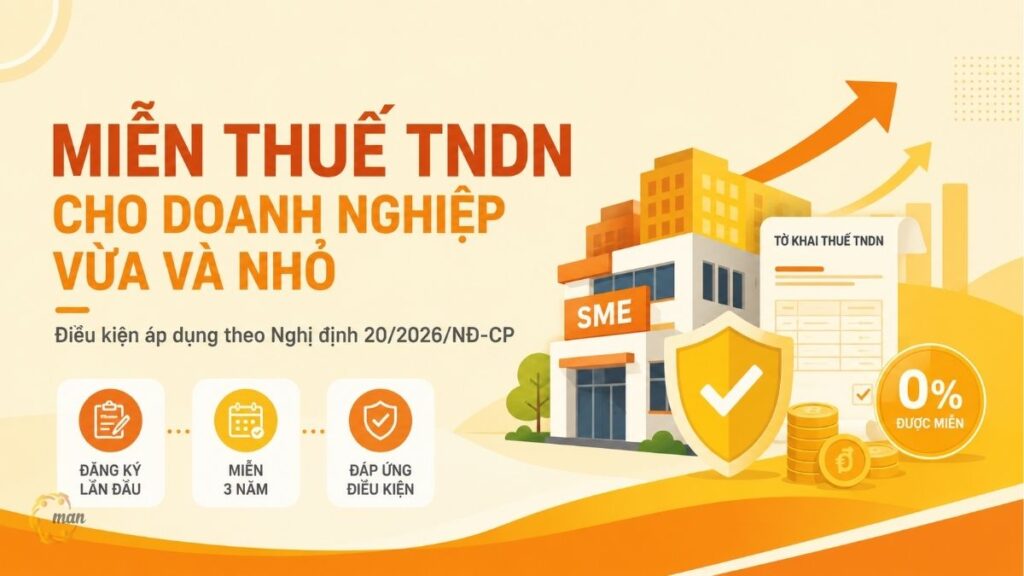
Corporate income tax exemption for small and medium-sized enterprises. This is a policy specifically stipulated in Decree 20/2026/ND-CP, This measure, effective from May 17, 2025, and applicable from the 2025 tax year, is a concrete step in implementing the spirit of Resolution 198/2025/QH15 on supporting the private sector, aiming to reduce the financial burden on newly established businesses in their initial operating phase, which is the most risky and financially stressful period.
With a team of tax and auditing consultants who have been operating in Vietnam for many years, MAN – Master Accountant Network It has been observed that many small business owners still confuse the tax exemption conditions under the old and new regulations, leading to incorrect declarations or missed benefits. This article provides a comprehensive analysis of the regulations in Decree 20/2026/ND-CP, from the scope of application and criteria for identifying small and medium-sized enterprises, to the exclusion cases that accountants need to pay special attention to.
| Corporate income tax exemption for small and medium-sized enterprises (SMEs) is a policy that exempts them from corporate income tax for three consecutive years, starting from the first year the enterprise is granted its initial business registration certificate. |
| Legal basis: Decree 20/2026/ND-CP, effective from May 17, 2025, applicable from the 2025 tax year. |
| Target audience: Micro, small, and medium-sized enterprises registering for the first time, including foreign-invested enterprises if they meet the specified criteria. |
| Exclusions: businesses established through mergers, divisions, changes in legal form, and certain specific income sources such as capital transfers, real estate transfers, and mineral transfers. |
| Businesses need to prepare documentation proving their scale criteria right from the registration stage to avoid being subject to retroactive tax collection during final settlement. |
What is corporate income tax exemption for small and medium-sized enterprises? Definition according to Decree 20/2026/ND-CP
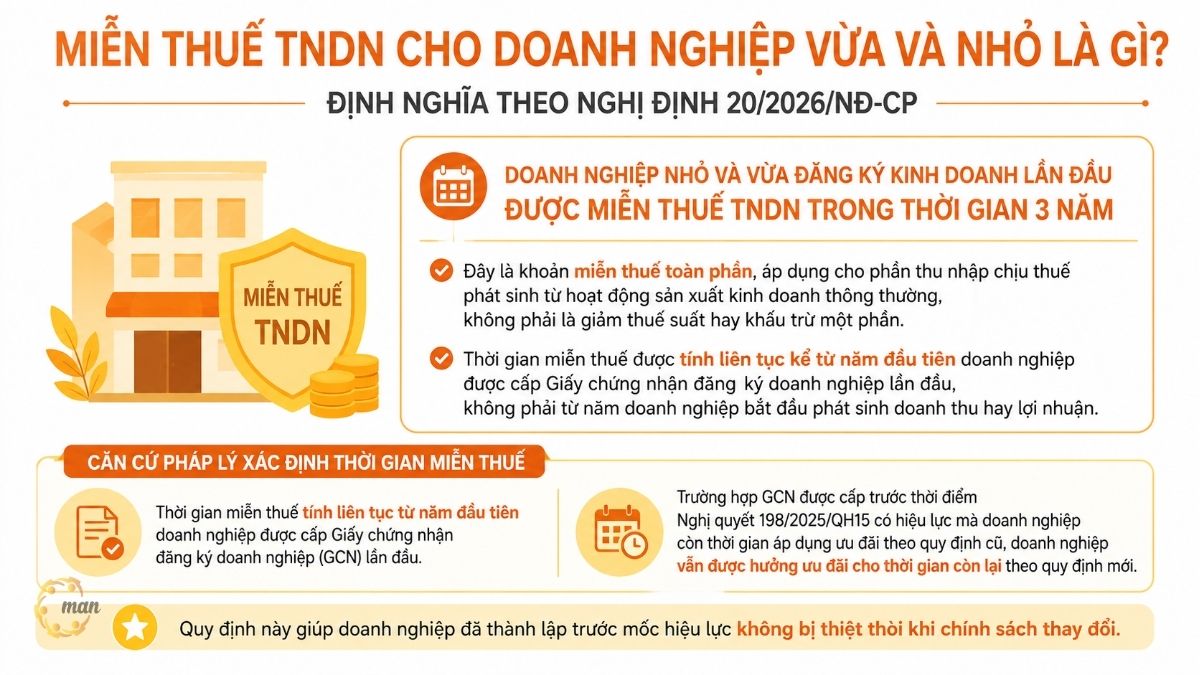
According to Decree 20/2026/ND-CP, small and medium-sized enterprises (SMEs) registering for the first time are exempt from corporate income tax for a period of 3 years. This is a full tax exemption, applicable to the taxable income arising from normal business operations, and is not a tax rate reduction or partial deduction.
The key point to understand is that the tax exemption period is calculated continuously from the first year the business is granted its initial business registration certificate, not from the year the business begins generating revenue or profit. This differs from some previous tax incentive policies which were calculated from the first year of taxable income.
Legal basis for determining the tax exemption period:
- The tax exemption period is calculated continuously from the first year the business is granted its initial Business Registration Certificate.
- In cases where the certificate was issued before the time Resolution 198/2025/QH15 If the old regulations are still in effect and the business has remaining time to apply for incentives, the business will still enjoy the incentives for the remaining period under the new regulations.
- This regulation helps ensure that businesses established before the effective date are not disadvantaged when the policy changes.
Why is exempting small and medium-sized enterprises from corporate income tax important for the economy?
Small and medium-sized enterprises (SMEs) account for a large proportion of the total number of businesses operating in Vietnam and are also the main job-creating sector in many localities. The first three years after establishment are usually a period when businesses have to invest heavily in machinery, personnel, and markets while revenue is not yet stable.
From this perspective MAN – Master Accountant Network, exemption corporate income tax During this phase, businesses can retain cash flow for reinvestment instead of having to pay taxes immediately upon making a profit. This is a key factor in increasing the survival rate of businesses through the initial phase, which is considered the phase with the highest dissolution rate in a business's lifecycle.
Which entities are eligible for corporate income tax exemption for small and medium-sized enterprises?
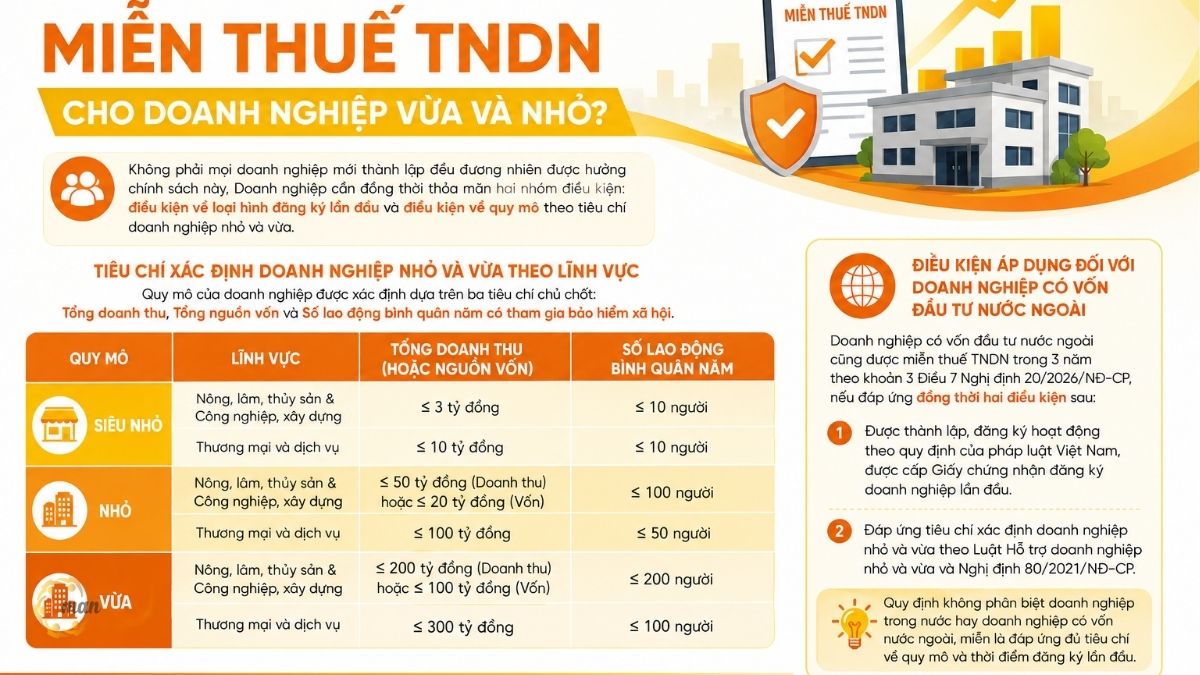
Not all newly established businesses are automatically eligible for this policy. Businesses need to simultaneously meet two sets of conditions: conditions regarding the type of initial registration and conditions regarding size according to the criteria for small and medium-sized enterprises.
Criteria for defining small and medium-sized enterprises by sector
The classification of micro, small, and medium-sized enterprises (MSMEs) is a crucial basis for applying state development support policies. According to regulations, the size of an enterprise is determined based on three key criteria: Total revenue, Total capital and Average number of employees per year They participate in social insurance.
To accurately determine scale, businesses need to keep the following principles in mind: You only need to meet one of the two financial conditions. (Total revenue or Total capital), combined with mandatory conditions regarding... Number of workers annual average.
| Scale | Field | Total revenue (or capital) | Average number of employees per year |
| Ultra small | Agriculture, forestry, fisheries & Industry, construction | ≤ 3 billion VND | ≤ 10 people |
| Trade and services | ≤ 10 billion VND | ≤ 10 people | |
| Small | Agriculture, forestry, fisheries & Industry, construction | ≤ 50 billion VND (Revenue) or ≤ 20 billion VND (Capital) | ≤ 100 people |
| Trade and services | ≤ 100 billion VND | ≤ 50 people | |
| Fit | Agriculture, forestry, fisheries & Industry, construction | ≤ 200 billion VND (Revenue) or ≤ 100 billion VND (Capital) | ≤ 200 people |
| Trade and services | ≤ 300 billion VND | ≤ 100 people |
Conditions applicable to foreign-invested enterprises
Foreign-invested enterprises are also exempt from corporate income tax for 3 years according to Clause 3, Article 7 of Decree 20/2026/ND-CP, if they simultaneously meet the following two conditions:
- Established and registered in accordance with Vietnamese law, and granted its first business registration certificate.
- Meeting the criteria for defining small and medium-sized enterprises according to the Law on Support for Small and Medium-Sized Enterprises and Decree 80/2021/ND-CP.
Therefore, the regulations do not differentiate between domestic and foreign-invested enterprises, as long as they meet the criteria regarding size and the time of initial registration.
When does a business begin to be eligible for tax-free periods?
The tax exemption period is calculated from the first year the business is granted its initial business registration certificate, regardless of whether the business generates revenue or profit in that year. This is a point that many novice accountants easily confuse with other corporate income tax incentives, which are calculated from the year taxable income is generated.
For businesses that were granted certificates before Resolution 198/2025/QH15 came into effect but still have remaining preferential treatment time according to previous regulations, they will continue to enjoy the preferential treatment for the remaining period, instead of having it abruptly cut off when the new policy is issued.
Legal documents related to corporate income tax exemption for small and medium-sized enterprises.
To determine whether a business is eligible for corporate income tax exemption for small and medium-sized enterprises (SMEs), several relevant legal documents need to be consulted. Specifically, Decree 20/2026/ND-CP stipulates the tax exemption policy, while the criteria for defining SMEs are guided by Decree 80/2021/ND-CP and the Law on Supporting Small and Medium-Sized Enterprises. The table below summarizes the important documents to refer to.
| Legal documents | Number / Effective Date | Related content |
| Decree 20/2026/ND-CP | Effective May 17, 2025, applicable from the 2025 tax year. | Regulations stipulate a 3-year corporate income tax exemption for newly registered small and medium-sized enterprises. |
| Resolution 198/2025/QH15 | National Assembly enacted in 2025 | The political and legal basis for policies supporting the private sector. |
| Law on Corporate Income Tax No. 67/2025/QH15 | National Assembly enacted in 2025 | Clause 3 of Article 18 stipulates income not eligible for tax exemption. |
| Law on Supporting Small and Medium-Sized Enterprises | Reference | Basis for determining criteria for small and medium-sized enterprises |
| Decree 80/2021/ND-CP | August 26, 2021 | Detailed guidelines on criteria for identifying small and medium-sized enterprises. |
Important Note: Businesses need to compare both Decree 20/2026/ND-CP and Decree 80/2021/ND-CP when determining whether they qualify as small and medium-sized enterprises, as the classification criteria are detailed in separate guidance documents and are not entirely repeated in the tax decrees.
In which cases is the corporate income tax exemption for small and medium-sized enterprises not applicable?
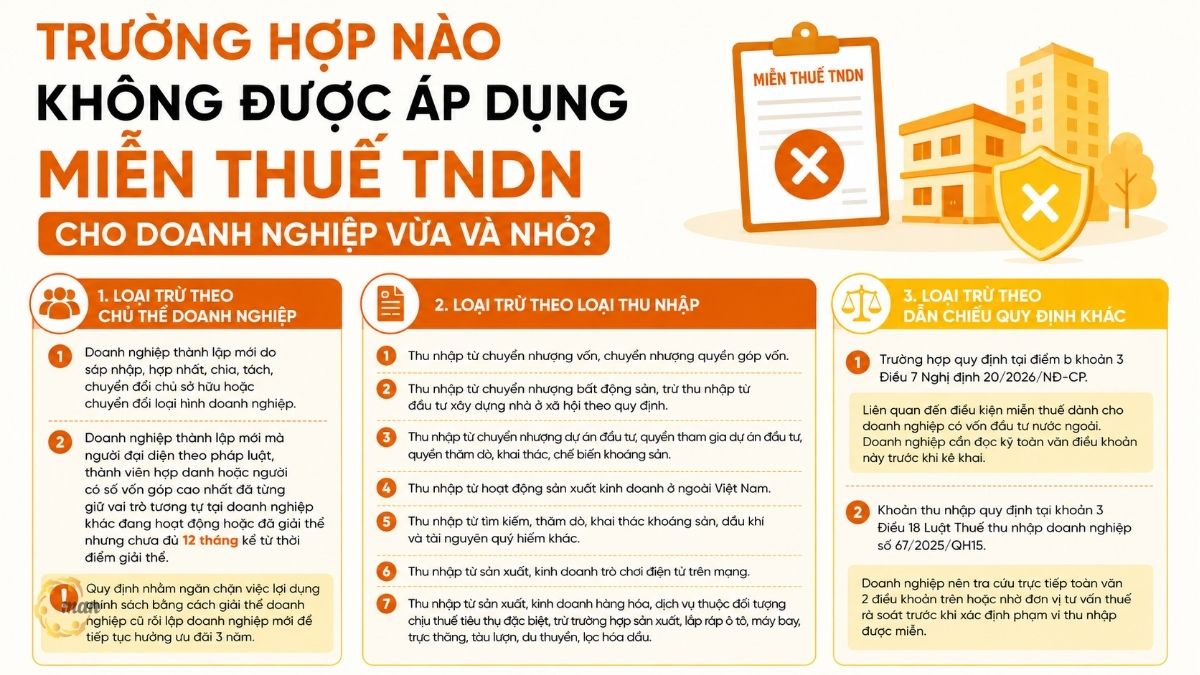
This is the section that businesses need to read most carefully because the scope of exclusions is quite broad, including exclusions by subject and exclusions by type of income.
Exclusion by business entity
- Newly established businesses result from mergers, consolidations, divisions, separations, changes in ownership, or changes in business type.
- Newly established businesses where the legal representative, general partner, or the person with the highest capital contribution has previously held a similar role in another business that is currently operating or has been dissolved but less than 12 months have passed since the dissolution.
This regulation aims to prevent the abuse of the policy by dissolving old businesses and then establishing new ones to continue enjoying the 3-year preferential treatment.
Exclusion by income type
Even if a business is eligible for tax exemption, some income is not subject to the exemption, including:
- Income from the transfer of capital and the transfer of equity rights.
- Income from the transfer of real estate, excluding income from investment in the construction of social housing as stipulated.
- Income from the transfer of investment projects, the right to participate in investment projects, and the right to explore, exploit, and process minerals.
- Income derived from business activities conducted outside Vietnam.
- Income from the search, exploration, and exploitation of minerals, oil, gas, and other rare resources.
- Income from the production and sale of online video games.
- Income from the production and sale of goods and services subject to excise tax, except for the production and assembly of automobiles, airplanes, helicopters, gliders, yachts, and petrochemicals.
Exclusions as otherwise stipulated.
In addition to the above-mentioned list of income categories, Decree 20/2026/ND-CP also specifies two cases where tax exemption does not apply, which businesses need to directly compare with the original documents:
- This applies to the case stipulated in point b, clause 3, Article 7 of Decree 20/2026/ND-CP. This is an exclusion clause associated with the tax exemption conditions for foreign-invested enterprises mentioned above; enterprises should carefully read the full text of this clause before filing their tax returns.
- Income as stipulated in Clause 3, Article 18 of the Corporate Income Tax Law No. 67/2025/QH15.
Since these two references are not detailed within the scope of this article's summary, MAN recommends that businesses, especially those with foreign investment, should directly consult the full text of these two provisions or have a tax consultant review them before determining the scope of income eligible for exemption.
Case Study: How do service-based startups in Ho Chi Minh City apply for tax exemptions?
Background
Company Y Limited operates in the field of technology consulting services and was granted its initial business registration certificate in June 2025 in Ho Chi Minh City. Its first-year revenue was approximately 12 billion VND, with a total registered capital of 5 billion VND, employing 25 workers covered by social insurance.
Process according to the new regulations.
Based on the criteria for small and medium-sized enterprises in the trade and service sector, the company falls into the small enterprise category with revenue below 100 billion VND and fewer than 50 employees. According to advice from MAN – Master Accountant Network, the company is implementing three main steps to ensure compliance with regulations.
Step one: Maintain complete documentation proving the scale of the business, including financial statements and a list of employees participating in social insurance. Step two: Clearly state in the 2025 corporate income tax return that the business is exempt from tax under Decree 20/2026/ND-CP. Step three: Verify the legal representative to confirm they do not fall under any exclusions due to the dissolution of another business within the last 12 months.
The measured results
- The company will not have to pay corporate income tax in the 2025 fiscal year, equivalent to an estimated saving of over 400 million VND based on taxable profits.
- The retained funds were used to expand the technical team, instead of having to balance cash flow to pay taxes in the first year of operation.
- Having complete documentation proving the size of the business prepared from the outset helps to avoid any problems with the tax authorities during the tax settlement process.
Summary table of criteria for small and medium-sized enterprises by sector
According to Decree 80/2021/ND-CP, small and medium-sized enterprises (SMEs) are classified by their business sector, total revenue, total capital, and number of employees participating in social insurance. Accurately determining the size of the enterprise is a crucial factor in considering eligibility for corporate income tax exemption. The table below summarizes the classification criteria for each sector.
| Field | Classify | Total revenue | Or total capital | Total workforce |
| Agriculture, forestry, and fisheries; industry and construction | Ultra small | Not more than 3 billion VND | Not more than 3 billion VND | No more than 10 people |
| Agriculture, forestry, and fisheries; industry and construction | Small | Not exceeding 50 billion VND | Not exceeding 20 billion VND | No more than 100 people |
| Agriculture, forestry, and fisheries; industry and construction | Fit | Not exceeding 200 billion VND | Not exceeding 100 billion VND | No more than 200 people |
| Trade and services | Ultra small | Not exceeding 10 billion VND | Not more than 3 billion VND | No more than 10 people |
| Trade and services | Small | Not exceeding 100 billion VND | Not exceeding 50 billion VND | No more than 50 people |
| Trade and services | Fit | Not exceeding 300 billion VND | Not exceeding 100 billion VND | No more than 100 people |
Expert opinion: Common business risks when applying corporate income tax exemption for small and medium-sized enterprises.
Experts at MAN – Master Accountant Network With over 30 years of practical experience in auditing and tax consulting in Vietnam, we note four main risks that businesses often face.
- Risk 1: Confusion regarding the tax-free period calculation: Many businesses believe that the tax exemption period starts from the first year of profitability, while the actual regulation states it starts from the year the certificate is first issued. If a business incurs losses in the first year and becomes profitable from the second year onwards, the tax exemption period is still only 2 years instead of the full 3 years from the year of profitability.
- Risk 2: Failure to review the legal representative's background check: If the legal representative or highest-ranking contributing member previously held a similar role in a dissolved enterprise less than 12 months ago, the new enterprise will not be eligible for tax exemption, even if it meets the size criteria. This is a point that is easily overlooked when establishing a new enterprise after restructuring.
- Risk 3: Incorrectly identifying the type of income eligible for exemption: Some businesses apply tax exemptions to income from real estate transfers or capital transfers, even though these are excluded under regulations. When tax authorities conduct an audit, the business must pay the incorrectly exempted tax amount along with late payment penalties.
- Risk 4: Lack of documentation demonstrating scale criteria: The tax authorities may require businesses to prove they are small and medium-sized enterprises (SMEs) through financial statements, lists of employees participating in social insurance, and accounting records. From MAN's perspective, businesses should keep these records alongside their annual tax returns to avoid having to search for old documents only when audited.
Conclude
The exemption of corporate income tax for small and medium-sized enterprises (SMEs) under Decree 20/2026/ND-CP is a practical support policy, helping newly established businesses gain additional financial resources in their initial stages of operation. However, the scope of application is subject to many specific conditions and exclusions, requiring businesses to thoroughly understand the regulations and prepare complete supporting documents from the moment of business registration.
With over 1000 clients returning for a second time in the past year, this is concrete evidence of the quality of consulting that MAN pursues. For specific support tailored to your business, please contact MAN – Master Accountant Network for a free consultation.
Tax services at MAN – Master Accountant Network
- Tax accounting services
- Tax consulting services
- Tax settlement services
- Tax reporting services
- VAT refund service
Service contact information at MAN – Master Accountant Network
- Address: No. 19A, Street 43, Tan Thuan Ward, Ho Chi Minh City
- Mobile/Zalo: 0903 963 163 – 0903 428 622
- E-mail: man@man.net.vn
- Google Business Profile: View MAN – Master Accountant Network's Google Business Profile
- LinkedIn Founder: View expert Le Hoang Tuyen's LinkedIn profile.
Responsible for production and professional content review by: Mr. Le Hoang Tuyen – Founder & CEO of MAN – Master Accountant Network, CPA Vietnam with over 30 years of experience in accounting, auditing, taxation, and corporate financial consulting.
Frequently Asked Questions about Corporate Income Tax Exemption for Small and Medium-Sized Enterprises
Yes. The tax exemption period is calculated continuously from the year the business registration certificate is first issued, regardless of whether the business has generated revenue or not.
Yes, if the business is established under Vietnamese law, has been granted its first business registration certificate, and meets the criteria for small and medium-sized enterprises according to Decree 80/2021/ND-CP.
No. Newly established businesses resulting from division, separation, merger, consolidation, or conversion of business type are not eligible for this tax exemption policy.
Businesses are still entitled to tax exemption for the remaining period if the previously stipulated incentive period is still in effect at that time.
No, except for income from investment in the construction of social housing as stipulated by law. Are newly established businesses that have not yet generated revenue eligible for a tax-free period?
Are foreign-invested enterprises eligible for corporate income tax exemption for small and medium-sized enterprises?
Are businesses established by splitting from a parent company exempt from taxes?
What happens if a business was granted a business registration certificate before Resolution 198/2025/QH15 came into effect?
Are income from the transfer of real estate by small and medium-sized enterprises exempt from tax?