
The entities subject to contractor tax include foreign organizations and individuals who generate income in Vietnam through contracts and business agreements with domestic partners. According to Circular 103/2014/TT-BTC, Accurately identifying this entity is a crucial first step for businesses to fulfill their budgetary obligations and effectively manage tax risks.
With the digital economy and international trade booming in 2026, cross-border transactions are becoming more complex than ever. Without a clear understanding of their nature and scope, Vietnamese businesses can easily fall into the trap of underreporting, leading to unfortunate tax arrears and administrative penalties from tax authorities.
Summary of key aspects regarding the taxable subjects of contractor tax.
The entities subject to contractor tax are foreign entities (organizations or individuals) that do not have legal personality in Vietnam but conduct business or generate income in Vietnam through contracts signed with Vietnamese partners.
These entities are subject to value-added tax and corporate income tax based on their revenue. Vietnamese businesses are obligated to deduct, declare, and pay contractor tax on behalf of their foreign partners before making payments.
Overview of the subjects liable to contractor tax

Understanding the correct scope of application is fundamental to financial management. Contractor tax, or more precisely, tax on foreign contractors (FCT), is not a new type of tax, but its application is frequently changed based on practical guidance documents.
The legal nature of contractor tax in Vietnam
Essentially, this is a tax applied to money flows from Vietnam to abroad in the form of payments for services, royalties, goods with accompanying services, or cross-border business activities. The Vietnamese tax authorities apply this tax to ensure fairness in the business environment, when foreign entities benefit from the Vietnamese market.
At MAN – Master Accountant Network, we always remind our clients that the absence of a permanent establishment in Vietnam does not mean that foreign partners are exempt from tax obligations. This is a common misconception that leads to many violations.
Why Vietnamese businesses need to pay special attention
When signing a contract, if you skip the step of identifying the contractor liable for tax, the actual project costs will skyrocket if the foreign partner demands a NET price (price after tax). At this point, the Vietnamese business will have to pay the tax out of pocket, significantly reducing profit margins. Furthermore, delays or errors in declarations can result in these costs being excluded when calculating corporate income tax, causing a double financial burden.
Details of entities subject to contractor tax according to current regulations.
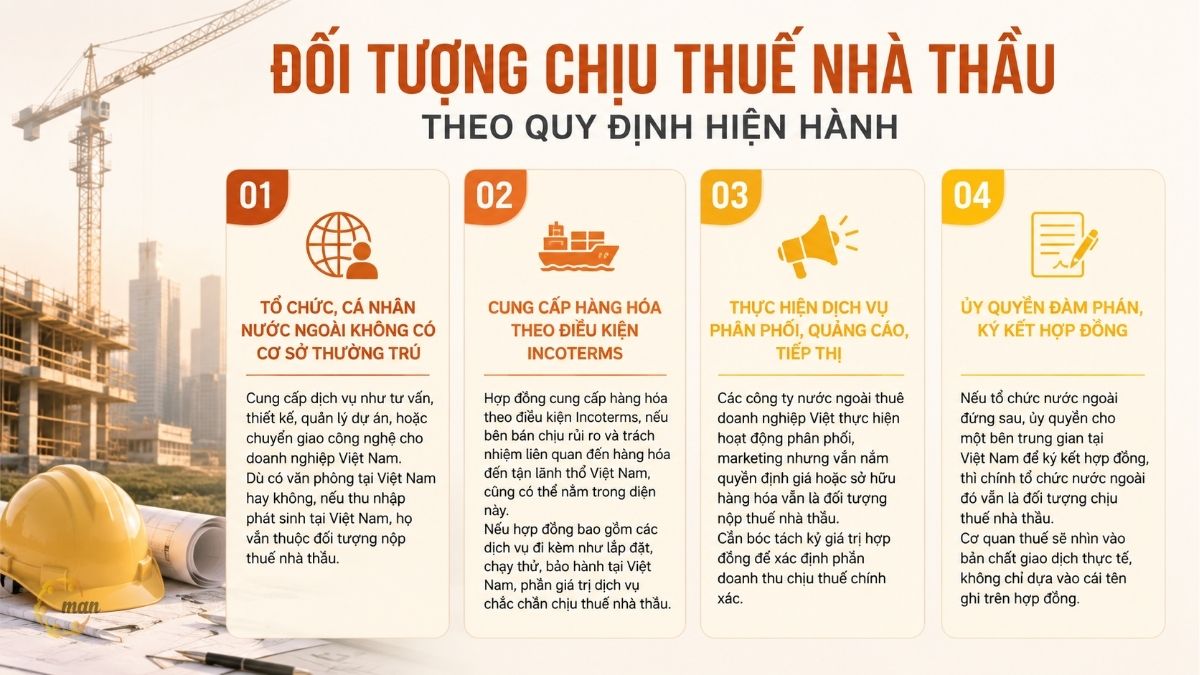
Vietnamese law categorizes various groups of entities in considerable detail. Understanding these groups allows purchasing and accounting staff to quickly identify risks right from the contract negotiation stage.
- Group of foreign organizations and individuals without a permanent establishment: This is the most common group. These foreign businesses provide services such as consulting, design, project management, or technology transfer to Vietnamese businesses. Whether or not they have offices in Vietnam, if income is generated in Vietnam, they are still subject to contractor tax.
- The group supplying goods under Incoterms conditions: Don't mistakenly think that only services are subject to contractor tax. Contracts for the supply of goods under Incoterms, if the seller assumes all risks and responsibilities related to the goods up to the territory of Vietnam, may also fall under this category. In particular, if the contract includes accompanying services such as installation, commissioning, and warranty services in Vietnam, the value of those services will certainly be subject to contractor tax.
- The team provides distribution, advertising, and marketing services: Foreign companies that hire Vietnamese businesses to perform distribution and marketing activities, but still retain the right to set prices or own the goods, are subject to contractor tax. This is a complex case, requiring accountants to carefully break down the contract value to determine the exact taxable revenue.
- Cases where authorization to negotiate and sign contracts is required: If a foreign organization acts as the intermediary in Vietnam to sign the contract, that foreign organization is still subject to contractor tax. The tax authorities will look at the actual nature of the transaction, not just the name on the contract.
See more articles: Official Document 1918/CT-CS: Corporate Income Tax for Foreign Contractors 2026
Criteria for determining entities subject to contractor tax in 2026
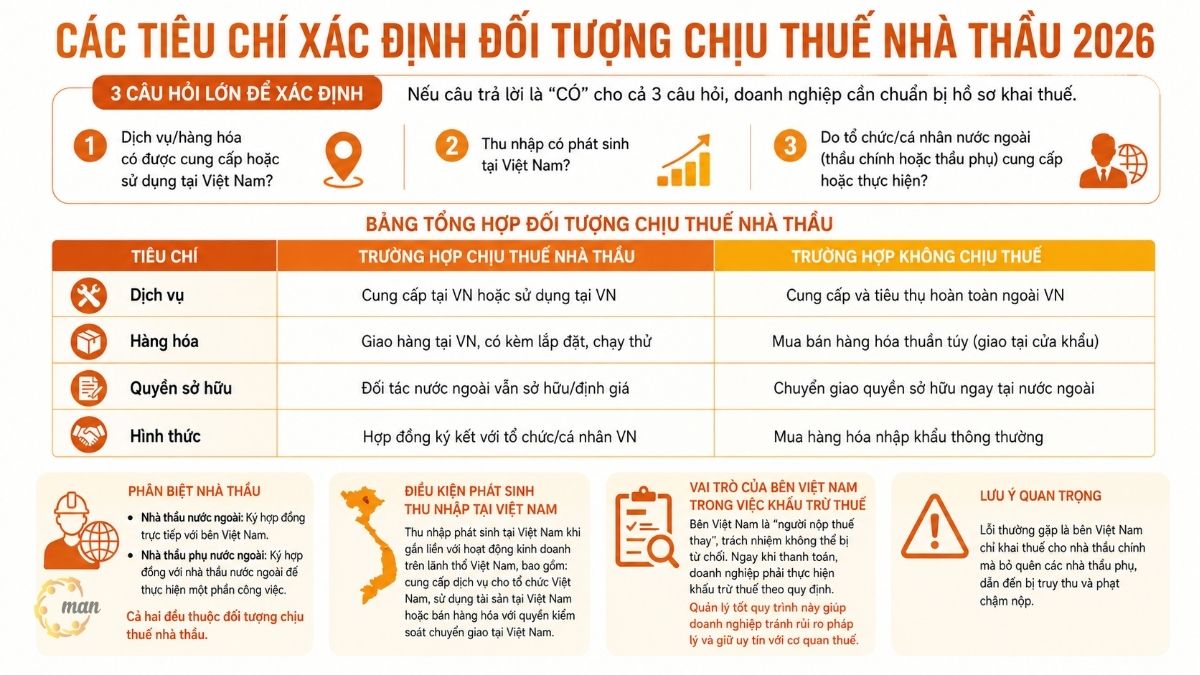
To determine this accurately, you need to ask three major questions for each international contract. If the answer is "yes" to all three, the business needs to prepare tax returns. Below is a summary table for quick reference.
Quick Summary Table: Contractor Taxable Entities
To determine whether a transaction is subject to contractor tax, businesses need to consider the nature of the service, the place of consumption, the method of delivery, and ownership of the goods. The table below summarizes common cases according to current regulations, helping businesses easily compare and assess their tax obligations.
| Criteria | Cases subject to contractor tax | Cases not subject to tax |
| Service | Supplied in Vietnam or for use in Vietnam | Supply and consumption are entirely outside of Vietnam. |
| Goods | Delivery within Vietnam, including installation and testing. | Purely commercial trade (delivery at the border) |
| Ownership | The foreign partner still owns/values the property. | Transfer of ownership directly abroad. |
| Form | Contract signed with Vietnamese organization/individual | Purchase regular imported goods. |
Distinguishing between foreign contractors and subcontractors.
A foreign contractor is an entity that signs a contract directly with a Vietnamese party. A foreign subcontractor is an entity that signs a contract with a foreign contractor to perform a part of the work. Both are subject to contractor tax. Experts at MAN – Master Accountant Network note that a common mistake is for Vietnamese parties to only declare taxes for the main contractor while neglecting subcontractors, leading to back taxes and penalties for late payment.
Conditions for generating income in Vietnam
Income is considered to arise in Vietnam when it is related to business activities taking place within the territory of Vietnam. This includes providing services to Vietnamese organizations, using assets in Vietnam, or selling goods under conditions where control of the goods is transferred in Vietnam.
The role of the Vietnamese side in tax deduction.
The Vietnamese party acts as the "taxpayer on behalf of the taxpayer." This responsibility cannot be refused. Upon payment, the business must deduct the tax. Professional management of this process helps businesses avoid legal complications and maintain credibility with the tax authorities.
How to calculate contractor tax in 2026 and methods of declaration.
Contractor tax (FCT) includes VAT and Corporate Income Tax calculated at a rate of 1% VAT to 3% VAT on revenue. If the contract stipulates that the Vietnamese party is responsible for the tax (NET price), the Vietnamese enterprise must perform a reverse conversion (Gross-up). Contractor tax calculation formula 2026 as follows:
Calculation formula for GROSS price contracts
The contract price includes tax. Foreign contractors are responsible for paying taxes.
- VAT payable = Taxable revenue × VAT rate (1% VAT rate)
- Corporate income tax payable = Taxable revenue × Corporate income tax rate (1% tax rate = 3% tax rate)
Formula for calculating NET Price for contracts
The contract price excludes tax. The Vietnamese company pays the tax on behalf of the company. To calculate the correct amount of tax payable, the gross revenue (including tax) must be calculated first using the following formula:
- Taxable revenue (Gross) = Contract value (NET) / (1 – (VAT rate + Corporate income tax rate))
- VAT payable = Taxable revenue × VAT rate (1% VAT rate)
- Corporate income tax payable = Taxable revenue × Corporate income tax rate (1/3/2000)
The % tax rate is commonly used for calculating taxes on revenue.
The applicable tax rates are based on the business sector as stipulated in Circular 103/2014/TT-BTC:
| Business lines | VAT rate % | Corporate income tax rate % |
| Services (Consulting, marketing, advertising, technical support, etc.) | 5% | 5% |
| Machinery and equipment rental; insurance | 5% | 5% |
| Copyright (License) | Not subject to VAT | 10% |
| Trade (Distribution and supply of goods in Vietnam) | 1% | 1% |
| Construction and installation (including materials supply) | 3% | 2% |
Regulations on tax declaration and payment
- Declaration documents: Use the Contractor Tax Declaration Form 01/NTNN. Circular 80/2021/TT-BTC.
- Deadline: Filing is required for each transaction (no later than the 10th day) or monthly (the 20th of the following month).
- Note: Cross-border transactions with digital platforms or e-commerce businesses are now subject to updated revenue regulations to align with the digital economy.
The practical risks of misidentifying the contractor tax liability.
Misidentifying the target is not just a procedural issue; it's a direct cash flow risk.
- Consequences of failing to deduct taxes on time: The tax authorities have the right to assess taxes if they discover that a business has not fully declared its taxes. In addition to the principal tax amount, businesses also face penalties for late payment and administrative fines for incorrect declarations. Sometimes, the penalty can amount to 20% on the amount of tax underpaid.
- Common mistakes in international contract management: The most common mistake is confusing outsourced services with contractor tax-taxable services. For example, purchasing software licenses is sometimes mistakenly considered a licensing fee (subject to contractor tax) instead of a regular commodity. This lack of understanding of the definition leaves businesses vulnerable when tax authorities audit their tax returns.
- A perspective on risk management from MAN – Master Accountant Network: Based on the experience of our team of experts with over 30 years of practical experience at MAN, the biggest risk lies in lump-sum contracts. If the contract does not clearly specify tax liability, or if it is unclear, the Vietnamese party often bears the burden of the resulting contractor tax. We advise businesses to review all existing contracts and renegotiate tax terms as soon as possible.
Case Study: Lessons Learned from Business Practice
To clarify further, let's look at a typical example that we have previously assisted in processing.
A scenario where a business imports software from abroad.
Company A in Vietnam purchased management software from a company in Singapore. The contract only stated a unit price of USD 50,000. Company A thought this was a normal purchase of goods and only needed to complete customs procedures. However, according to regulations, this activity included granting the right to use the software, and therefore is subject to contractor tax.
Expert solutions for turnkey contracts.
When the tax authorities conducted an audit, Company A was ordered to pay back contractor tax for the entire contract value. At MAN – Master Accountant Network, we helped this company explain the situation by separating the value of the software (goods) from the value of the accompanying technical support services, thereby minimizing the amount of tax payable. The lesson here is to always separate the value of services and goods right from the contract drafting stage.
Key circulars and legal documents to note
Having a legal roadmap will help you avoid getting lost. Below are the documents you should keep in your filing cabinet.
- Circular 103/2014/TT-BTC serves as a guiding principle: This is the original document guiding contractor tax. All concepts, tax calculation methods, and taxable subjects originate from here. Despite its age, this circular remains an irreplaceable foundation.
- Revised documents and updated guidance letters 2026: Besides the original circular, you need to monitor the General Department of Taxation's official documents providing guidance for specific cases such as cross-border e-commerce and advertising services on social media platforms. These documents are usually highly up-to-date and reflect changes in business practices.
Conclude
Correctly identifying the taxable contractor not only helps businesses comply with the law but also optimizes costs effectively. A well-negotiated contract with clear tax terms will protect businesses from unnecessary financial risks. Don't let regulatory ambiguity hinder your growth.
At MAN – Master Accountant Network, with over 30 years of practical experience, we partner with businesses to review contracts, optimize tax obligations, and build robust risk management systems. If you need advice, please contact us. tax settlement services, tax reporting services Whether you require any in-depth accounting solution, our team of experts is always ready to assist you, ensuring complete peace of mind for your business.
Service contact information at MAN – Master Accountant Network
- Address: No. 19A, Street 43, Tan Thuan Ward, Ho Chi Minh City
- Mobile/Zalo: 0903 963 163 – 0903 428 622
- E-mail: man@man.net.vn
- Google Business Profile: View MAN – Master Accountant Network's Google Business Profile
- LinkedIn Founder: View expert Le Hoang Tuyen's LinkedIn profile.
Responsible for production and professional content review by: Mr. Le Hoang Tuyen – Founder & CEO of MAN – Master Accountant Network, CPA Vietnam with over 30 years of experience in accounting, auditing, taxation, and corporate financial consulting.
Frequently Asked Questions about Contractor Taxpayers
No, if the delivery ends at a foreign border crossing and the Vietnamese party is solely responsible for importing the goods.
The Vietnamese party will be responsible for paying the tax. The tax will be calculated based on the revenue converted from net price to gross price.
The VAT already paid by the contractor may be deductible if the business meets all the requirements regarding invoices, supporting documents, and its business activities are subject to VAT.
The corporate income tax rate is typically 10% of the total taxable revenue and the value-added tax rate is 5% of the total taxable revenue.
The deadline for filing tax returns for each transaction is the 10th day from the date the tax liability arises. Are contractor taxes payable when purchasing goods purely from overseas?
If the contract specifies a net price, who is responsible for the contractor tax?
Is it possible to deduct the contractor tax already paid from input tax?
What is the contractor tax rate for software services?
What is the deadline for submitting contractor tax returns?