

Tax accounting services for sole proprietorships are witnessing a historic change from January 1, 2026, when the lump-sum tax system is officially abolished in Vietnam. All individual business households, from small to large scale, must completely switch to a self-declaration and self-payment method based on actual invoices and documents. This new legal context forces shop owners and online shop owners to quickly familiarize themselves with maintaining accounting records and issuing electronic invoices.
Adapting quickly to new regulations helps businesses avoid heavy administrative penalties from tax authorities. To help business owners struggling with complex procedures, this article will analyze in detail the latest bookkeeping management process and tax obligations. From there, you will find the optimal solution to maintain smooth business operations while ensuring full compliance with current laws.
What is tax accounting for sole proprietorships and why is it mandatory under the new 2026 law?
When it comes to tax accounting for sole proprietorships, many people still think it's optional or only applicable to large businesses. However, since January 1, 2026, this notion is completely inaccurate as the government's tax management regulations have become stricter.
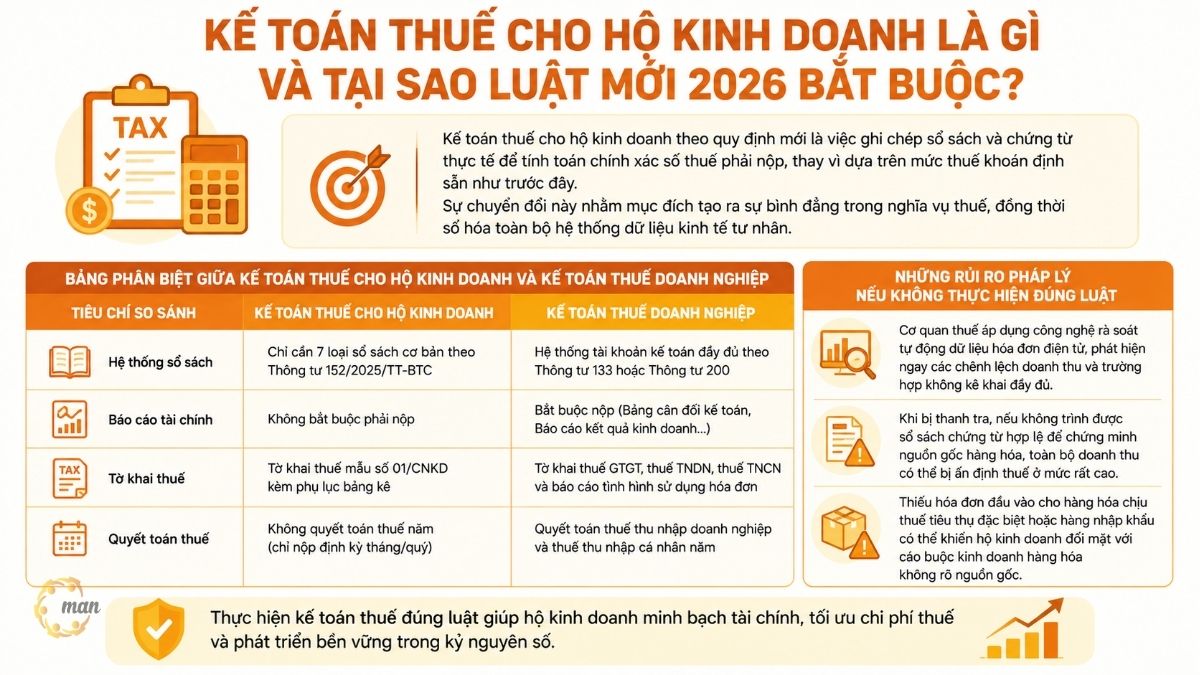
The essence of tax accounting for household businesses under the new regulations is the recording of actual books and documents to accurately calculate the amount of tax payable, instead of relying on a predetermined flat tax rate as before. This shift aims to create equality in tax obligations and simultaneously digitize the entire private economic data system.
The difference between tax accounting for sole proprietorships and tax accounting for businesses.
Compared to corporate accounting, tax accounting Household businesses have a simpler accounting system structure but require a very high level of document updating. Household businesses are not required to prepare year-end financial statements or perform complex closing entries like joint-stock companies or limited liability companies.
However, the requirements regarding the legality of input invoices, the timing of output invoice issuance, and the accuracy of actual revenue are just as strict as those for corporate tax accounting. Below is a detailed comparison table between the two types to help homeowners easily understand:
| Comparison criteria | Tax accounting for sole proprietorships | Corporate tax accounting |
| Accounting system | Just 7 basic types of accounting records are needed. Circular 152/2025/TT-BTC | A complete accounting chart of accounts according to Circular 133 or Circular 200 |
| Financial report | Not required to submit | Mandatory submission (Balance Sheet, Income Statement, etc.) |
| Tax return | Tax return form No. 01/CNKD with attached appendix | Declaration VAT, corporate income tax, personal income tax and report on invoice usage. |
| Tax settlement | No annual tax settlement (only monthly/quarterly tax payments). | Corporate income tax settlement and personal income tax year |
Legal risks of not properly performing tax accounting for sole proprietorships.
Failure to maintain accurate tax accounting for household businesses can lead to extremely serious financial consequences for the business owner. Tax authorities now employ automated electronic invoice data review technology, enabling immediate detection of revenue discrepancies and cases of incomplete declarations.
During an inspection, if a business cannot present valid accounting records and documents to prove the origin of its goods, the entire revenue may be subject to a very high tax rate. Furthermore, the lack of input invoices for goods subject to excise tax or imported goods could lead to accusations of trading goods of unknown origin.
What are the common legal risks and tax penalties for sole proprietorships?
Many household owners still maintain the habit of keeping simple notebooks or selling goods without issuing invoices because they believe it is difficult for tax authorities to monitor. In reality, modern management processes have directly linked data from the household owner's bank account with the tax authorities to verify the actual flow of money.
From the perspective of MAN – Master Accountant Network, a unit with over 30 years of experience in auditing and tax consulting in Vietnam, the biggest risk for household businesses today is a lack of understanding of tax filing deadlines and how to handle daily generated electronic invoices.
Administrative penalties for late submission of tax returns and electronic invoices.
Decree 125/2020/ND-CP The government stipulates very heavy penalties for errors related to tax declarations and invoices. For submitting tax returns after the deadline, the fine ranges from VND 2,000,000 to VND 25,000,000 depending on the number of days of delay.
For electronic invoices, issuing invoices at the wrong time or failing to issue invoices when selling goods or services can result in fines ranging from VND 3,000,000 to VND 8,000,000 for each violation. These are significant amounts that can directly erode the entire monthly profit of a small or medium-sized business.
Risks arising from the inability to prove the origin of raw materials.
A classic mistake that online shop owners often make is importing raw materials from wholesale markets, unofficial sources, or processing factories without proper invoices. When self-declaring taxes, all purchase expenses that are to be recognized as legitimate for tax deduction purposes must be accompanied by a valid purchase invoice.
Without valid input invoices, household businesses will have to pay taxes based on gross revenue without being able to deduct the cost of goods sold. This leads to a situation of "false profit, real loss" as the taxes payable erode the working capital of the household business.
What are the steps involved in the self-service tax accounting process for sole proprietorships?
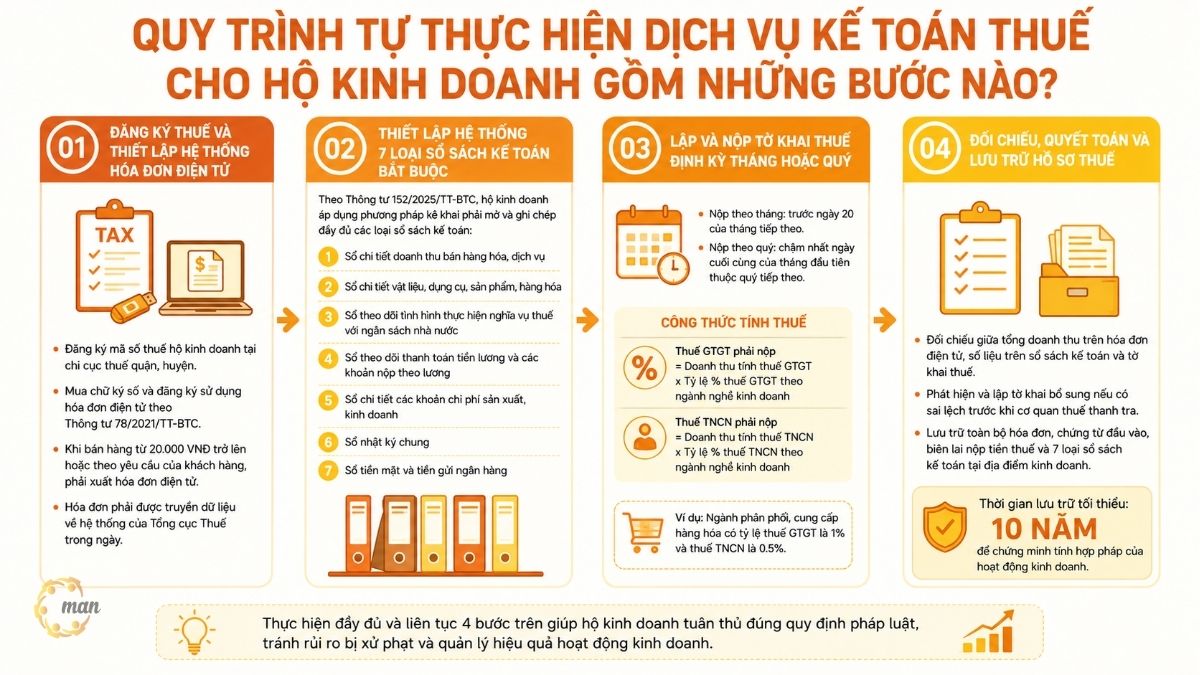
To manage tax accounting for a sole proprietorship, the business owner needs to adhere to a standardized and consistent process on a daily and monthly basis. Any disruption at any stage will create data gaps, causing significant difficulties when reconciling end-of-period figures with the relevant tax authorities.
Step 1: Register for tax and set up the electronic invoicing system.
Immediately after receiving the business registration certificate, the household business owner must register for a business tax code at the district or county tax office where the business is located. After obtaining the tax code, you need to purchase a digital signature specifically for household businesses and register to use electronic invoices according to Circular 78/2021/TT-BTC through a licensed solution provider.
When selling any item valued at VND 20,000 or more, or upon customer request, business households must issue electronic invoices. These invoices must be transmitted directly to the General Department of Taxation's system on the same day to ensure their validity.
Step 2: Set up the system of 7 mandatory accounting books.
According to Circular 152/2025/TT-BTC, business households applying the mandatory declaration method must open and maintain complete accounting books. The process of preparing accounting books for business households requires meticulous attention to detail to match the actual inventory levels with invoices. These books include:
- The detailed sales revenue ledger for goods and services is used to record daily invoice revenue.
- The detailed inventory ledger for materials, tools, products, and goods is used to track inventory levels and the cost of goods sold.
- The register for tracking tax obligations to the state budget records the amount of tax paid and the amount still owed.
- A payroll and related payment tracking ledger is used to control the personnel costs of a household business.
- The detailed ledger of production and business expenses is used to accumulate costs for rent, utilities, and transportation.
- A general ledger is used to track all transactions in chronological order.
- Cash and bank deposit ledgers are used to reconcile the cash balances and payment accounts of the business household.
Step 3: Prepare and submit your monthly or quarterly tax return.
Household businesses that meet the large-scale criteria or choose to pay taxes monthly must file their tax returns before the 20th of the following month. Other households will file quarterly, with the deadline for submission being the last day of the first month of the following quarter.
The basic tax calculation formula for household businesses using the declaration method is as follows:
- VAT payable = Taxable revenue x VAT rate based on business sector
- Personal income tax payable = Taxable personal income x Personal income tax rate based on business sector
The percentage tax rates are clearly categorized according to the Ministry of Finance's industry classifications. For example, the goods distribution and supply industry has a VAT rate of 11% and a personal income tax rate of 0.5% (1% of the total tax).
Step 4: Reconcile, settle, and archive tax records.
At the end of each tax filing period, business owners need to carefully compare the total revenue on issued electronic invoices with the revenue recorded in their accounting books and the figures on the tax return. Any discrepancies must be detected and a supplementary tax return filed immediately before the tax authorities decide to conduct an audit.
All invoices, input documents, tax payment receipts, and the seven types of accounting books must be securely stored at the business location for a minimum of 10 years. This documentation serves as proof of the business's legitimacy in the event of a surprise inspection.
What are MAN's solutions for optimizing tax costs and controlling risks?
Understanding these challenges, MAN's tax accounting service for sole proprietorships was created to provide complete peace of mind for shop owners and individual business owners. We understand that you need to dedicate your time to finding customers and optimizing sales, instead of wasting hours dealing with complex tax figures.
Solutions from MAN – Master Accountant Network are custom-designed for specific business sectors, from traditional retail stores to large distribution chains and e-commerce shops.
What are the benefits of tax accounting services for sole proprietorships at MAN?
When you trust your choice tax accounting services At MAN, business owners will receive a comprehensive solution system including:
- Initial setup of the electronic invoicing system and registration of standardized digital signatures with the directly managing tax authority.
- Receive monthly input and output invoices to perform accounting and record all 7 types of accounting books in accordance with the mẫu prescribed in Circular 152/2025/TT-BTC.
- The household representative works directly with the tax authorities when there is a request for clarification of data or for periodic inspections.
- We provide consulting services on cash flow risk control and optimizing purchasing costs, helping businesses legally minimize their tax liabilities.
With over 30 years of experience, our team of experts at MAN is committed to maintaining the absolute confidentiality of all business information and will be fully responsible for compensation if any errors occur due to our fault.
Reference price list for tax accounting services for sole proprietorships at MAN.
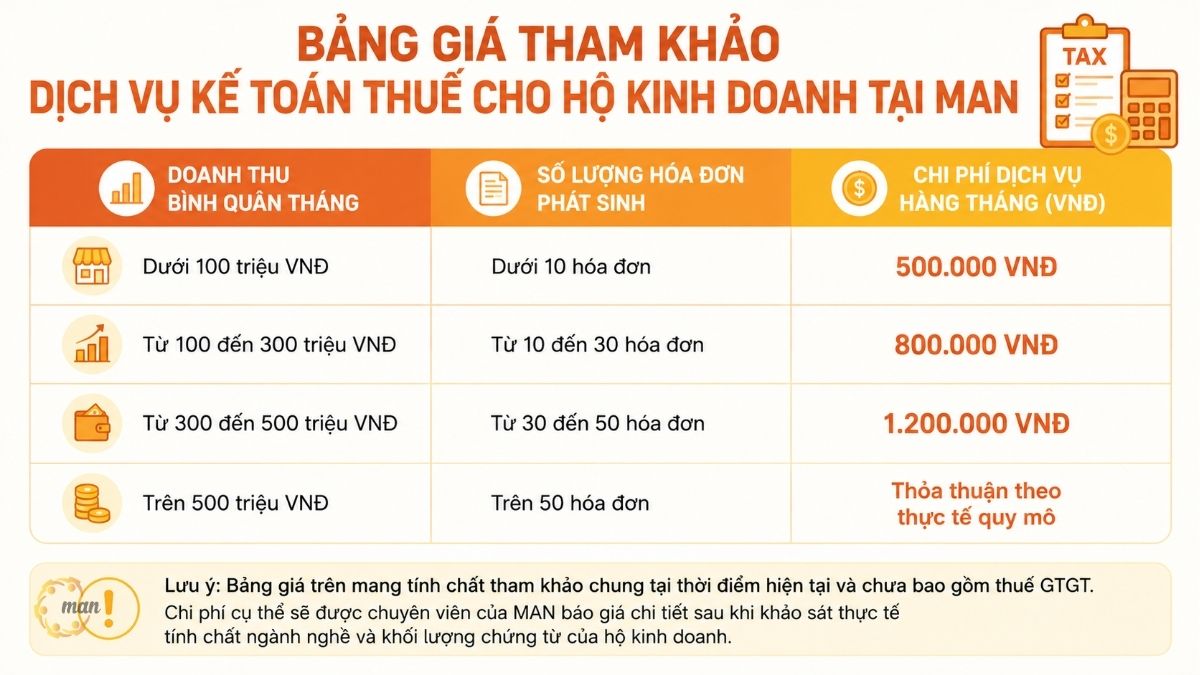
To help business owners proactively manage their budget, we present the following transparent fee schedule for tax accounting services for household businesses for your reference:
| Average monthly revenue | Number of invoices generated | Monthly service fee (VNĐ) |
| Under 100 million VND | Under 10 invoices | 500,000 VND |
| From 100 to 300 million VND | From 10 to 30 invoices | 800,000 VND |
| From 300 to 500 million VND | Between 30 and 50 invoices | 1,200,000 VND |
| Over 500 million VND | Over 50 invoices | Agreement based on scale |
Note: The above price list is for general reference only at the current time and does not include VAT. Specific costs will be quoted in detail by MAN specialists after an on-site survey of the business's industry and document volume.
MAN's service area covers Ho Chi Minh City, Binh Duong, and nationwide.
With a wide network of offices and the application of modern online work technology, MAN – Master Accountant Network supports clients nationwide. We focus on providing the most in-depth service in key economic areas in the South, including:
- Ho Chi Minh City area: District 1, District 3, District 5, District 7, District 10, Thu Duc City and neighboring districts and counties.
- Binh Duong province area: Thu Dau Mot city, Thuan An, Di An, Ben Cat and Tan Uyen.
- Other neighboring provinces and cities include Dong Nai, Long An, and Ba Ria Vung Tau.
No matter where your business is located, MAN specialists can reach you, assist with document collection on-site, or process your application remotely through our secure online portal.
Optimize costs with comprehensive tax accounting services for sole proprietorships.
Many business owners are concerned about the cost of switching to the tax declaration model. However, using MAN's comprehensive tax accounting services for business households is actually a cost-effective solution. Compared to hiring a private accountant (with costs for salary, insurance, computer, and software) or paying penalties for tax errors, MAN's service fee is only a fraction of the cost. We are committed to delivering the highest efficiency, helping business households optimize their actual tax payments by reviewing reasonable and legitimate expenses in a legal manner.
Real-world case study: How did MAN remove tax accounting barriers for sole proprietorships?

The project to standardize tax accounting for Mr. T's household business in District 1 is a real-world example demonstrating our capabilities. Mr. T owns a store distributing imported household appliances with monthly revenue exceeding 800 million VND, but he completely failed to keep accurate records of his input invoices.
When the regulation abolishing the lump-sum tax comes into effect at the beginning of 2026, Mr. T faces the risk of having his taxable revenue assessed by the tax authorities at a very high level due to the lack of accounting records to prove the cost of goods sold. He contacted MAN in a state of extreme anxiety about having to close his store due to the soaring tax costs.
Experts at MAN, with 30 years of experience, quickly stepped in to implement comprehensive solutions:
- Review the store's entire supply chain and instruct Mr. T to request that factories issue legitimate electronic invoices for each incoming shipment.
- Re-establish the entire system, including 7 missing accounting books from the beginning of the year, and accurately record the rental costs for premises in District 1 and sales labor costs in the detailed ledger.
- Revise the quarterly tax returns to accurately reflect the actual cash flow through the business's bank account.
After three months of collaboration, Mr. T's business has entered a well-structured operational phase. The amount of tax payable has been optimized, reduced by over 351 TP3T compared to the initial assessment by the tax authorities, thanks to the proof of legitimate and reasonable expenses. Mr. T is now fully confident in continuing to expand his business without worrying about violating tax laws.
Expert opinion: Classic tax accounting mistakes for sole proprietorships
Based on our 30 years of experience in the finance and tax risk management industry in Vietnam, tax accounting for household businesses often suffers from errors in managing personal and business cash flow. Most household owners still use a single personal bank account for both family expenses and receiving payments from customers.
This creates an extremely high risk when tax authorities conduct audits of the flow of money through the account. Without detailed accounting records, the tax authorities have the right to attribute the entire amount of money generated in that bank account as taxable revenue for the business household.
A safe solution is to hire a professional firm to handle tax accounting for your business to avoid unfortunate legal risks. The business owner should open a separate bank account solely for receiving sales revenue and paying for raw materials, and provide all bank statements to the accountant for monthly verification.
Conclude
Implementing tax accounting for household businesses is not only a mandatory legal responsibility from 2026, but also an opportunity for business owners to standardize their entire operational process in the digital age. When all expenses and revenues are clearly recorded, you will have a more realistic and accurate view of your business's performance, thereby making sound investment decisions.
If you're struggling with initial bookkeeping setup or worried about tax penalty risks, let MAN be your partner. As a leading trusted partner, MAN provides comprehensive professional solutions for tax accounting, tax consulting, tax settlement, and tax reporting in Vietnam. Contact MAN today to receive direct advice from our experienced financial experts.
Tax services at MAN – Master Accountant Network
- Tax accounting services
- Tax consulting services
- Tax settlement services
- Tax reporting services
- VAT refund service
Service contact information at MAN – Master Accountant Network
- Address: No. 19A, Street 43, Tan Thuan Ward, Ho Chi Minh City
- Mobile/Zalo: 0903 963 163 – 0903 428 622
- E-mail: man@man.net.vn
- Google Business Profile: View MAN – Master Accountant Network's Google Business Profile
- LinkedIn Founder: View expert Le Hoang Tuyen's LinkedIn profile.
Responsible for production and professional content review by: Mr. Le Hoang Tuyen – Founder & CEO of MAN – Master Accountant Network, CPA Vietnam with over 30 years of experience in accounting, auditing, taxation, and corporate financial consulting.
Frequently Asked Questions about Tax Accounting for Household Businesses
Yes, establishing tax accounting for household businesses is mandatory for all newly established businesses that choose to pay taxes using the declaration method from 2026 onwards. Small-scale household businesses that are not subject to declaration requirements must still retain complete sales invoices to facilitate verification of the origin of goods by market management authorities.
According to the current Tax Administration Law, the entire system of 7 types of accounting books, input invoices, output invoices, and related payment documents must be securely stored at the business registration location for a minimum of 10 years from the date of filing the tax return for that period.
Outsourcing accounting services is currently very cost-effective for business owners, ranging from VND 500,000 to VND 1,500,000 per month depending on the volume of invoices generated and the size of the business. This cost is significantly lower than hiring a dedicated in-house accountant for the store.
You can absolutely file tax returns and issue invoices online yourself through the General Department of Taxation's eTax Mobile application or integrated accounting software. However, doing it yourself requires you to have certain professional knowledge about how to classify documents and record transactions to avoid errors that could lead to administrative penalties.
Yes, the tax authorities plan annual audits of businesses that pay taxes using the declaration method, focusing particularly on businesses with high revenue, those using many electronic invoices, or those with high-risk indicators regarding cash flow through bank accounts.
Absolutely, and this is an inevitable trend as business activity thrives. The government always has policies to support businesses converting to enterprises by providing fee reductions and tax exemptions in the initial years of operation to encourage the development of the private economy. Is it mandatory for newly established sole proprietorships to provide tax accounting services?
How long do household businesses need to keep their tax accounting records?
What are the costs of outsourcing tax accounting for a sole proprietorship?
Can I handle the tax accounting for my online business myself?
Are sole proprietorships subject to periodic tax audits like businesses?
Can I convert my sole proprietorship into a business entity when it grows larger?