


Nine cases will be inspected by the tax authorities at their headquarters. These are business situations identified as high-risk under the 2025 Tax Administration Law, which officially takes effect on July 1, 2026. Understanding these regulations not only helps businesses comply with the law but is also a necessary preparation to protect their financial security against inspections and audits from authorities.
In Vietnam's volatile business environment, transparency in tax filings is crucial. At MAN – Master Accountant Network, with over 30 years of experience in auditing and tax consulting, we understand that proactively managing risks is key to sustainable business growth. This article will provide an in-depth analysis of the legal basis and offer practical considerations for managers.
Overview of the 9 cases that will be subject to on-site tax audits.

Effective July 1, 2026, Tax Administration Law 2025 and Personal Income Tax Law 2025 This has created a new legal framework with stricter criteria. Local tax authorities have updated their list of situations that make it highly likely for businesses to be inspected at their premises.
From the perspective of MAN – Master Accountant Network, this is an inevitable shift as tax authorities apply big data to management. Keeping up with these regulations is a mandatory requirement for accounting departments and management. We note that on-site audits are no longer random events but are the result of risk analysis based on system data.
Why do tax authorities need to conduct on-site inspections at businesses?
On-site inspections are a crucial operational measure. When the tax authority's system detects discrepancies between tax declarations and actual cash flow, or transactions showing signs of irregularities, they will conduct on-site investigations.
The purpose of this inspection is to verify the authenticity of the original documents. The tax authorities will examine accounting records, economic contracts, and the actual goods in the warehouse. This is an assessment process to ensure that the business has truthfully and fully declared all taxes due.
Those affected by the new regulations
This regulation covers most economic entities. In particular, businesses in high-risk sectors such as import/export, e-commerce, or those with complex supply chains are often subject to special attention.
At MAN, we emphasize that even with good compliance, a thorough understanding of audit criteria remains crucial. It helps businesses self-assess their internal tax management processes, thereby building a prepared and accountable record for any situation.
What are the 9 circumstances under which the tax authorities conduct on-site inspections at taxpayers' premises?
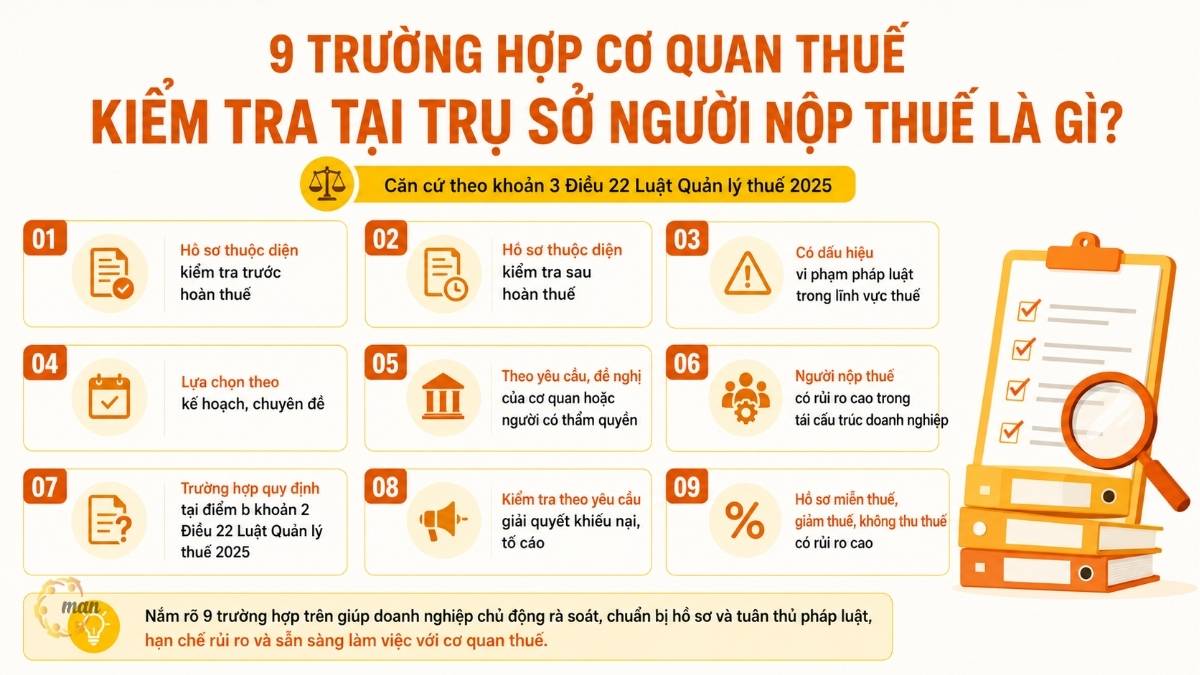
According to Clause 3, Article 22 of the 2025 Tax Administration Law, tax authorities will conduct on-site inspections at taxpayers' premises in one of the following nine situations. This is a fundamental legal basis that every manager needs to understand thoroughly.
The file is subject to pre-refund verification.
These are the documents that the tax authorities are required to verify the validity of before deciding on the amount of tax refund to businesses. This aims to minimize the risk of tax refund fraud from the state budget.
The file is subject to post-refund verification.
This applies to tax refund applications that are eligible for advance refunds but are based on the principle of risk management. The tax authorities will conduct a review within 5 years from the date of issuance of the tax refund decision to verify the refunded funds.
There are signs of violations of the law in the field of taxation.
If businesses engage in practices such as falsely declaring revenue, inflating expenses, or other irregularities in their accounting records detected through automated monitoring systems, the tax authorities will conduct on-site inspections to clarify these signs of violations.
Selection based on plan and subject matter.
Each year, the tax authorities develop inspection plans based on specific themes, such as inspections by industry, by business size, or by key geographical areas. This is a standard periodic inspection process.
As requested or suggested by the competent authority or person.
In certain special circumstances or when there are complaints or requests for investigation from other authorities, the tax agency will conduct on-site inspections to verify information and carry out its duties as requested.
Taxpayers face high risk in business restructuring.
Businesses that undergo division, separation, merger, consolidation, conversion of business type, bankruptcy, dissolution, cessation of operations, privatization, termination of tax identification number, or relocation are typically classified as high-risk. Tax authorities will conduct inspections to ensure that tax obligations are fulfilled before the business changes its status.
The case stipulated in point b, clause 2, Article 22 of the 2025 Law on Tax Administration.
This is a situation where the tax authorities request explanations or additional information, but the business fails to provide complete information or the explanations are unconvincing. In such cases, the tax authorities have the right to proceed with an on-site inspection at the business premises.
Inspections are conducted as required in the resolution of complaints and denunciations.
When complaints or allegations arise regarding an entity's tax obligations, the tax authorities conduct an audit to obtain accurate data, in order to resolve the complaints transparently and in accordance with the law.
Applications for tax exemption, tax reduction, or no tax payment carry a high risk.
For tax exemption applications, if the assessment system determines a high risk of ineligibility, the tax authority will conduct an on-site inspection to compare the actual documents with the eligibility criteria.
Ten behaviors identified as tax evasion under the 2025 Tax Administration Law.
To help businesses avoid legal risks, understanding the behaviors that constitute tax evasion under the new regulations is crucial. Below are details of 10 behaviors that should be absolutely avoided.
- Failure to submit tax registration documents or returns: This is the most fundamental violation. Failure to fully comply with the legal obligation to submit documents results in a shortfall in tax payable or an increase in exempted, reduced, or refunded amounts.
- Filing tax returns late: Submitting the tax return more than 90 days after the deadline or the extended deadline without a valid reason, resulting in discrepancies in the amount of tax payable, exempted, or refunded.
- Failure to record income in the accounting books: Many businesses intentionally fail to record revenue in their accounting books in order to reduce their tax liability. With current bank account reconciliation technology, this practice is very easy to detect.
- No invoices were issued and no taxes were declared. Selling goods or providing services without issuing invoices, or recording a lower value on invoices than the actual payment, is a common tax evasion practice that authorities are strictly controlling.
- Using illegal invoices and documents: Using forged input invoices, or invoices from shell companies, to account for expenses in order to reduce the amount of tax payable is a serious violation of the law.
- The documents do not accurately reflect the nature of the transaction: Using documents and records that do not accurately reflect the actual transaction to falsely determine the amount of tax payable or the amount of tax refundable constitutes calculated tax evasion.
- Falsely declaring imported or exported goods: Businesses that falsely declare the quantity, type, and value of goods but do not voluntarily rectify the situation by paying the full amount of tax as required by law.
- Deliberate failure to declare goods: The act of intentionally failing to declare or falsely declaring taxes on imported and exported goods for the purpose of defrauding the state of tax revenue.
- Colluding with the shipper: Colluding with suppliers to import goods in order to evade taxes is a violation of the law that authorities are focusing on cracking down on.
- Misuse of goods and improper notification of temporary suspension: Using tax-exempt or non-taxable goods for purposes other than those intended without declaring the conversion; or conducting business activities during a period of temporary suspension without notifying the tax authorities.
The role of tax audits in corporate risk management.
Tax audits are not just an obligation, but also a measure of a company's financial health. According to experts at MAN – Master Accountant Network, viewing tax audits as an opportunity to review the entire accounting system is a positive approach.
- Why do businesses need to prepare before an audit? Proactive preparation of documentation helps businesses save time and costs and avoid penalties related to the failure to provide accounting records in a timely manner. In particular, businesses frequently face tax risks such as discrepancies between taxable revenue and accounting revenue; early preparation is key to protecting business profits.
- The link between auditing and tax administration: Independent auditing and tax inspections are two distinct but complementary activities. Through regular audits, businesses in the MAN – Master Accountant Network are often advised to identify weaknesses in their accounting processes early on, allowing for timely adjustments before the tax authorities conduct a formal inspection.
Key timelines and practical conditions to note.
The 2025 Tax Administration Law clearly stipulates the frequency of inspections. For businesses subject to planned inspections or restructuring, tax authorities are only allowed to inspect them no more than once a year.
- Please note the rule of once a year: This regulation is a positive new development, helping to reduce pressure on businesses. However, it should be noted that this does not apply to re-inspections if the business shows signs of violating the law or if new risks arise. At MAN, we always remind our clients that not being inspected more than once does not mean that businesses can be negligent in document management.
- Impact of relocating a business: Changing a business location is one of the events that can easily lead to a tax audit. Businesses need to follow the correct notification procedures with the business registration authority and the tax authority before making the change to avoid being subject to surprise inspections.
Expert opinion from MAN on tax risk management.
With over 30 years of experience in auditing and tax consulting, the team of experts at MAN – Master Accountant Network recognizes that tax risks often stem from a lack of legal knowledge and lax accounting practices within businesses.
Many businesses often view taxes as a financial burden rather than a part of strategic management. As management thinking shifts, data control will become part of daily operational processes, keeping businesses prepared for any audit.
Common business risks
The most common risk identified by MAN experts is inconsistency between accounting figures and tax returns. This often occurs when accounting personnel fail to keep up with the changes in the 2025 Tax Administration Law.
Another risk is lax management of input documents. Many businesses have expenses disallowed during on-site audits due to minor errors such as missing signatures on documents, or economic contracts that don't align with the invoice date.
Optimal handling techniques from MAN experts.
At MAN, we apply a risk control approach from the source. Instead of only conducting audits at the end of the financial year, we recommend performing periodic quarterly reviews of the books.
This review process helps detect discrepancies early. This allows businesses to proactively adjust their tax returns before the tax authorities announce an on-site inspection. This helps businesses avoid unnecessary administrative penalties.
Case Study: Handling situations when an inspection team arrives at the headquarters
Consider a real-world scenario at a medium-sized electronics component manufacturing company. This company receives a tax audit notice due to a large tax refund figure for 2026.
Situation analysis
Businesses are concerned because their record-keeping is not entirely systematic. A small number of internal shipping documents have been lost. This creates a risk of input costs being rejected and tax refunds already received being withheld.
The team of experts from MAN – Master Accountant Network was brought in to assist with the review. We began by reclassifying all records chronologically and by transaction type, comparing them with the latest tax regulations.
Treatment method and results
MAN has guided businesses in providing detailed explanations of their production processes and the logic of their goods flow. We also assist businesses in preparing supplementary documents to prove the legitimacy of transactions lacking original documentation, using valid alternative methods.
As a result, when the inspection team worked at the headquarters, the business presented a complete, logical, and legally sound case. The tax refund was approved by the tax authorities, and the business only had to make minor adjustments to its expense accounting without incurring heavy penalties, thus preserving the company's reputation and cash flow.
Comparison table of tax audits and tax inspections
To give businesses a clearer picture, experts at MAN have compiled the following comparison table between the two forms of tax authority operation.
| Criteria | On-site inspection | Tax inspector |
| Purpose | Identify risks, control declarations. | Comprehensive legal compliance check |
| Scope | Focus on one or more types of taxes. | Conduct a comprehensive review of all taxes during the period. |
| Frequency | It can happen multiple times a year. | According to a regular or ad hoc schedule. |
| Object | High-risk businesses | The company shows signs of major violations. |
Businesses need to clearly distinguish between these two forms of inspection in order to prepare the appropriate documentation. Whether it's an audit or an inspection, the honesty and transparency of the documentation are always decisive factors in determining success or failure.
Conclude
Understanding the nine situations in which tax authorities will conduct on-site inspections is a crucial step in financial management. Timely grasp of new legal regulations effective from July 1, 2026, will help businesses minimize legal risks and operate more efficiently.
If you need a reliable partner to accompany you, MAN – Master Accountant Network is always ready. With extensive experience, we provide the following services: tax settlement services, tax accounting services, tax reporting services and tax consulting services Professionalism helps businesses confidently develop sustainably. Contact MAN today for advice on the most optimal tax risk management solutions.
Service contact information at MAN – Master Accountant Network
- Address: No. 19A, Street 43, Tan Thuan Ward, Ho Chi Minh City
- Mobile/Zalo: 0903 963 163 – 0903 428 622
- E-mail: man@man.net.vn
- Google Business Profile: View MAN – Master Accountant Network's Google Business Profile
- LinkedIn Founder: View expert Le Hoang Tuyen's LinkedIn profile.
Responsible for production and professional content review by: Mr. Le Hoang Tuyen – Founder & CEO of MAN – Master Accountant Network, CPA Vietnam with over 30 years of experience in accounting, auditing, taxation, and corporate financial consulting.
Frequently Asked Questions about Tax Audits
An on-site inspection does not necessarily mean a business is suspected of tax evasion. It could be a routine check to verify tax refund figures or because the business falls into a high-risk category according to the classification of the regulatory authority.
Businesses need to review their entire system of invoices, documents, and accounting records. Ensure that all transactions are legally valid and properly accounted for. MAN recommends conducting a comprehensive review immediately upon receiving notification to minimize risks.
Businesses are not allowed to refuse a tax audit if they have received a valid notice. However, businesses have the right to explain and provide evidence to protect their legitimate rights during the audit process.
Businesses should proactively file supplementary tax returns and pay all applicable taxes and penalties before the tax authorities announce a tax audit at their premises. This will significantly reduce penalties under the Tax Administration Law.
MAN - Master Accountant Network assists businesses in reviewing documents, developing explanation scenarios, and directly accompanying businesses throughout the process of working with inspection teams. We ensure that businesses are always proactive, professional, and fully protected in terms of their rights. Why are businesses being audited even if they haven't evaded taxes?
What should I prepare when I receive a notice of inspection at the office?
Is it permissible to refuse an inspection?
What if errors are discovered before the inspection?
What services can MAN provide during an inspection?




