


The 2026 foreign contractor tax rate is crucial information that businesses dealing with foreign partners need to pay special attention to. Understanding the regulations not only helps ensure legal compliance but also protects cash flow and minimizes the risk of tax arrears or tax assessments. Based on practical tax consulting and auditing experience, experts at MAN – Master Accountant Network have observed that many businesses, especially in the construction and installation sector, still face difficulties in handling mixed contracts and determining appropriate tax obligations.
The legal landscape of 2026 demands meticulous attention to every contract clause. Instead of viewing these as mandatory costs, businesses need to understand the nature of each item to plan their finances effectively. This article will analyze in detail how to determine tax rates, address the challenge of separating contract values, and provide practical insights to help businesses operate safely in a volatile business environment.
Summary of key points regarding foreign contractor tax rates in 2026
Foreign Contractor Tax (FCT) is an indirect tax applied to foreign organizations and individuals earning income from providing services or goods in Vietnam without establishing a legal entity under Vietnamese law. This is a mandatory tax obligation that the Vietnamese party is responsible for withholding, declaring, and paying on behalf of the foreign contractor.
The taxable entities include all foreign contractors and subcontractors generating revenue in the Vietnamese market. Businesses need to apply the tax immediately upon signing a contract or making a payment to the contractor to avoid the risk of retroactive tax collection and late payment penalties.
Detailed schedule of foreign contractor tax rates for 2026.
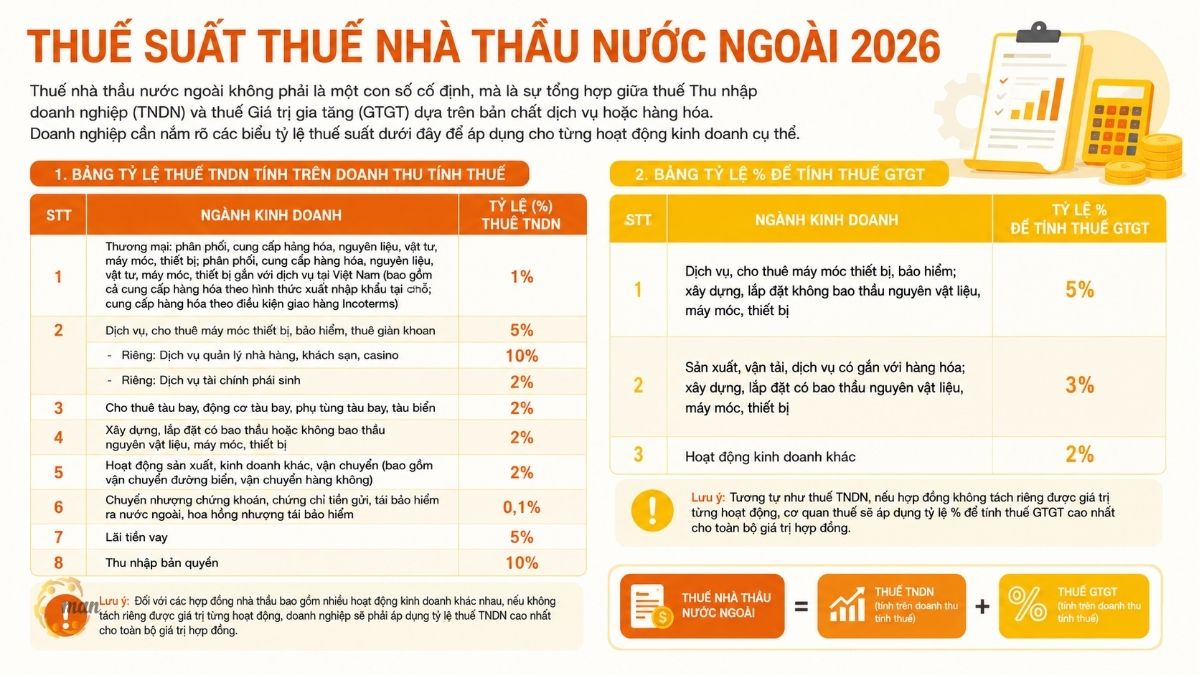
Foreign contractor tax is not a fixed figure, but rather a combination of taxes. Corporate income tax (CIT) and Value Added Tax (VAT) Based on the nature of the service or goods, businesses need to understand the following tax rate schedules to apply them to each specific business activity.
Table of corporate income tax rates based on taxable revenue
According to regulations, the corporate income tax rate (%) for business sectors is classified as follows:
| STT | Business sector | Corporate income tax rate (%) |
| 1 | Trade: distribution and supply of goods, raw materials, supplies, machinery, and equipment; distribution and supply of goods, raw materials, supplies, machinery, and equipment associated with services in Vietnam (including the supply of goods through on-site import and export; and the supply of goods under Incoterms delivery conditions). | 1 |
| 2 | Services, equipment rental, insurance, drilling rig rental | 5 |
| – Specifically: Restaurant, hotel, and casino management services | 10 | |
| – Specifically: Derivative financial services | 2 | |
| 3 | Leasing of aircraft, aircraft engines, aircraft parts, and ships. | 2 |
| 4 | Construction and installation services, with or without the supply of materials, machinery, and equipment. | 2 |
| 5 | Other production and business activities, transportation (including sea transport and air transport) | 2 |
| 6 | Transfer of securities, certificates of deposit, reinsurance abroad, reinsurance cession commissions. | 0,1 |
| 7 | Interest on loans | 5 |
| 8 | Royalties | 10 |
Note: For contractor contracts encompassing multiple business activities, if the value of each activity cannot be separated, the enterprise will have to apply the highest corporate income tax rate to the entire contract value.
Table of % ratios for calculating VAT.
Similarly, the ratio (%) for calculating VAT on revenue is regulated according to business sectors:
| STT | Business sector | The ratio % is used to calculate VAT. |
| 1 | Services, machinery and equipment rental, insurance; construction and installation without contracting for materials, machinery, and equipment. | 5 |
| 2 | Production, transportation, and services related to goods; construction and installation including procurement of materials, machinery, and equipment. | 3 |
| 3 | Other business activities | 2 |
Note: Similar to corporate income tax, if the contract does not separately specify the value of each activity, the tax authorities will apply the % rate to calculate the highest VAT for the entire contract value.
Detailed instructions on how to calculate foreign contractor tax in 2026.
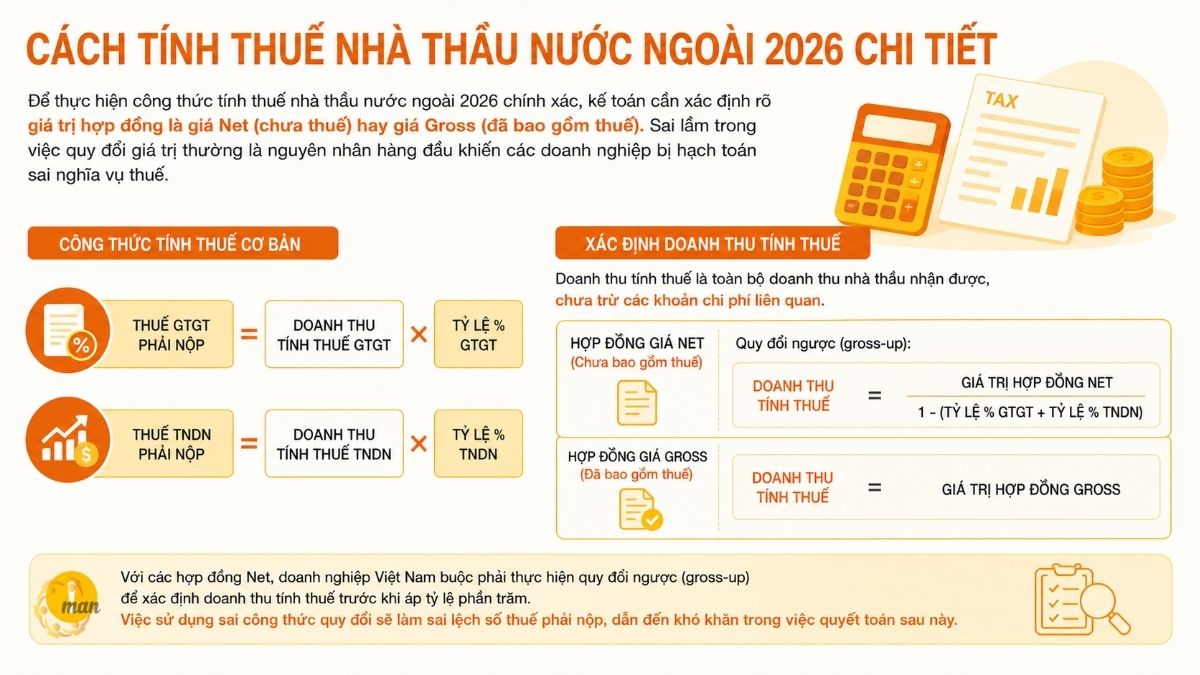
To perform Formula for calculating foreign contractor tax in 2026 Specifically, accountants need to clearly determine whether the contract value is the net price (excluding tax) or the gross price (including tax). Errors in converting value are often the leading cause of businesses incorrectly accounting for their tax obligations.
The basic formulas for calculating VAT and corporate income tax are as follows:
- VAT payable = Taxable revenue x VAT rate (1% VAT).
- Corporate income tax payable = Taxable revenue x Corporate income tax rate (1% tax, 3% tax).
In this context, taxable revenue is the total revenue received by the contractor, before deducting related expenses. For net contracts, Vietnamese businesses are required to perform a gross-up to determine taxable revenue before applying the percentage rate. Using the wrong conversion formula will lead to inaccurate tax payments, causing difficulties in tax settlement later.
The problem of hybrid contracts and the risk of tax assessment.
In the construction, electromechanical, and production line installation industries, most EPC projects are mixed contracts. This is the area with the highest potential risk regarding contractor tax in 2026. According to regulations, if the contract does not separately specify the value of each activity, the tax authorities will apply the highest tax rate to the entire contract value.
To optimize tax revenue, experts at MAN advise that businesses should clearly define the value details right from the contract negotiation stage:
- The value of goods, machinery, and equipment (which usually have a lower tax rate).
- The value of installation, operation, and training services (which usually have a higher tax rate) is also included.
A detailed list of items (BOQ – Bill of Quantities) and unit prices for each part is a prerequisite. If the contract only states a total value without an appendix separating the value of goods and services, there is a very real risk that the tax authorities will assess the service tax rate for the entire value of the machinery.
Legal regulations and the latest basis for foreign contractor tax rates in 2026.
The current legal framework serves as a guide for all tax-related activities. These regulations include:
- Corporate Income Tax Law No. 67/2025/QH15 and the Value Added Tax Law (amended).
- Decree 320/2025/ND-CP provides detailed guidance on the Corporate Income Tax Law.
- Circular 20/2026/TT-BTC Regarding guidelines for implementing contractor tax.
Businesses should note that Circular 20/2026/TT-BTC has made adjustments regarding the timing of determining taxable revenue, with a particular focus on transparency regarding expenses paid by Vietnamese parties. Regularly updating these documents is the responsibility of the accounting department to ensure compliance. MAN experts always recommend that businesses keep complete records of guidance documents and responses from tax authorities for each specific case to use as explanatory documents when needed.
Real-world case study: EPC contracts in the manufacturing industry
Consider a scenario where a Vietnamese company signs an EPC contract with a foreign contractor to install a production line worth 100 billion VND. The contract does not separate the value of the machinery from the installation costs.
As a result, during tax settlement, the authorities applied a VAT rate of 51% and a corporate income tax rate of 51% to the entire 100 billion VND, instead of applying the 3% VAT rate and 2% corporate income tax rate to the machinery portion. The total tax difference amounted to billions of VND. This is a costly lesson about shortcomings in contract drafting.
The solution from MAN – Master Accountant Network in this case is to require the contractor to create an addendum to the contract clearly separating the value of the equipment at the port of entry from the cost of technical services in Vietnam. For the equipment, complete customs declarations and shipping invoices are required to clearly demonstrate that the goods are exempt from installation tax. Preparing transparent documentation from the outset helps businesses save significant costs.
Expert opinion from MAN
Based on over 30 years of experience handling complex tax cases, the team of experts at MAN – Master Accountant Network has identified three of the most common mistakes businesses make:
- There was a lack of coordination between the technical and accounting departments when drafting the contract.
- Failure to prepare a plan for converting net prices to gross prices can lead to disputes over tax obligations with foreign partners.
- Delays in updating double taxation avoidance agreements (DTAs) may apply to contractors.
An important note from MAN is that the application of the tax agreement does not automatically mean tax exemption. Foreign contractors need to follow the procedures for notifying the tax authorities in Vietnam as required. Vietnamese businesses need to support contractors in this process to ensure legality and maximize benefits for their partners, thereby maintaining a long-term cooperative relationship.
Conclude
Managing contractor tax is an integral part of the financial management strategy for internationally operating businesses. Understanding the 2026 foreign contractor tax rates helps businesses not only comply with the law but also proactively optimize cost flows and enhance competitiveness in the market.
At MAN – Master Accountant Network, we understand the challenges businesses face in dealing with complex regulations. With our deep understanding of the realities of risk management in Vietnam, the MAN team is ready to partner with your business in these areas. tax settlement services, Tax accountant, tax reporting and contract consulting, allowing you to focus on your core business operations with peace of mind. Contact us to receive the most in-depth advice for your project.
Service contact information at MAN – Master Accountant Network
- Address: No. 19A, Street 43, Tan Thuan Ward, Ho Chi Minh City
- Mobile/Zalo: 0903 963 163 – 0903 428 622
- E-mail: man@man.net.vn
- Google Business Profile: View MAN – Master Accountant Network's Google Business Profile
- LinkedIn Founder: View expert Le Hoang Tuyen's LinkedIn profile.
Responsible for production and professional content review by: Mr. Le Hoang Tuyen – Founder & CEO of MAN – Master Accountant Network, CPA Vietnam with over 30 years of experience in accounting, auditing, taxation, and corporate financial consulting.
Frequently Asked Questions about Foreign Contractor Tax Rates 2026
If a contract doesn't separate the value of goods and services, are there any other options for a business?
Currently, the tax authorities require the highest rate to be applied to the entire contract. The only way is to negotiate with the contractor to sign an addendum separating the value of each part of the work.
If a foreign contractor has already paid taxes in their home country, are those taxes deductible?
This depends on the Double Taxation Avoidance Agreement (DTA) between Vietnam and the contractor's country. Proof of tax residency is required, along with notification procedures to the Vietnamese tax authorities.
Will the foreign contractor tax rate change significantly in 2026?
Essentially, the percentage of occupations remains stable, but there is stricter regulation in determining taxable revenue under the new circulars.
What support does MAN - Master Accountant Network provide in contractor tax settlement?
We provide contract review services, consulting on contract value breakdown for tax optimization, and representing businesses in filing documents with tax authorities.
What is the deadline for submitting contractor tax returns?
The deadline is no later than the tenth day from the date the tax obligation arises (payment to the contractor). If filing monthly, the deadline is the 20th of the following month.




