
Decree 253/2026/ND-CP This is the most important implementing guidance document for the Personal Income Tax Law 2025, which officially takes effect from July 1, 2026 and replaces previous regulations. Decree 65/2013/ND-CP This document has been in effect for over a decade. Comprising 7 chapters and 71 articles, it revises the entire legal framework regarding taxpayers, taxable income, tax-exempt income, tax calculation basis, and deduction and settlement mechanisms. This is the legal basis that all accounting and human resources departments in businesses are required to update immediately in the third quarter of 2026.
From this perspective MAN – Master Accountant Network, According to [Name of consulting firm], a tax, accounting, and auditing firm with over 30 years of practical experience in Vietnam, Decree 253/2026/ND-CP not only simply re-legalizes old regulations but also adds many groundbreaking new points: tax exemption for high-quality digital technology personnel, expansion of tax exemption for night work and overtime pay, and stricter requirements for documentation when claiming deductions. This article provides a detailed analysis of each point to help businesses and employees prepare proactively.
| Decree 253/2026/ND-CP is a document issued by the Government on June 30, 2026, providing detailed regulations and guidance on the implementation of the Personal Income Tax Law No. 109/2025/QH15. |
| Effective from July 1, 2026, replacing Decree 65/2013/ND-CP. |
| Applicable to: resident individual taxpayers, non-resident individual taxpayers, tax authorities, and income-paying organizations. |
| Main content: determining taxable income, list of 22 tax-exempt income provisions, personal deductions, conversion of foreign currency income, tax period, basis for tax calculation for each type of income, tax deduction and tax settlement. |
| Businesses need to review their payroll regulations, time sheets, and supporting documents before the 2026 tax settlement period (deadline March 2027). |
| Summary of 10 new points in Decree 253/2026/ND-CP |
What is Decree 253/2026/ND-CP? Legal basis and scope of application.
Decree 253/2026/ND-CP issued by the Government based on Law on Organization of the Government No. 63/2025/QH15 and the Personal Income Tax Law No. 109/2025/QH15 (amended and supplemented by Law No. 09/2026/QH16). The document, signed by Deputy Prime Minister Nguyen Van Thang on behalf of the Government on June 30, 2026, took effect just one day later.
According to Article 1 of the Decree, the scope of regulation includes two groups of content. Firstly, it details the provisions mandated by law, ranging from the concept of resident individuals, taxable income, tax-exempt income, to the basis for tax calculation. Secondly, it outlines the organizational measures for implementation: identifying taxpayers, income conversion, tax periods, deductions, filing tax returns on behalf of others, paying taxes on behalf of others, tax settlement, and tax refunds.
Scope of application of Decree 253/2026/ND-CP
Article 2 clearly defines the scope of application, including taxpayers, tax authorities, and other relevant organizations and individuals. More specifically, Article 3 classifies taxpayers into two groups: resident individuals with taxable income arising within and outside the territory of Vietnam, and non-resident individuals who are only taxable on the portion of income arising in Vietnam.
When does Decree 253/2026/ND-CP take effect?
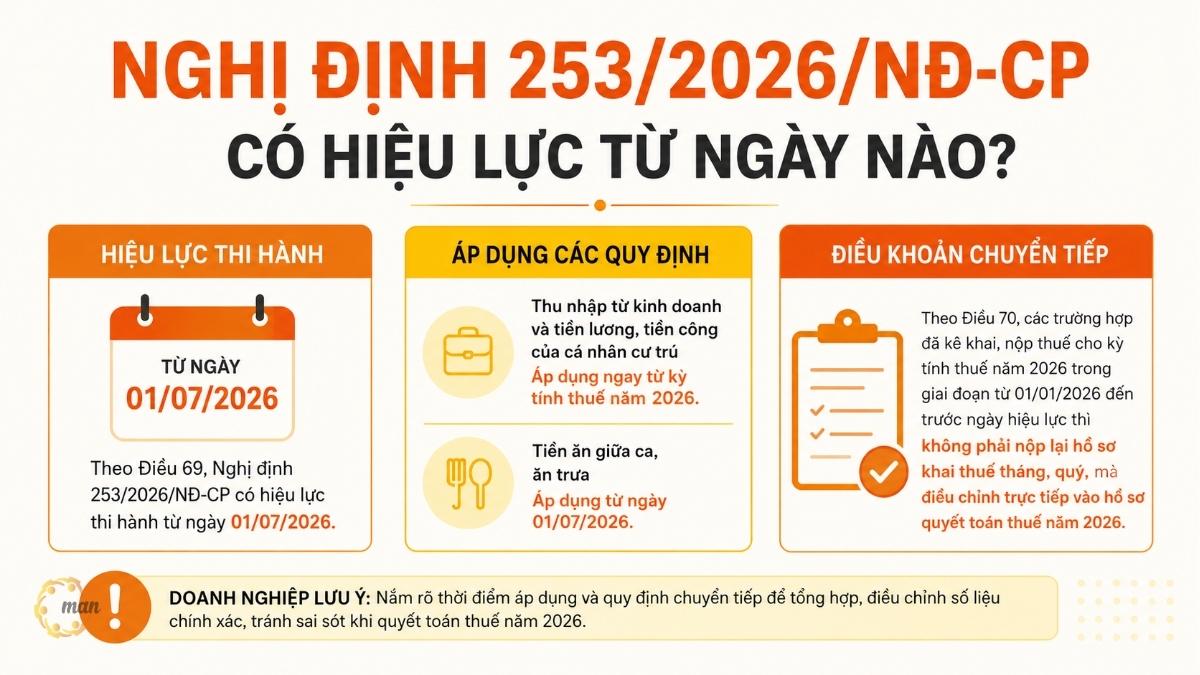
Article 69 stipulates that the Decree shall take effect from July 1, 2026. However, regulations related to income from business activities and salaries and wages of resident individuals will apply immediately from the 2026 tax year, while regulations on meal allowances and lunch allowances will apply from the effective date.
The Decree also clarifies the transitional provisions in Article 70: in cases where taxes have been declared and paid for the 2026 tax year during the period from January 1, 2026, until before the effective date, there is no need to resubmit monthly or quarterly tax declarations; adjustments can be made directly in the 2026 annual tax settlement documents. This is a point businesses need to be aware of to avoid errors when compiling year-end data.
Who is considered a resident individual according to Decree 253/2026/ND-CP?
Article 4 stipulates that resident individuals must meet one of two conditions. The first condition is being present in Vietnam for 183 days or more in a calendar year or 12 consecutive months from the first day of arrival. The second condition is having a permanent residence in Vietnam, including a registered permanent residence or rented accommodation with a total contract term of 183 days or more in the tax year.
In cases where an individual has a permanent residence but is actually present for less than 183 days, if they cannot prove they are a resident of another country with a Certificate of Residence or a copy of their passport, they will still be determined to be a resident of Vietnam according to Clause 3, Article 4.
What income is subject to tax under Decree 253/2026/ND-CP?
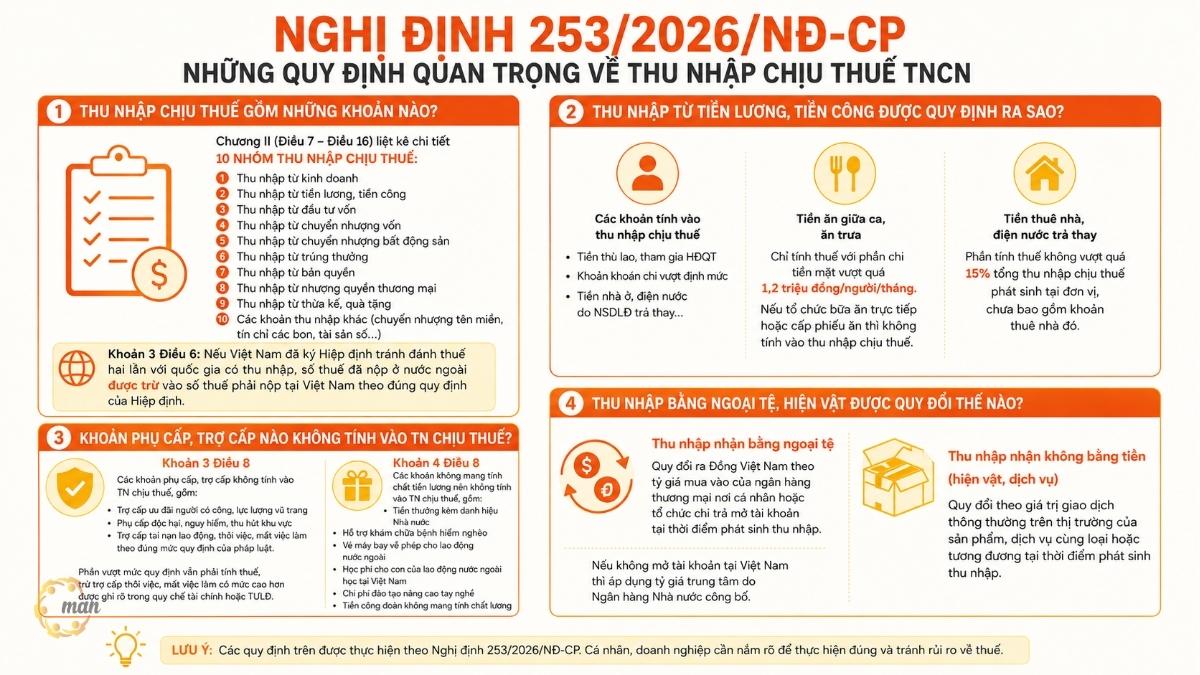
Chapter II of the Decree, from Article 7 to Article 16, details ten groups of taxable income: income from business, salaries and wages, capital investment, capital transfer, real estate transfer, lottery winnings, royalties, franchise fees, inheritance and gifts, and other income such as domain name transfers, carbon credits, and digital assets.
Clause 3 of Article 6 also adds an important benefit for individuals with income from abroad: if Vietnam has signed a Double Taxation Avoidance Agreement with that country, the tax paid abroad can be deducted from the tax payable in Vietnam in accordance with the provisions of the Agreement.
How is income from salaries and wages defined?
Article 8 is the longest and most complex provision, listing benefits included in taxable income such as remuneration, board membership fees, allowances for exceeding allocated funds, housing allowances, and utility payments made by the employer. Notably, meal allowances during work shifts and lunches are only taxed if the cash payment exceeds 1.2 million VND per person per month; if the company provides meals directly or issues meal vouchers, these are not included in taxable income.
Regarding rent and utility bills paid by the employer, the Decree limits the taxable portion to no more than 15% of the total taxable income generated at the unit, excluding the rent.
Which allowances and subsidies are not included in taxable income?
Clause 3 of Article 8 lists a long list of allowances and subsidies that are not included in taxable income, including preferential allowances for meritorious individuals, allowances for the armed forces, hazardous and dangerous work allowances, regional attraction allowances, work accident allowances, and severance pay/unemployment benefits as prescribed by law. Any amount exceeding the prescribed limits for these allowances is still subject to tax, except for severance pay/unemployment benefits with higher amounts clearly stated in the financial regulations or labor agreement.
Clause 4 of Article 8 adds a group of non-salary payments that are not included in taxable income, for example, bonuses accompanying state awards, support for the treatment of serious illnesses for employees and their relatives, airfare for foreign workers returning home on leave, tuition fees for children of foreign workers studying in Vietnam, training costs for skill enhancement, and union fees that are not considered salary payments.
How are incomes in foreign currency and in kind converted?
Article 17 stipulates that taxable income received in foreign currency must be converted into Vietnamese Dong at the buying rate of the commercial bank where the individual or organization paying the income has an account at the time the income is generated. If no account is opened in Vietnam, the central exchange rate announced by the State Bank of Vietnam shall apply.
For income received in non-monetary form, such as goods or services, the Decree requires conversion according to the normal market transaction value of similar or equivalent products or services at the time the income is generated.
Decree 253/2026/ND-CP stipulates which types of income are exempt from tax.
This is the section that businesses and employees are most interested in. Section 1 of Chapter III, from Article 18 to Article 39, lists 22 tax-exempt income groups. The table below summarizes the main groups.
| Clause | Tax-exempt content |
| Articles 18, 19, 20 | Transfer, inheritance, or gift of real estate between relatives; sole residence; land allocated by the State free of charge. |
| Articles 21, 22, 23 | Income of farming households directly involved in agriculture, forestry, and fisheries; profits from "large-scale farming"; conversion of agricultural land. |
| Articles 24 and 25 | Interest on government bonds, interest on bank deposits, interest on life insurance; remittances. |
| Article 26 | Night shift pay, overtime pay, and pay for non-holiday work (the difference above the normal rate). |
| Articles 27, 28, 29 | Pensions; scholarships; insurance compensation, workers' compensation, state compensation. |
| Articles 30, 31, 32, 33 | Charitable income; foreign aid; income of Vietnamese seafarers; offshore fisheries services. |
| Articles 34, 35, 36, 37 | Carbon credits, green bonds; income from science and technology projects, innovation; innovative startups. |
| Articles 38 and 39 | Foreign experts working on ODA projects, United Nations organizations; income of private business owners. |
How is the tax exemption for night work and overtime pay under Article 26 applied?
Article 26 of Decree 253/2026/ND-CP stipulates tax exemption for night shift wages, overtime pay, and wages paid for non-leave days, provided they comply with the conditions and time requirements under labor law. Organizations paying this income must prepare a statement clearly reflecting the night shift and overtime hours and the corresponding wages paid, and keep it at the unit for presentation upon request from the tax authorities.
Clause 3 of Article 26 clearly states an important principle: if night shift or overtime pay exceeds the limits stipulated by labor law, the excess amount must be included in taxable income. In other words, only the legally recognized excess amount is exempt, while the basic salary remains taxed as before.
What's new about tax exemptions for digital and high-tech professionals?
Articles 41 and 42 are two completely new provisions compared to the old law. Individuals who are high-quality digital technology professionals working in concentrated digital technology zones, or participating in research and development of key digital technology products, semiconductor chips, and artificial intelligence systems, are exempt from personal income tax for five consecutive years. Similar regulations apply to high-tech personnel conducting strategic technology research under the High-Tech Law.
What tax exemptions or reductions are available for investors in stocks and open-ended funds?
Article 43 exempts income from the transfer of open-ended fund certificates from tax, provided the holding period is at least 2 years from the date of purchase. Fund certificates purchased before July 1, 2026, are still tax-exempt when transferred after this date, provided they meet the 2-year holding requirement, calculated on a first-buy, first-sell basis.
Article 44 stipulates an additional preferential policy of reducing personal income tax for 5 years, applicable to dividends received by individual investors from securities investment funds or real estate investment funds established under the Securities Law, from July 1, 2026 to June 30, 2031.
Decree 253/2026/ND-CP stipulates the basis for calculating tax for resident individuals.
Chapter IV, from Article 45 to Article 62, stipulates the tax calculation formula for each type of income. For salaries and wages, the tax is calculated according to the progressive tax rate schedule after deducting mandatory insurance, personal allowances, and other deductions. For other types of income, the Decree applies a fixed tax rate for each transaction.
| Income type | Tax rate | Base |
| Capital investment | 5% on taxable income | Article 52 |
| Capital transfer (with a specified purchase price) | 20% on taxable income | Article 53 |
| Capital transfer (purchase price not specified) | 2% on transfer price | Article 53 |
| Securities transfer | 0.1% on the transfer price | Article 54 |
| Real estate transfer | 2% on transfer price | Article 57 |
| Winnings (amount exceeding 20 million VND) | 10% | Article 58 |
| Royalties (amount exceeding 20 million VND) | 5% | Article 59 |
| Franchise fee (amount exceeding 20 million VND) | 10% | Article 60 |
| Inheritance, gifts (amounts exceeding 20 million VND) | 10% | Article 61 |
How are personal deductions and other deductions calculated?
Articles 47 and 48 stipulate that taxpayers are entitled to deductions for themselves and for each dependent, provided they have registered for tax and registered their dependents before December 31st of the tax year. Article 49 adds further deductions for medical expenses up to a maximum of 23 million VND per year and education and training expenses up to a maximum of 24 million VND per year, provided there are valid invoices and supporting documents and the expenses are not paid from other sources.
Specifically, the deduction for supplementary retirement insurance contributions, voluntary retirement insurance, and life insurance is a maximum of 3 million VND per month, calculated for both the employer's contribution and the individual's contribution, as per point a, clause 2, Article 46.
How are non-resident individuals taxed according to Decree 253/2026/ND-CP?
Chapter V, Articles 63 to 65, regulates taxation for non-resident individuals. The biggest difference compared to resident individuals is the fixed tax rate 20% applied to all salaries and wages received for work performed in Vietnam, without the application of the progressive tax rate schedule and without personal deductions.
For non-resident individuals working simultaneously in Vietnam and abroad without being able to separate their income, Article 64 provides a formula for allocation based on the number of working days or days present in Vietnam divided by the total number of working days in the year or over 365 days.
How are tax deductions and tax settlements implemented according to Decree 253/2026/ND-CP?
Article 50 stipulates that organizations paying income to individuals without labor contracts or with contracts of less than 3 months, with payments of 5 million VND or more per payment, must deduct tax before payment. If the individual estimates that their income after personal deductions is below the tax threshold, they can make a commitment using the provided form to allow the organization to temporarily waive the tax.
Regarding tax settlement, Article 51 allows individuals with only one source of income from a salary contract of 3 months or more with an organization, and currently employed there at the time of settlement, to authorize that organization to settle their tax on their behalf. Individuals with average occasional income not exceeding 15 million VND per month, which has already been subject to tax deductions, are also not required to settle this portion of their income.
What are the regulations regarding tax periods and tax reductions due to natural disasters and epidemics as stipulated in Decree 253/2026/ND-CP?
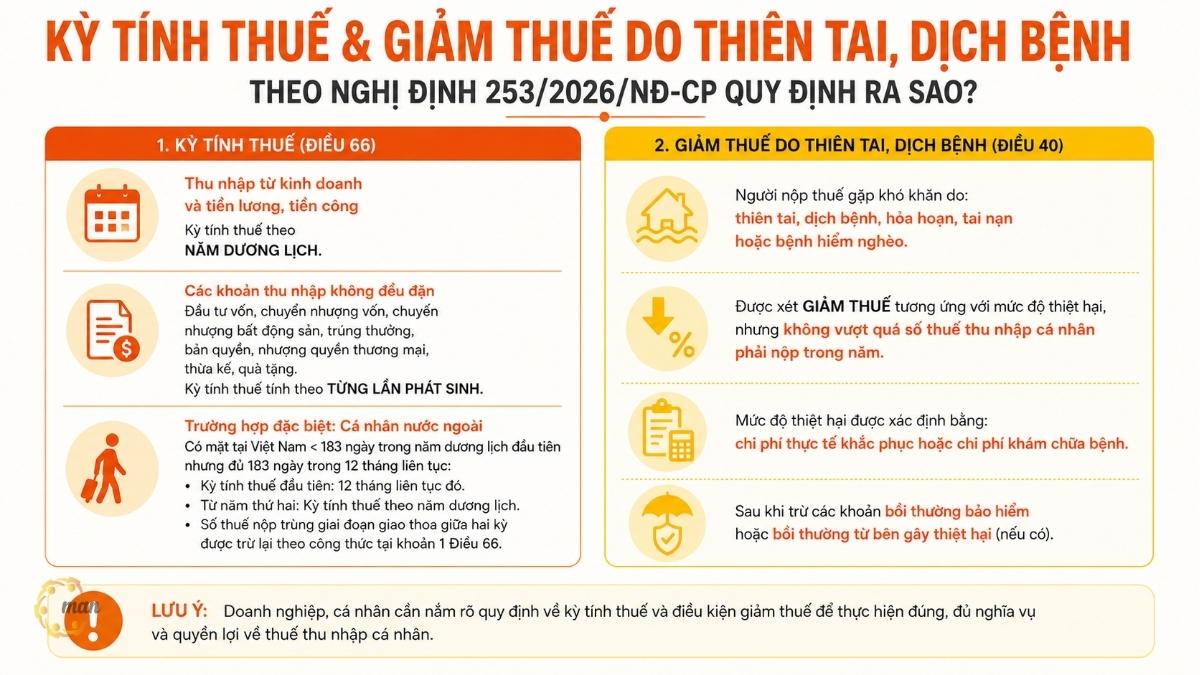
Article 66 distinguishes between two methods of determining the tax period. For income from business activities and salaries and wages, the tax period is based on the calendar year. For irregular income such as capital investments, capital transfers, real estate transfers, lottery winnings, royalties, franchise fees, inheritances, and gifts, the tax period is calculated on a case-by-case basis.
In special cases, if a foreign individual is present in Vietnam for less than 183 days in the first calendar year but for 183 consecutive days within a 12-month period, the first tax period is determined as those 12 consecutive months. From the second year onwards, the tax period reverts to the calendar year, and any overlapping tax payments during the transitional period between the two periods are deducted according to the formula in Clause 1, Article 66.
Furthermore, Article 40 stipulates that taxpayers facing difficulties due to natural disasters, epidemics, fires, accidents, or serious illnesses may be considered for tax reductions commensurate with the extent of the damage, but not exceeding the amount of personal income tax payable for the year. The extent of the damage is determined by the actual cost of remediation or medical treatment, after deducting any insurance compensation or compensation from the party causing the damage, if any.
Case Study: Manufacturing businesses in Binh Duong applying Decree 253/2026/ND-CP
Background
Company X, a limited liability company operating in the electronics component manufacturing sector in Binh Duong, has 1,200 workers, including approximately 301 night shift workers and 201 regular overtime workers. Before July 1, 2026, all night shift and overtime allowances were added to the monthly salary for personal income tax calculation according to the old regulations.
How to handle matters after Decree 253/2026/ND-CP comes into effect.
Following advice from MAN – Master Accountant Network, the company took three steps to comply with Articles 26 and 46 of the Decree: updating the payroll software to separate the basic salary from night shift and overtime pay; establishing a process for verifying shift attendance sheets with signatures from the team leader and the HR department; and adjusting the monthly tax deduction method by deducting the tax-exempt portion before calculating tax on the remaining income.
The measured results
Each night shift worker saves an average of 280,000 to 650,000 VND in personal income tax per month. The company's entire workforce of 1,200 employees reduces their monthly tax liability by approximately 400 to 600 million VND. During periodic tax audits, the separate time sheets and payroll records allow for a two-day reconciliation process without errors.
Expert opinion: Common business risks when applying Decree 253/2026/ND-CP
Experts at MAN – Master Accountant Network With over 30 years of experience in tax consulting and auditing in Vietnam, we note some common risks when businesses implement Decree 253/2026/ND-CP.
The first risk is confusion between the basic salary and the tax-exempt supplementary income, leading to incorrect tax exemptions for the wrong individuals and amounts. The second risk is a lack of documentation proving eligibility for tax exemption, especially for new categories such as income for high-skilled digital technology personnel under Article 41, which requires confirmation from the relevant regulatory agency. The third risk is that domestic accounting software has not yet updated its data fields to separate these new tax exemptions, causing discrepancies between accounting records and tax returns during the annual settlement.
Another less-noticed risk is determining the timing of income generation for interim payroll payments made before and after July 1, 2026. Businesses need to keep clear records to avoid disputes when tax authorities compare the 2026 tax settlement figures, which are due in March 2027.
Conclude
Decree 253/2026/ND-CP creates a more comprehensive and detailed legal framework compared to previous periods, expanding tax exemptions for night shift workers, overtime workers, and high-tech personnel, while also tightening documentation requirements for businesses. Thorough understanding of each provision, from determining individual residency and taxable income to the tax calculation formulas for each type of income, is essential to avoid the risk of tax arrears and penalties during the 2026 tax year.
Tax services at MAN – Master Accountant Network
- Tax accounting services
- Tax consulting services
- Tax settlement services
- Tax reporting services
- VAT refund service
Service contact information at MAN – Master Accountant Network
- Address: No. 19A, Street 43, Tan Thuan Ward, Ho Chi Minh City
- Mobile/Zalo: 0903 963 163 – 0903 428 622
- E-mail: man@man.net.vn
- Google Business Profile: View MAN – Master Accountant Network's Google Business Profile
- LinkedIn Founder: View expert Le Hoang Tuyen's LinkedIn profile.
Responsible for production and professional content review by: Mr. Le Hoang Tuyen – Founder & CEO of MAN – Master Accountant Network, CPA Vietnam with over 30 years of experience in accounting, auditing, taxation, and corporate financial consulting.
Frequently Asked Questions about Decree 253/2026/ND-CP
Decree 253/2026/ND-CP replaces Decree 65/2013/ND-CP and repeals several articles in Decree 91/2014/ND-CP and Decree 12/2015/ND-CP related to personal income tax.
Businesses are required to prepare a list of night shifts and overtime hours, and keep it attached to time sheets, payroll records, and employment contracts containing overtime clauses, to present when requested by the tax authorities, as per Article 26.
No. According to Article 64 of Decree 253/2026/ND-CP, non-resident individuals are subject to tax under Article 20% on all income from salaries and wages earned in Vietnam, and are not eligible for personal deductions like resident individuals.
According to Article 41, the tax exemption period is 5 consecutive years from the month the exempted income is generated, applicable to income from key digital technology projects, semiconductor chips, or artificial intelligence systems.
According to Article 49, medical examination and treatment expenses can be deducted up to a maximum of 23 million VND per year, and education and training expenses can be deducted up to a maximum of 24 million VND per year, provided that all invoices and valid documents are available. Which document does Decree 253/2026/ND-CP replace?
What documents do businesses need to prepare to apply for tax exemption on night shift and overtime pay?
Are non-residents eligible for personal deductions?
For how long will high-quality digital technology personnel be exempt from taxes?
What is the maximum amount deductible for healthcare and education expenses according to Decree 253/2026/ND-CP?