


Official document 4233/QNI-QLDN2 The regulations issued by the Quang Ninh Provincial Tax Department on August 24, 2026, provide important guidance on corporate income tax incentives for outsourcing certain stages of production. In this context... Corporate Income Tax Law 2025 and Decree 320/2025/ND-CP With the tightening of tax management mechanisms based on geographical location, many manufacturing businesses face the risk of being excluded from incentives if they cannot prove the location of each stage of the manufacturing process.
The introduction of this document directly addresses the practical difficulties faced by investment units in industrial parks and economic zones that have outsourcing contracts. If accountants do not adhere closely to specific accounting conditions and cost allocation guidelines, businesses can easily fall into the trap of incorrect declarations, leading to administrative penalties and late payment fees. The following analysis from our team of tax and finance experts will help managers proactively identify and prevent risks.
Summary of key points in Official Letter 4233/QNI-QLDN2
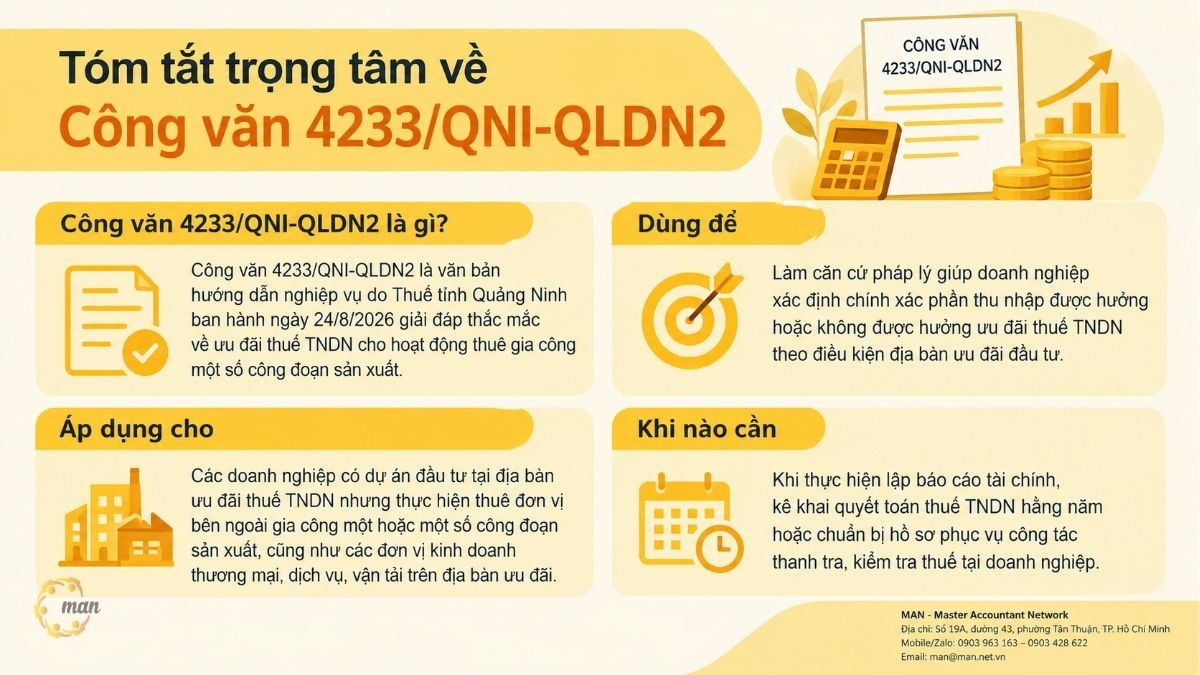
- Official document 4233/QNI-QLDN2 is a professional guidance document issued by the Quang Ninh Provincial Tax Department on August 24, 2026, addressing questions regarding corporate income tax incentives for outsourcing certain stages of production.
- Used to: Provide a legal basis for businesses to accurately determine the portion of income eligible for or not eligible for corporate income tax incentives based on the conditions of investment-incentive areas.
- Applicable to: Businesses with investment projects in areas eligible for corporate income tax incentives but which outsource one or more stages of production to external units, as well as commercial, service, and transportation businesses operating in these tax-incentive areas.
- When needed: When preparing financial statements, filing annual corporate income tax returns, or preparing documents for tax audits and inspections at the enterprise.
What does Official Document 4233/QNI-QLDN2 stipulate regarding corporate income tax incentives for outsourcing activities?

Context for the issuance of Official Letter 4233/QNI-QLDN2 by the Quang Ninh Provincial Tax Department.
In modern manufacturing models, specialization in each stage of production is a solution that helps businesses optimize operating costs. Many companies choose to locate their main factories in economically disadvantaged areas or industrial zones to benefit from preferential tax policies. However, due to technological limitations or equipment capacity constraints, businesses have to outsource some stages of product manufacturing to external partners.
This situation has given rise to many disputes when tax inspectors examine the eligibility for preferential treatment. On August 24, 2026, the Quang Ninh Provincial Tax Department issued Official Letter 4233/QNI-QLDN2 to officially address taxpayers' concerns. The document clearly clarifies the distinction between income generated from actual production stages within the preferential area and income from processing outside the area.
Core guidelines on eligibility for corporate income tax incentives based on geographical location.
According to the guidelines in Official Letter 4233/QNI-QLDN2, the company has an investment project in an area eligible for incentives. corporate income tax, If a company outsources its processing activities to other businesses but these activities do not meet the production criteria for investment-incentive areas, then the income corresponding to these outsourced processing stages will not be eligible for corporate income tax incentives under the investment-incentive area conditions.
This regulation emphasizes the nature of the local tax incentive policy. The State only exempts or reduces taxes on the value added actually created within the boundaries of the investment-incentive area. Moving a production stage to another unit outside the incentive area causes the income from that stage to lose its eligibility for tax incentives.
Which businesses are directly affected by Official Letter 4233/QNI-QLDN2?

Businesses in industrial parks and economic zones outsource production stages.
The most severely affected are processing, manufacturing, mechanical, and electronics businesses operating in industrial parks, economic zones, or high-tech zones. When businesses outsource tasks such as painting, component casting, quality control, or packaging to facilities outside the preferential tax areas, the income generated from these tasks will not be eligible for corporate income tax incentives.
From MAN's perspective, tax authorities, during audits, will meticulously examine the technological process and outsourcing contracts. If a business combines all product profits to apply preferential tax rates or exemptions, the tax authorities will separate and exclude the preferential treatment for the outsourced stages.
The manufacturing company sells its products outside the project area.
Article 23 of Decree 320/2025/ND-CP, point a, clause 3, clearly stipulates: Enterprises with investment projects for production that enjoy tax incentives based on the criteria of tax-incentive areas for corporate income tax, and which generate income from supplying products and goods produced by the project to areas outside the investment project's implementation location, are also entitled to tax incentives for this income.
This regulation creates a favorable mechanism for direct production units. Regardless of the market where the product is sold, domestically or internationally, as long as the entire production process takes place at the factory within the preferential area, sales revenue retains its corporate income tax incentive status.
When are investment projects in the trade and service sectors located in areas eligible for corporate income tax incentives?
Point b, Clause 3, Article 23 of Decree 320/2025/ND-CP specifically stipulates the conditions for applying corporate income tax incentives to the trade and service sector. Accordingly, investment projects in the trade and service sector in areas eligible for corporate income tax incentives (including economic zones, high-tech zones, high-tech agricultural zones, and concentrated digital technology zones) are only entitled to incentives for income generated within the investment project's location.
This means that commercial activities or service provision must be directly related to the investment location. Income from service contracts performed outside the preferential area will not meet the conditions for calculating corporate income tax exemption or reduction.
What tax incentives are available for businesses in the transportation sector?
Decree 320/2025/ND-CP also provides specific guidance for the transportation industry in Clause 3, Article 23. Enterprises with investment projects in the transportation business sector that meet the conditions for preferential treatment regarding location are entitled to corporate income tax incentives on income from transportation services based on the location where the investment project is established, provided that the origin or destination of the project is within the same location.
Regulations restricting the origin or destination of a business help prevent companies from registering their headquarters in preferential areas but conducting transportation business entirely on routes outside the province that are not eligible for preferential treatment.
How should businesses account for and allocate income according to Circular 4233/QNI-QLDN2?
The principle of separate accounting for preferential and non-preferential income.
To preserve legal preferential rights and ensure compliance with the law, Official Letter 4233/QNI-QLDN2 requires the Company to separately account for income from production and business activities eligible for corporate income tax incentives from income from production and business activities not eligible for corporate income tax incentives, based on the actual production and business situation at the unit.
Separate accounting requires the accounting department to meticulously track the revenue and direct costs of each stage of in-house production and each stage of outsourced processing. The system of warehouse release slips, processing contracts, acceptance reports, and cost calculation sheets must clearly show the value contributed by each stage.
Income allocation method when separate accounting is not possible, as per Article 23 of Decree 320/2025/ND-CP.
In cases where the company cannot separately account for income from outsourced processing stages outside the local area from income from self-produced stages, Circular 4233/QNI-QLDN2 instructs that it should comply with the provisions of Article 23 of Decree 320/2025/NĐ-CP.
The formula for allocating non-preferential income is based on the ratio of the production and business costs of outsourcing activities to the total production and business costs of the project. Experts at MAN, with 30 years of experience, note that this allocation method often increases the tax liability compared to accurately accounting separately from the initial documentation stage.
The underlying legal framework related to Official Letter 4233/QNI-QLDN2
Clause 2, Article 10 of Circular 96/2015/TT-BTC on tax incentives based on geographical area.
Official document 4233/QNI-QLDN2 cites Clause 2, Article 10 of Circular 96/2015/TT-BTC (amending and supplementing Clause 4, Article 18 of Circular 78/2014/TT-BTC). This regulation clearly states:
Businesses with investment projects that are eligible for corporate income tax incentives due to meeting the preferential conditions regarding location (including industrial parks, economic zones, and high-tech zones) will have their entire income generated from production and business activities within the preferential area eligible for corporate income tax incentives, excluding the income items mentioned in points a, b, and c of Clause 1, Article 18 of Circular 78/2014/TT-BTC.
Excluded income includes: income from the transfer of real estate, investment projects, participation rights in investment projects, and the right to explore, exploit, and process minerals; and income from production and business activities outside the preferential areas.
Article 23 of Decree 320/2025/ND-CP specifies the conditions for preferential treatment.
Decree 320/2025/ND-CP is a document detailing the implementation of the Corporate Income Tax Law 2025. Article 23 of the Decree establishes the legal basis for verifying the conditions for corporate income tax incentives, directly linked to Article 18 of the Corporate Income Tax Law 2025.
The Decree clarifies each specific case for production, trade, service, and transportation activities. The combination of Decree 320/2025/ND-CP and the guidance in Official Letter 4233/QNI-QLDN2 creates a complete legal framework for the tax authorities to inspect the corporate income tax obligations of preferential projects in the area.
In which cases does the government stipulate that corporate income tax payable be calculated at a rate of 1% of total tax on revenue?
Besides the method of calculating tax based on taxable income, the Corporate Income Tax Law 2025, in Clause 2, Article 11, specifically stipulates the cases in which the Government prescribes the amount of corporate income tax payable calculated at a rate of 1% of taxable income to 3% of revenue. This regulation applies to the following three groups of entities:
- Businesses as stipulated in points c and d, clause 2, Article 2 of the 2025 Corporate Income Tax Law; entities obligated to declare and pay taxes, the timing and method of determining taxable income arising in Vietnam (including foreign contractors and foreign organizations doing business in Vietnam).
- Businesses with total annual revenue not exceeding 3 billion VND as stipulated in Clause 2, Article 10 of the 2025 Corporate Income Tax Law, in cases where revenue can be determined but the costs and income of production and business activities cannot (micro-enterprises applying the % ratio method on revenue).
- Cooperatives, cooperative unions, public service units, and other organizations specified in points c, d, and e of Clause 1, Article 2 of the 2025 Corporate Income Tax Law that engage in the production and business of goods and services with taxable income (excluding tax-exempt income as stipulated in Article 4 of the 2025 Corporate Income Tax Law) and which can account for revenue but cannot determine the costs and income of their production and business activities.
Cases where taxes are paid at a rate of % on the aforementioned revenue operate under a separate mechanism and are not subject to the regulations on the allocation of preferential income based on geographical areas as stipulated in Circular 4233/QNI-QLDN2.
A real-world case study on the risks of tax arrears collection when applying Circular 4233/QNI-QLDN2.
A real-life situation arising at an equipment manufacturing company.
X Industrial Equipment Joint Stock Company has its manufacturing plant located in the Dong Trieu Economic Zone (Quang Ninh), an area eligible for corporate income tax incentives. Company X's project is currently in the phase of applying the preferential tax rate of 10% and is exempt from 100% of corporate income tax payable.
In 2026, Company X entered into a contract for surface plating of metals with Company Y, whose headquarters and production facility are located in Hai Duong province (an area not eligible for tax incentives). The plating processing cost was 4 billion VND, accounting for 20% of the total production cost of 20 billion VND for the shipment. At the end of the 2026 fiscal year, the total profit from the sale of this shipment was 5 billion VND. Company X's accountant declared the entire 5 billion VND profit as tax-exempt for corporate income tax (100%).
Table showing the difference in corporate income tax obligations and penalties incurred.
When the tax authorities conducted a tax audit for the year 2026, based on Official Letter 4233/QNI-QLDN2 and Article 23 of Decree 320/2025/ND-CP, the audit team reassessed Company X's tax obligations. Since Company X could not separately account for the income from the electroplating process, the tax authorities applied the method of allocating income according to the ratio of production costs.
| Calculation item | Data self-declared by businesses | The figures were recalculated by the tax authorities. | Difference / Notes |
| Total profit before tax | 5,000,000,000 VND | 5,000,000,000 VND | Constant |
| Outsourcing cost ratio | 0% (Not separate) | 20% (4 billion / 20 billion) | Determined based on processing costs in Hai Duong. |
| Income eligible for tax exemption (80%) | 5,000,000,000 VND | 4,000,000,000 VND | Applicable tax rate: 0% |
| Non-taxable income (20%) | 0 VND | 1,000,000,000 VND | General tax rate applicable: 20% |
| Corporate income tax payable | 0 VND | 200,000,000 VND | Collection of back taxes on corporate income. |
| Administrative fines (20%) | 0 VND | 40,000,000 VND | Administrative penalties for underreporting taxes. |
| Late payment penalty (estimated at 0.03%/day) | 0 VND | Calculated based on the actual number of days of late submission. | Arising from the deadline for submitting settlement documents. |
In the case of Company X, if the business had proactively negotiated to transfer the electroplating process to a partner located in the Dong Trieu Economic Zone or accurately accounted for the income separately from the beginning, the 240 million VND in back taxes and fines would not have arisen.
Comparison table of corporate income tax incentives based on business type and location.
Determining the nature of the activity and the location of contract execution is crucial in determining corporate income tax obligations. The comparison table below details realistic scenarios according to current regulations:
| Type of activity | Location of execution / Conditions met | Right to enjoy corporate income tax incentives | Legal basis for regulation |
| Self-produced 100% | The factory, 100%, is located in a preferential area. | Enjoy the 100% incentive on all project income. | Clause 2, Article 10 of Circular 96/2015/TT-BTC |
| Outsourcing part of the manufacturing process. | The processing contractor is located within a preferential zone. | Enjoy the 100% incentive on all project income. | Official document 4233/QNI-QLDN2 |
| Outsourcing part of the manufacturing process. | The processing contractor is located OUTSIDE the preferential treatment area. | No preferential treatment will be granted for the portion of income corresponding to outsourced processing stages. | Official Document 4233/QNI-QLDN2 & Decree 320/2025/ND-CP |
| Production for sale outside the local area. | Produced in a preferential area, but sold outside that area. | Enjoy tax benefits on all income from product sales. | Point a, Clause 3, Article 23 of Decree 320/2025/ND-CP |
| Trade and services | Implement the project in a preferential area. | Only income generated within the project's implementation area will be eligible for preferential treatment. | Point b, Clause 3, Article 23 of Decree 320/2025/ND-CP |
| Transportation business | Establish the project in a preferential location. | Enjoy discounts if your itinerary includes a departure or arrival point within the project area. | Clause 3, Article 23 of Decree 320/2025/ND-CP |
| Calculate the % tax on revenue. | Micro-enterprises, foreign contractors, and cooperatives are able to account for their revenue. | No geographical incentives apply; taxes are paid based on fixed revenue (%). | Clause 2, Article 11 of the Corporate Income Tax Law 2025 |
Expert analysis from MAN on tax risks and mitigation strategies.
Common business risks and blind spots when outsourcing.
Through practical experience supporting hundreds of FDI corporations and businesses in Vietnam, experts at MAN point out that the most common mistake made by Chief Financial Officers and Chief Accountants is the product-based mindset. Businesses often assume that as long as the final product is shipped and sold from a factory located in a tax-priority area, all income from that product will automatically be tax-exempt or tax-reduced.
Some common cost management and legal blind spots that businesses frequently encounter include:
- The outsourcing contract does not specify the actual location of the outsourcing company's production facility.
- The accounting records do not aggregate production costs by detailed stage of production, but instead record them collectively as general production costs.
- Applying an incorrect method of income allocation that does not match the nature of the expenses incurred can lead to tax assessments during audits.
- Lack of technical documentation proving the percentage of value added generated in the preferential area.
MAN's strategy for optimizing tax costs and ensuring legal safety.
To control the risk of corporate income tax arrears and optimize operating costs for businesses, the solution from MAN – Master Accountant Network proposes a 3-step management process:
- Review the entire supply chain: Create a checklist for all outsourcing contracts. Accurately determine the administrative coordinates and tax incentive status of outsourcing service providers.
- Establish a detailed accounting system: Develop a cost accounting method that clearly separates in-house production from outsourced production. Create technical documentation and standards to demonstrate the cost contribution ratio of each stage.
- Restructuring the partner network: Priority should be given to selecting processing units with factories located directly in areas with equivalent tax incentives. This helps businesses retain their full corporate income tax benefits on all product revenue.
Conclude
The content of Official Letter 4233/QNI-QLDN2 raises the issue of strict management for businesses currently benefiting from corporate income tax incentives based on geographical location. Understanding the regulations excluding incentives for outsourced processing, combined with separate accounting of income, is key to helping businesses protect their financial security and avoid the risk of tax arrears.
Tax services at MAN – Master Accountant Network
- Tax accounting services
- Tax consulting services
- Tax settlement services
- Tax reporting services
- VAT refund service
Service contact information at MAN – Master Accountant Network
- Address: No. 19A, Street 43, Tan Thuan Ward, Ho Chi Minh City
- Mobile/Zalo: 0903 963 163 – 0903 428 622
- E-mail: man@man.net.vn
- Google Business Profile: View MAN – Master Accountant Network's Google Business Profile
- LinkedIn Founder: View expert Le Hoang Tuyen's LinkedIn profile.
Responsible for production and professional content review by: Mr. Le Hoang Tuyen – Founder & CEO of MAN – Master Accountant Network, CPA Vietnam with over 30 years of experience in accounting, auditing, taxation, and corporate financial consulting.
Frequently Asked Questions (FAQ) regarding Official Letter 4233/QNI-QLDN2
Do businesses that outsource production processes (under the 100% model) outside their local area receive tax incentives?
No. If a business outsources all stages of production to a facility located outside the preferential tax area, all income from this activity will not be eligible for corporate income tax incentives based on the location.
Does Official Document 4233/QNI-QLDN2 from Quang Ninh Province apply to other provinces and cities?
Official document 4233/QNI-QLDN2, issued by the Quang Ninh Provincial Tax Department, provides direct guidance to taxpayers in Quang Ninh province. However, because the document is based on the Corporate Income Tax Law 2025, Decree 320/2025/ND-CP, and Circular 96/2015/TT-BTC, tax authorities in other provinces and cities also apply similar processing principles.
Are businesses that calculate corporate income tax at a rate of 1% of total tax and 3% of total tax on revenue subject to the provisions of this document?
No. This guidance document applies to businesses determining corporate income tax using the taxable income method. Cases where tax is paid at a rate of 1% of taxable income and 3% of taxable revenue are handled separately according to the provisions of Clause 2, Article 11 of the Corporate Income Tax Law 2025.
When separate accounting is not possible, which indicator is used as the criterion for income allocation?
Based on Article 23 of Decree 320/2025/ND-CP, enterprises shall allocate non-incentive income based on the ratio of production and business costs of outsourcing activities outside the locality to the total production and business costs of the project.
What conditions must transportation businesses in preferential areas meet to be eligible for corporate income tax exemptions or reductions?
According to Decree 320/2025/ND-CP, transportation businesses are entitled to tax incentives if they establish a project in a preferential area and the transportation route must have a starting point or a destination point within the area where the project is established.




