

Official document 20010/CHQ-GSQL Issued by the Customs Department on August 7, 2026, this document aims to address practical issues arising at export processing enterprises (EPEs) operating under the free trade zone regulations. This document was issued in the context of many local customs branches being confused about determining the conditions for applying the policy. import and export taxes This applies to export processing zones, especially when businesses no longer fully meet the current customs inspection and supervision criteria.
In direct response to the concerns raised by the Customs Sub-Department of Region IV in Official Letter No. 2239/HQKV4-NVHQ dated June 17, 2026, Official Letter 20010/CHQ-GSQL has systematized all relevant legal grounds, from the 2016 Export and Import Tax Law to the latest guiding decrees of 2025 and 2026. From this perspective... MAN – Master Accountant Network, This document holds significant reference value for FDI enterprises operating export processing zones in Vietnam.
Summary of key points in Official Letter 20010/CHQ-GSQL
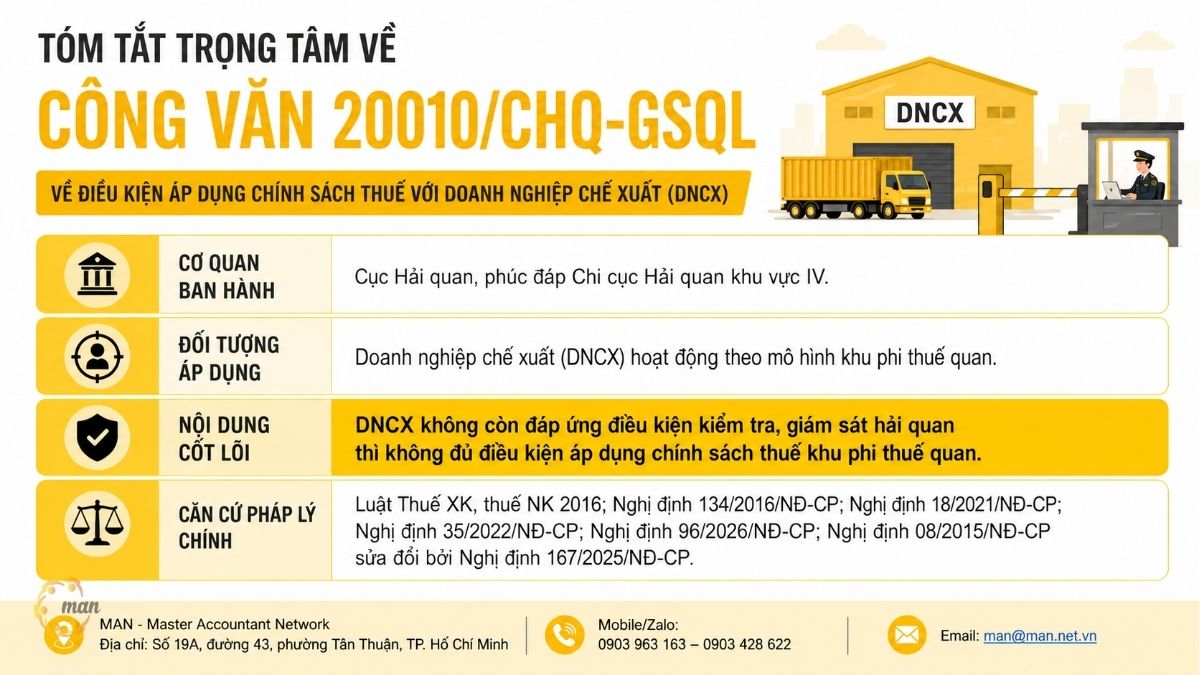
Official Letter 20010/CHQ-GSQL is a document issued by the Customs Department on August 7, 2026, addressing issues regarding customs inspection and supervision conditions and the application of tax policies for export processing enterprises (EPEs) that are non-tariff zones.
- Issuing authority: Customs Department, responding to the Regional Customs Sub-Department IV.
- Applicable entities: Export processing enterprises (EPEs) operating under the free trade zone model.
- The core content: If an export processing zone (EPZ) no longer meets the conditions for customs inspection and supervision, it is not eligible to apply the duty-free zone tax policy.
- Main legal basis: Law on Export and Import Taxes 2016; Decree 134/2016/ND-CP; Decree 18/2021/ND-CP; Decree 35/2022/ND-CP; Decree 96/2026/ND-CP; Decree 08/2015/ND-CP amended by Decree 167/2025/ND-CP.
In what context was Official Document 20010/CHQ-GSQL issued?
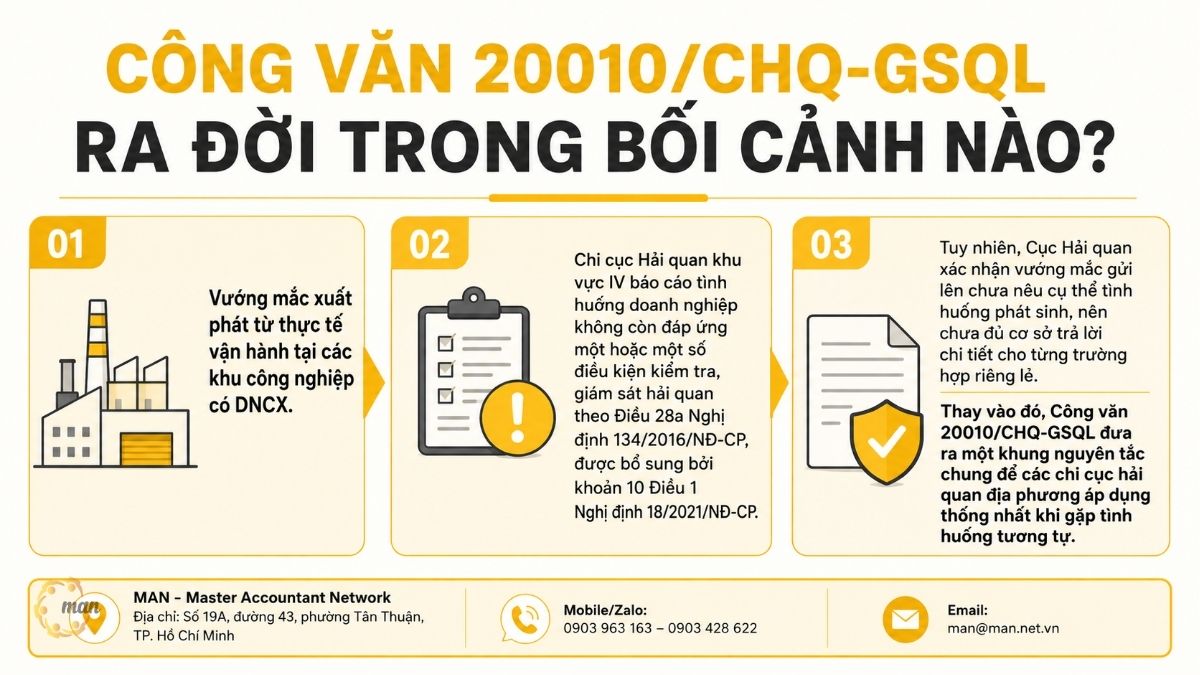
The problem stems from the practical operation of industrial parks with export processing enterprises. The Customs Sub-department of Region IV reported a situation where enterprises no longer meet one or more conditions for customs inspection and supervision according to Article 28a of Decree 134/2016/ND-CP, supplemented by Clause 10, Article 1 of Decree 18/2021/ND-CP.
However, the Customs Department acknowledged that the submitted request did not specify the particular situation, and therefore lacked sufficient basis to provide a detailed response for each individual case. Instead, Circular 20010/CHQ-GSQL provides a general framework of principles for local customs branches to apply uniformly when encountering similar situations.
How are free trade zones and export processing zones defined?
To correctly understand the content of Official Letter 20010/CHQ-GSQL, businesses need to grasp two fundamental concepts: free trade zones and export processing zones (EPZs). These are two closely related legal terms, but they are not entirely identical.
What is a free trade zone according to the 2016 Law on Export and Import Taxes?
According to Clause 1, Article 4 of the Law on Export and Import Taxes 2016 dated April 6, 2016, a non-tariff zone is an economic area located within the territory of Vietnam, established in accordance with the law, with a defined geographical boundary, separated from the outside area by a physical barrier. This area must ensure conditions for customs inspection, supervision, and control of imported and exported goods and vehicles and passengers entering and exiting the country.
The buying and selling of goods between a free trade zone and the outside world is defined as an export and import relationship. This is the basis for goods entering and leaving the free trade zone to benefit from special tax policies, different from those applied to goods circulating within the domestic market.
Is DNCX considered a duty-free zone?
According to Clause 2, Article 26 of Decree 35/2022/ND-CP dated May 28, 2022, export processing zones, export processing enterprises (EPEs), or industrial zones designated for EPEs must be separated from the outside territory by a system of fences, gates, and entrances. This system must ensure conditions for inspection, supervision, and control by customs authorities in accordance with regulations applicable to non-tariff zones.
Therefore, an export processing zone (EPZ) is only considered a duty-free zone when it fully meets the conditions regarding physical barriers and customs control mechanisms. This is the key point emphasized in Circular 20010/CHQ-GSQL: the status of a duty-free zone is not a permanent fixed attribute, but depends on whether the enterprise continues to maintain the physical conditions and control procedures.
Which goods in the free trade zone are exempt from export and import taxes?
Based on point c, clause 4, Article 2 of the 2016 Law on Export and Import Taxes, the subjects liable to export and import taxes do not apply to three specific groups of goods. This is the most important legal basis explaining why maintaining the status of a free trade zone is of great value to export processing enterprises.
- Goods exported from the free trade zone to foreign countries.
- Goods imported from abroad into the free trade zone and used only within the free trade zone.
- Goods are transferred from one free trade zone to another.
A prerequisite for enjoying the aforementioned tax exemption policy is that the export processing zone (EPZ) must be recognized as a truly tax-free zone, meaning it must fully meet the conditions for customs inspection and supervision as stipulated in Article 28a of Decree 134/2016/ND-CP. This is the direct link between the regulations on tax-exempt entities and the principles affirmed in Official Letter 20010/CHQ-GSQL.
Which entities are directly affected by Official Letter 20010/CHQ-GSQL?
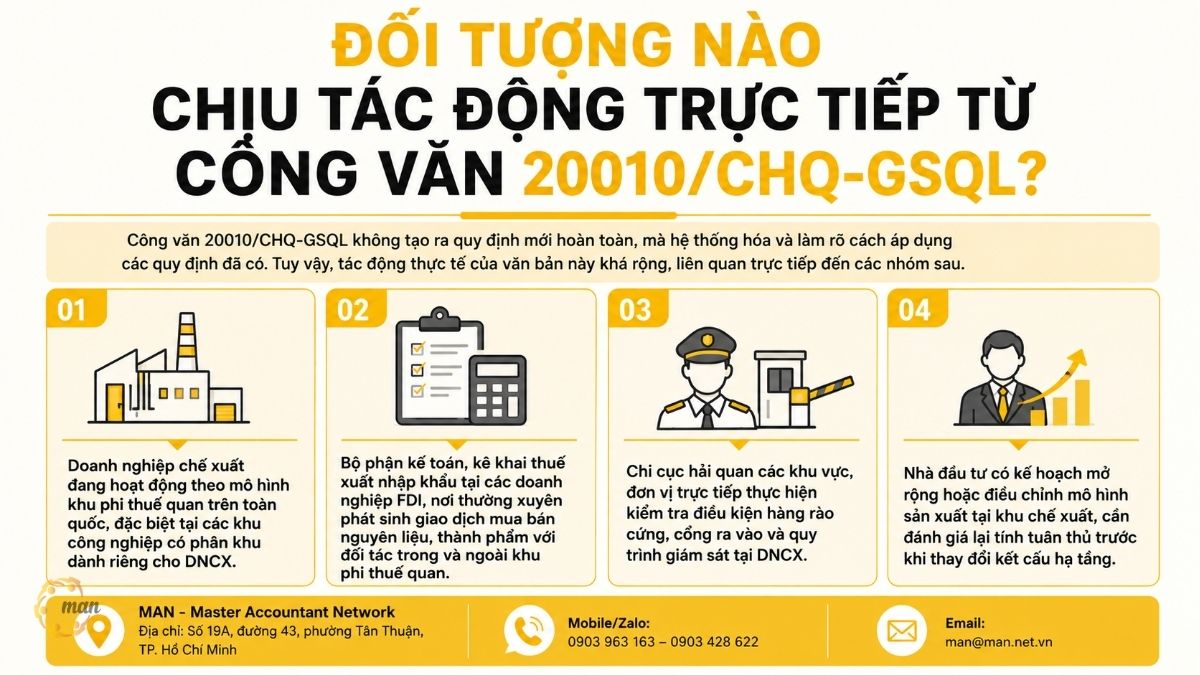
Circular 20010/CHQ-GSQL does not create entirely new regulations, but rather systematizes and clarifies the application of existing regulations. However, the practical impact of this document is quite broad, directly affecting the following groups.
- Export processing enterprises are operating under a free trade zone model nationwide, especially in industrial parks with dedicated zones for export processing enterprises.
- The accounting and import/export tax declaration department at FDI enterprises, where transactions involving the purchase and sale of raw materials and finished products with partners inside and outside the free trade zone frequently occur.
- The regional customs branches are the units directly responsible for inspecting the conditions of physical barriers, entrance gates, and monitoring procedures at export processing zones.
- Investors planning to expand or modify their production models within export processing zones need to reassess compliance before making any changes to the infrastructure.
When is an export processing zone (EPZ) considered no longer eligible for the free trade zone tax policy?
This is the central and most practical content in Circular 20010/CHQ-GSQL. The principle established by the Customs Department is very clear, leaving no room for alternative interpretation.
Based on Article 28a of Decree 134/2016/ND-CP, supplemented by Clause 10, Article 1 of Decree 18/2021/ND-CP, export processing enterprises (EPEs) must meet specific customs inspection and supervision conditions to be recognized as non-tariff zones. When one or more of these conditions are no longer met, the EPE will not be eligible to apply the tax policy for non-tariff zones for the corresponding period.
This principle is similar to the provisions in Clause 3, Article 23 of Decree 96/2026/ND-CP dated March 31, 2026, on adjusting investment incentives. Accordingly, during the period when an investment project does not meet the conditions for enjoying incentives, the investor is not entitled to incentives for that specific period. Similarly, in the field of import and export taxes, when an export processing zone enterprise (EPZ) does not meet the inspection and supervision conditions, the tax policy for the non-tariff zone is also temporarily suspended for the corresponding period and is not retroactive.
In what situations does a business need to file a new customs declaration?
One point that businesses often overlook is the obligation to file a new customs declaration when there are changes related to tax-exempt items or tax-exempt purposes. This regulation directly affects export processing enterprises when the status of the free trade zone changes.
According to Clause 5, Article 25 of Decree 08/2015/ND-CP, as amended and supplemented by Clause 12, Article 1 of Decree 167/2025/ND-CP dated June 30, 2025, customs declarants must file a new customs declaration in two main cases. Firstly, imported or exported goods that were previously exempt from or not subject to tax but subsequently change in terms of tax exemption or the purpose of tax exemption. Secondly, imported raw materials and supplies for processing or manufacturing export goods, or temporarily imported/temporarily exported goods, which, after customs clearance, change in purpose of use and are transferred for domestic consumption.
The management and tax policies for goods will be applied at the time of registering the new customs declaration, except in cases where the enterprise has fully complied with the management policies at the time of registering the initial declaration. This is the point of intersection between Circular 20010/CHQ-GSQL and the actual declaration obligations of export processing enterprises when the status of the free trade zone changes.
Compilation of legal documents related to Official Letter 20010/CHQ-GSQL
To fully understand the legal validity of Official Letter 20010/CHQ-GSQL, businesses need to compare it with multiple documents simultaneously. The table below summarizes the main grounds directly cited by the Customs Department in the document.
| Legal documents | Number / Date of Issue | Related content |
| Law on Export and Import Taxes 2016 | April 6, 2016 | Definition of a free trade zone; goods within a free trade zone are exempt from import and export taxes. |
| Decree 134/2016/ND-CP | September 1, 2016 | Customs inspection and supervision conditions for export processing enterprises that are duty-free zones (Article 28a) |
| Decree 18/2021/ND-CP | March 11, 2021 | Add Clause 10 to Article 1, providing detailed regulations for Article 28a of Decree 134/2016/ND-CP. |
| Decree 35/2022/ND-CP | May 28, 2022 | Specific regulations apply to export processing zones and export processing enterprises; conditions for physical barriers, and access rights to export processing zones. |
| Decree 96/2026/ND-CP | March 31, 2026 | Adjusting investment incentives when a project fails to meet the conditions within a certain period. |
| Decree 08/2015/ND-CP | January 21, 2015 | Customs procedures for goods entering and leaving the free trade zone (Article 42) |
| Decree 167/2025/ND-CP | June 30, 2025 | Amend Clause 12 of Article 1, stipulating the declaration of a new customs declaration form when the purpose of use changes. |
| Official document 2239/HQKV4-NVHQ | June 17, 2026 | The document from the Customs Sub-Department of Region IV reports the difficulties encountered, serving as the basis for issuing Document 20010/CHQ-GSQL. |
Important Note: Official Letter 20010/CHQ-GSQL is merely a document addressing a matter of principle and does not replace the original decrees. When specific situations arise, local customs offices still need to compare the details of each enterprise's actual records before applying the regulations.
What are the customs procedures for goods entering and leaving a free trade zone?
In addition to understanding the applicable tax policies, businesses need to be familiar with the corresponding customs procedures, as stipulated in Article 42 of Decree 08/2015/ND-CP.
- Goods brought into a free trade zone from abroad, or exported from a free trade zone to abroad, must be declared to customs.
- Goods brought from free trade zones into the domestic market must go through the same procedures as imported goods.
- Goods brought from the domestic market into the free trade zone must go through the same procedures as goods exported.
- Goods transferred from one free trade zone to another undergo the same procedures as goods transported under customs supervision.
The Minister of Finance is the competent authority to specify the detailed customs procedures for each type of goods mentioned above. Businesses need to monitor the specific guiding circulars to avoid errors when declaring, especially during the transitional period when the export processing zone enterprise changes its status in meeting the conditions of a free trade zone.
Do export processing enterprises (EPEs) that sell goods to the domestic market have to pay taxes?
In addition to customs inspection and supervision conditions, businesses need to pay attention to regulations regarding export processing zones (EPZs) selling goods to the domestic market, which is often confused with the tax exemption policy applied to free trade zones. According to Clause 11, Article 26 of Decree 35/2022/ND-CP, EPZs are permitted to sell goods to the domestic market.
However, goods imported from export processing zones and non-tariff zones into the domestic market are subject to taxes as stipulated by the law on export and import taxes. In other words, the tax exemption policy only applies to goods circulating within the non-tariff zone or exported abroad. As soon as goods from export processing zones are consumed in the domestic market, this transaction is considered a normal import and must be declared and taxed in full.
Who is permitted to enter and exit the export processing zone according to current regulations?
Controlling personnel entry and exit is one of the conditions for establishing a free trade zone status for an export processing zone (EPZ), directly related to the content of Official Letter 20010/CHQ-GSQL. According to Clause 12, Article 26 of Decree 35/2022/ND-CP, only investors, employees working in EPZs, and those with working relationships with EPZs are allowed to enter and exit the enterprise.
Strict control over entry and exit is not only a requirement for internal security, but also part of the customs supervision conditions for maintaining the status of a free trade zone. If the export processing zone (EPZ) relaxes this step, it could become one of the grounds for the customs authority to determine that the enterprise no longer meets the inspection and supervision conditions as stipulated in Circular 20010/CHQ-GSQL.
Case Study: Export Processing Enterprises in Southern Industrial Zones Address Obstacles Regarding Free Trade Zone Conditions
Real-world context
A DNCX (a Vietnamese company manufacturing electronic components) in the Southern Industrial Park, during the factory expansion process, temporarily demolished a section of its perimeter fence to construct an internal transport route for two months. During this period, the access control gate system was also not fully operational according to the procedures registered with the customs office.
Risks arise
According to word analysis MAN – Master Accountant Network, This is a typical situation mentioned in Official Letter 20010/CHQ-GSQL. During the period when the perimeter fence is no longer intact, the export processing zone enterprise (EPZ) does not meet the conditions in Article 28a of Decree 134/2016/ND-CP, meaning that imported raw materials for the two months of construction risk not being subject to the usual free zone tax policy.
Recommended course of action
Experts at MAN, with over 30 years of experience in tax consulting and auditing in Vietnam, recommend that businesses take the following three steps when a similar situation arises.
- Provide prior written notification to the directly managing customs office regarding the construction plan and the expected timeframe for any impact on the rigid barrier.
- Implement temporary alternative monitoring measures, such as increasing security personnel and installing surveillance cameras in the construction area.
- Review and maintain complete records of customs declarations generated during the construction phase to proactively provide explanations if tax policies are retroactively applied, as stipulated in Clause 5, Article 25 of Decree 08/2015/NĐ-CP.
The measured results
Thanks to proactive notification and the preservation of supporting documents, the business in the aforementioned situation avoided being subject to retroactive import tax collection on the entire shipment of raw materials generated during the construction phase. The subsequent inspection by the customs authorities lasted only one working day, and no administrative violation penalties were issued.
Comparison table of free trade zone conditions before and during the non-compliance period.
To clarify the differences in benefits and risks, businesses can compare the conditions for applying the free trade zone policy in two states: when all conditions are met and when they are not met.
| Criteria | When all conditions are met | When the conditions are not met |
| Import and export tax policy | It is treated as a duty-free zone, exempt from import and export taxes according to point c, clause 4, Article 2 of the 2016 Law on Export and Import Taxes. | Not eligible to apply the free trade zone tax policy during the corresponding period. |
| Customs declaration procedures | Follow the standard procedures for the free trade zone. | A new customs declaration may need to be filed in accordance with Clause 5, Article 25 of Decree 08/2015/ND-CP. |
| Access control | According to the list of investors, employees, and those with work relationships. | A temporary monitoring plan needs to be added to mitigate the risk of being assessed as ineligible. |
| Tax risks | Low, if the application is fully compliant. | Risk of being subject to retroactive collection of import taxes and administrative penalties. |
Expert opinion: Common business risks when implementing Circular 20010/CHQ-GSQL
Based on practical experience advising numerous FDI enterprises in key industrial zones, the experts at MAN – Master Accountant Network Four of the most common risk groups related to maintaining the free trade zone status of export processing zones (EPZs) have been identified.
- Risk 1: Negligence in maintaining rigid fences and gate systems: Many businesses consider the installation of a solid fence as a one-time formality upon establishment, neglecting regular maintenance. When the fence deteriorates or is damaged by natural disasters or flooding, businesses often discover the problem late, leading to a longer-than-necessary period of non-compliance.
- Risk 2: Failure to provide timely notification of infrastructure changes: Factory expansion and new construction projects often result in temporary disruptions to fences or control gates. If businesses do not proactively notify the customs office in advance, they will find it difficult to explain the justification for the period when inspections occur, especially if the conditions are not met.
- Risk 3: Lack of record-keeping procedures to document when issues arise and how they are resolved: In accordance with Clause 3, Article 23 of Decree 96/2026/ND-CP on the principle of not retroactively applying preferential treatment to periods when conditions are not met, businesses need to clearly identify the start and end dates of the violation. Lack of documentation proving the precise timeframe makes it difficult to determine the scope of the impact and can easily lead to adverse treatment being applied more broadly than is actually the case.
- Risk 4: Confusion between the obligation to file a new customs declaration and to amend an old declaration: Many import-export accountants make mistakes when faced with a change in the intended use of goods, only adjusting the old declaration instead of creating a new one in accordance with Clause 5, Article 25 of Decree 08/2015/ND-CP as amended. This error can lead to the incorrect application of tax policies that are no longer appropriate.
Conclude
Circular 20010/CHQ-GSQL reinforces an important principle in import and export tax management for export processing zones (EPZs): the status of a duty-free zone is linked to the continuous maintenance of customs inspection and supervision conditions, not a fixed, one-time privilege granted indefinitely. Businesses need to proactively review their barrier systems, control gates, and personnel entry and exit management procedures periodically, and prepare complete supporting documentation before any changes affecting infrastructure occur.
Tax services at MAN – Master Accountant Network
- Tax accounting services
- Tax consulting services
- Tax settlement services
- Tax reporting services
- VAT refund service
Service contact information at MAN – Master Accountant Network
- Address: No. 19A, Street 43, Tan Thuan Ward, Ho Chi Minh City
- Mobile/Zalo: 0903 963 163 – 0903 428 622
- E-mail: man@man.net.vn
- Google Business Profile: View MAN – Master Accountant Network's Google Business Profile
- LinkedIn Founder: View expert Le Hoang Tuyen's LinkedIn profile.
Responsible for production and professional content review by: Mr. Le Hoang Tuyen – Founder & CEO of MAN – Master Accountant Network, CPA Vietnam with over 30 years of experience in accounting, auditing, taxation, and corporate financial consulting.
Frequently Asked Questions about Official Document 20010/CHQ-GSQL
When was Official Document 20010/CHQ-GSQL issued?
Official document 20010/CHQ-GSQL issued by the Customs Department on August 7, 2026, to address the issues raised by the Customs Sub-Department of Region IV.
If a DNCX (Export Processing Zone) fails to meet customs inspection and supervision requirements, will it permanently lose its free trade zone status?
No. Official document 20010/CHQ-GSQL only specifies that the export processing enterprise (EPE) is ineligible for the non-tariff zone tax policy for the period during which it does not meet the conditions, not that its status is permanently terminated.
What is the primary legal basis for Official Letter 20010/CHQ-GSQL?
Mainly Article 28a of Decree 134/2016/ND-CP, supplemented by Decree 18/2021/ND-CP, along with the 2016 Law on Export and Import Taxes and Decree 35/2022/ND-CP.
If an export processing zone (EPZ) does not meet the requirements, does the enterprise have to file a new customs declaration?
Depending on the specific circumstances, it may be necessary to declare, in accordance with Clause 5, Article 25 of Decree 08/2015/ND-CP as amended by Decree 167/2025/ND-CP, if there are changes to the tax-exempt items or the intended use of the goods.
Who is allowed to enter and exit the export processing zone according to current regulations?
According to Clause 12, Article 26 of Decree 35/2022/ND-CP, only investors, employees working in export processing zones, and those with working relationships with export processing zones are allowed to enter and exit the enterprise.




