Invoices for gifts will be issued from July 1, 2026. This is a topic of great interest to many accountants and business owners when Decree 254/2026/ND-CP The new regulations have officially come into effect. They not only mandate the issuance of electronic invoices for goods and services given as gifts or donations, but also tighten the required content on invoices, the method of determining the taxable value, and the timing of invoice issuance. Many manufacturing, distribution, and retail businesses with promotional programs or customer gifts are at risk of being subject to back taxes and penalties if they fail to update their information promptly during tax settlement.
This article is based on the original regulations in Decree 254/2026/ND-CP and related documents, combined with practical analysis from MAN – Master Accountant Network, a tax, accounting, and auditing consulting firm with over 30 years of practical experience in Vietnam. The content helps corporate accountants understand the process and avoid errors when preparing invoices for gifts and donations during the transition period under new regulations.
Summary of key points regarding invoicing for gifts from July 1, 2026.
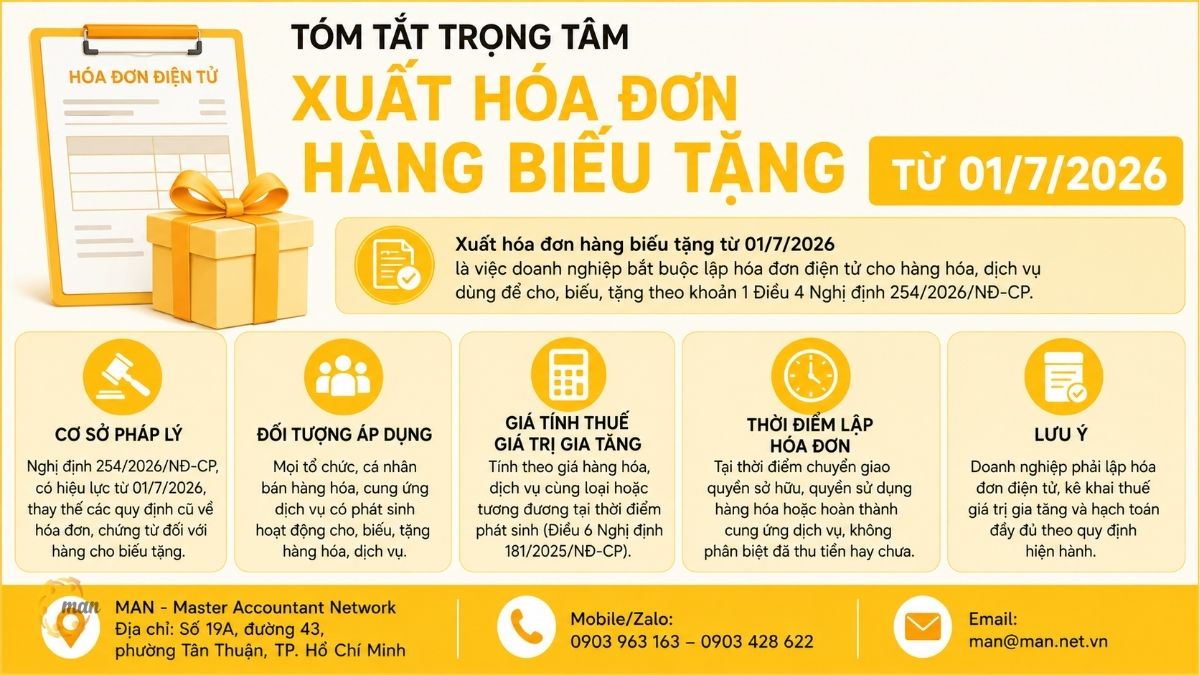
- Issuing invoices for goods and services given as gifts from July 1, 2026, means that businesses are required to issue electronic invoices for goods and services used for giving or gifting, as stipulated in Clause 1, Article 4 of Decree 254/2026/ND-CP.
- Legal basis: Decree 254/2026/ND-CP, effective from July 1, 2026, replaces the old regulations on invoices and documents for goods given as gifts.
- Applicable to: All organizations and individuals selling goods or providing services that involve giving away or gifting goods or services.
- Value-added tax base: Calculated based on the price of similar or equivalent goods and services at the time of transaction (Article 6 of Decree 181/2025/ND-CP).
- Time of invoice issuance: At the time of transfer of ownership or right to use goods or completion of service provision, regardless of whether payment has been received or not.
What are the legal regulations regarding issuing invoices for gifts and presents from July 1, 2026?
According to Clause 1, Article 4 Decree 254/2026/ND-CP, For goods and services intended for giving away, gifting, or donation, the seller Electronic invoices must be issued. In accordance with regulations. This is a mandatory principle, regardless of whether the gift is given with or without payment from the recipient.
Electronic invoices must comply with standard data formats and contain all the required information in accordance with tax laws, accounting laws, and Article 10 of this Decree. The seller is legally responsible for the accuracy of the issued invoice, even if the goods are given as gifts or free of charge to customers or partners.
Why do gifts still need to be invoiced even though no payment is received?
Many novice accountants often mistakenly believe that goods not collected in cash do not require invoices. In reality, from a tax management perspective, giving, gifting, or donating is still considered a transaction that incurs value-added tax (VAT) declaration obligations, and may even affect deductible expenses when calculating corporate income tax.
From this perspective MAN – Master Accountant Network, This is precisely the point that tax authorities usually scrutinize most closely when auditing year-end promotional programs and gifts offered by retail and consumer goods manufacturing businesses.
The role of invoicing for gifts in tax management and auditing.
Properly invoicing gifts and promotional items is not only a legal obligation but also an important internal control tool. Valid invoices help businesses demonstrate that gift and promotional expenses are reasonable and legitimate when settling corporate income tax at the end of the year.
Conversely, if invoices for gifts are omitted or incorrectly prepared, businesses face two parallel risks: the expense being disallowed when calculating corporate income tax and the possibility of being subject to retroactive collection of output value-added tax. In many audits, this is a frequently adjusted item due to missing original documents or discrepancies in the invoice details.
Which entities are required to issue invoices for gifts and presents from July 1, 2026?
This regulation applies to all organizations and individuals engaged in production and business activities involving the giving, gifting, or donating of goods and services, including:
- Manufacturers give away product samples and promotional gifts to customers.
- Commercial and retail businesses offer free gifts as part of a purchase program.
- The service provider offers free service packages to loyal customers.
- Businesses give gifts internally and to partners during holidays and events.
Point to note: the regulations do not exclude categories based on business size or the value of the gift. Even if the value is small, gifted goods must still be recorded and invoiced in accordance with proper procedures, except for certain cases listed in the Appendix to the decree where a full invoice is not necessarily required.
Mandatory information on gift invoices according to Article 10 of Decree 254/2026/ND-CP
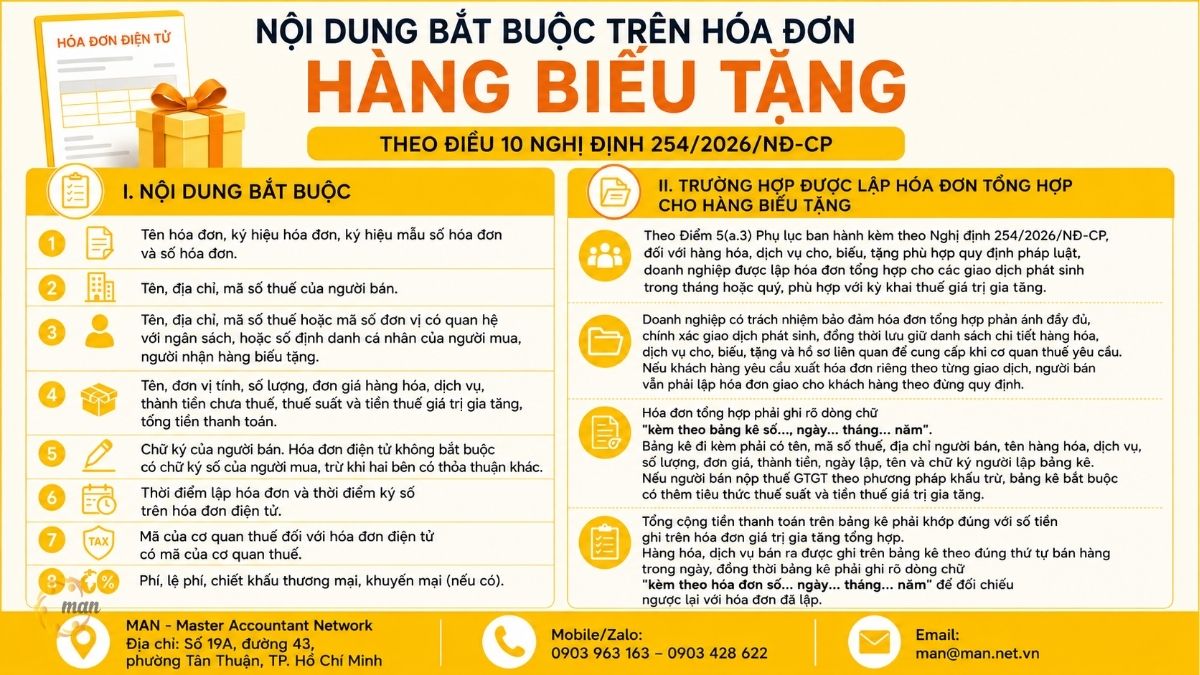
According to Clause 1, Article 10 of Decree 254/2026/ND-CP, invoices for gifts must contain the following information:
- Invoice name, invoice symbol, invoice form number symbol, and invoice number.
- Name, address, and tax identification number of the seller.
- The name, address, tax identification number or budget-related unit code, or personal identification number of the buyer or recipient of the gift.
- Name, unit of measurement, quantity, unit price of goods/services, total amount before tax, tax rate and value-added tax amount, total payment amount.
- The seller's signature. Electronic invoices are not required to have the buyer's digital signature, unless the two parties have agreed otherwise.
- The time of invoice creation and the time of digital signature on the electronic invoice.
- The tax authority code for electronic invoices includes a tax authority code.
- Fees, charges, trade discounts, promotions (if any).
Cases where a consolidated invoice is issued for gifts:
According to Point 5(a.3) of the Appendix issued with Decree 254/2026/ND-CP, for goods and services given as gifts or donations in accordance with legal regulations, enterprises consolidated invoice for transactions occurring within the month or quarter, in accordance with the value-added tax filing period.
Businesses are responsible for ensuring that the consolidated invoice fully and accurately reflects all transactions, and for maintaining a detailed list of goods and services given as gifts or donations, along with related documentation, to provide when requested by the tax authorities. If a customer requests a separate invoice for each transaction, the seller must still issue an invoice to the customer in accordance with regulations.
The consolidated invoice must clearly state "attached with list number…, dated… month… year". The accompanying list must include the name, tax code, and address of the seller, the name of the goods or services, quantity, unit price, total amount, date of issue, and the name and signature of the person who prepared the list. If the seller pays value-added tax using the deduction method, the list must also include the tax rate and the amount of value-added tax.
The total amount payable on the sales list must match the amount recorded on the consolidated value-added tax invoice. Goods and services sold must be recorded on the sales list in the correct order of sale during the day, and the list must clearly state "attached to invoice number… dated… month… year" for verification against the issued invoice.
What are the regulations regarding the date of invoicing for gifts and presents from July 1, 2026?
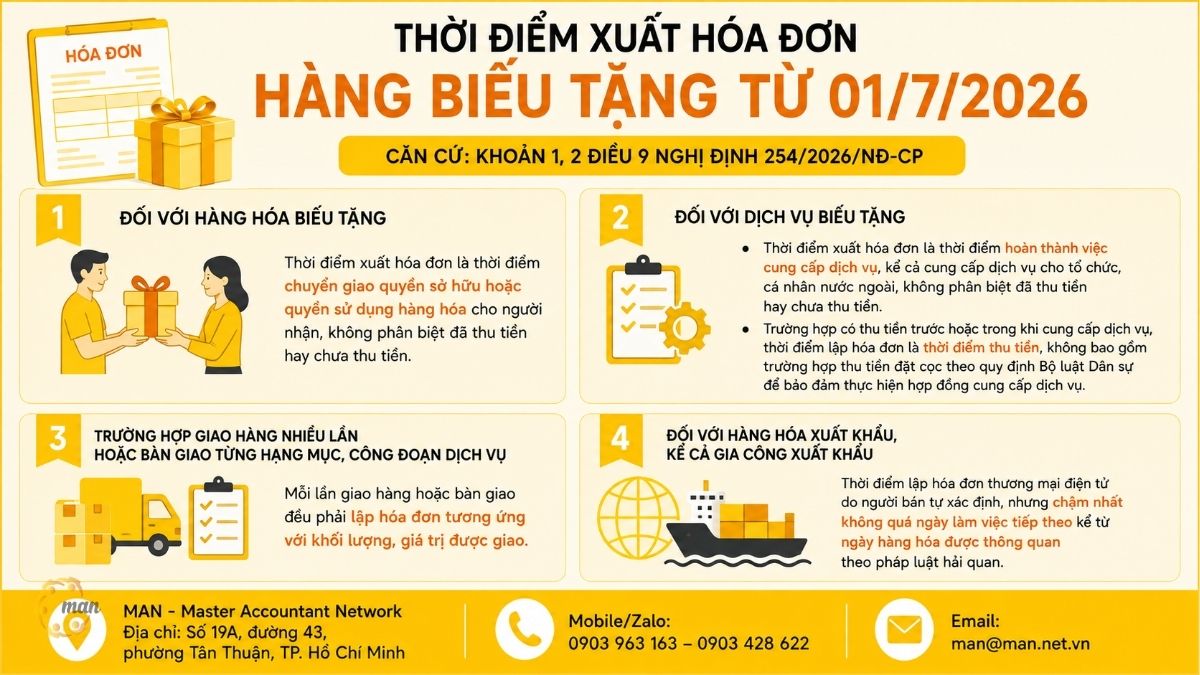
This is a contentious issue between the sales and accounting departments within a business. According to Clauses 1 and 2 of Article 9 of Decree 254/2026/ND-CP, the time of invoice issuance is determined as follows:
- For goods given as gifts: the time of invoice issuance is the time of transfer of ownership or the right to use the goods to the recipient, regardless of whether payment has been received or not.
- For gift services: the time of invoice issuance is the time of completion of service provision, including service provision to foreign organizations or individuals, regardless of whether payment has been received or not. If the service provider receives payment before or during service provision, the time of invoice issuance is the time of payment, excluding cases of receiving deposits as stipulated in the Civil Code to guarantee the performance of the service contract.
- In cases of multiple deliveries or handover of individual items or service stages, an invoice must be issued for each delivery or handover, corresponding to the quantity and value delivered.
For exported goods, including goods processed for export, the time of issuing the electronic commercial invoice is determined by the seller, but no later than the next working day from the date the goods are cleared through customs according to customs law.
How to determine the value for VAT purposes for gifts.
According to Clause 1, Article 6 of Decree 181/2025/ND-CP, the taxable value for value-added tax on goods and services used for gifts or donations is price of similar or equivalent goods or services at the time of occurrence This refers to activities involving giving, gifting, or donating. Businesses are not allowed to use cost price or arbitrary prices when declaring taxes for gifted or donated goods.
Here's an example illustrating the calculation method:
Company B manufactures cosmetics and gives customers a sample set of products that sell for 500,000 VND on the market. Even though the company doesn't charge customers, it must still issue an electronic invoice recording the taxable price of 500,000 VND and calculate the corresponding output value-added tax at the applicable tax rate for that item.
If company B gives away 200 sets of products in a month, the total taxable value is 100,000,000 VND, which can be used as the basis for declaring output value-added tax on the tax return for the corresponding tax period, even if no cash flow is generated.
How to look up information on electronic invoices for gifts when inspecting goods in circulation?
In addition to the obligation to issue invoices, businesses also need to understand the regulations regarding how authorities can verify invoices when inspecting goods in circulation, because gifts and donations transported on the road can still be inspected like regular goods. This is stipulated in Article 35 of Decree 254/2026/ND-CP.
Accordingly, when inspecting goods circulating in the market in cases where electronic invoices are used, state agencies and authorized persons shall... Access the Tax Management Information System To retrieve electronic invoice information for management purposes, businesses are not required to present paper invoices. Relevant agencies are responsible for arranging equipment to access and retrieve electronic invoice data directly at the inspection site.
In cases of force majeure due to technical failures or natural disasters affecting internet access, preventing the retrieval of invoice data, the state agency or authorized person conducting the inspection will apply other appropriate measures to verify the electronic invoice information. Businesses transporting gifts should proactively save copies of electronic invoices or lookup codes on the delivery person's mobile device for quick verification when needed.
Compilation of legal documents related to issuing invoices for gifts.
Important note: Detailed guidance documents for specific situations arising in practice may continue to be issued by the tax authorities after July 1, 2026. Experts at MAN recommend that businesses regularly update themselves on new guidance documents to ensure accurate application and avoid risks during year-end tax settlements.
| Legal documents | Number / Date of Issue | Related content |
| Decree 254/2026/ND-CP | Effective from July 1, 2026 | Regulations on the principles of invoicing, invoice content, and timing of invoice issuance for gifts and presents. |
| Decree 181/2025/ND-CP | Article 6 | Regulations on the taxable value for value-added tax on goods and services given as gifts or donations. |
| Appendix: Contents of the invoice (attached to Decree 254/2026/ND-CP) | Section 9, Point 5(a.3) | Regulations specifying cases where invoices do not need to contain all the necessary information; guidelines for preparing consolidated invoices for gifts and presents. |
| Article 35 of Decree 254/2026/ND-CP | Effective from July 1, 2026 | Regulations for searching electronic invoice information to facilitate the inspection of goods circulating in the market. |
Case Study: How do retail businesses handle invoices for gifts and presents?
Background
The C chain of electronics supermarkets in Ho Chi Minh City regularly offers free accessories with the purchase of main products, and also gives thank-you gifts to VIP customers at the end of the year. Before July 1, 2026, the sales department only recorded transactions internally using delivery notes, and did not issue separate invoices for each small gift-giving event.
Processing after July 1, 2026
According to advice from MAN – Master Accountant Network, the business implemented three adjustment steps: (1) Classify gift-giving programs according to frequency of occurrence to apply monthly consolidated invoices for low-value gifts, with detailed statements in accordance with the prescribed form; (2) Develop an internal reference price list for each group of gift items based on similar selling prices, as a basis for calculating value-added tax; (3) Retrain cashier staff on coordinating with accountants to fully record recipient information when the value of gifts exceeds the prescribed threshold.
The measured results
- All gift-giving transactions for the month are consolidated into a single invoice with a summary statement, reducing the workload of preparing individual invoices for the accounting department by approximately 60%.
- Complete documentation helps ensure that the periodic tax audit proceeds smoothly, without any outstanding tax arrears related to gifts or donations.
- Businesses can proactively control the cost of gifts that are deductible when calculating corporate income tax, avoiding situations where expenses are disallowed due to lack of documentation.
Expert opinion: Common risks when invoicing for gifts.
Experts at MAN – Master Accountant Network With over 30 years of experience in auditing and tax consulting in Vietnam, we note four main risks that businesses often face:
- Risk 1: Missing to invoice small-value gifts: Many businesses believe that low-value gifts do not require invoices. This is a misconception that can lead to retroactive collection of output value-added tax when tax authorities compare the quantity of goods shipped with the issued invoices.
- Risk 2: Incorrect determination of the tax base price: Some accountants use the cost price instead of the selling price of similar items to calculate value-added tax for gifts, leading to under-declaration of tax payable. This is a common mistake when businesses do not establish a clear reference price list for each item.
- Risk 3: The itemized statement does not match the consolidated invoice: When using consolidated invoices, if the statement is not fully and accurately updated regarding the quantity and unit price of each transaction, businesses are easily suspected of overstating or understating when comparing annual settlement figures.
- Risk 4: Lack of coordination between the sales and accounting departments: In practice, promotional programs and giveaways are often implemented by the sales department but are not promptly communicated to the accounting department. This leads to delays or omissions in invoicing, directly affecting the validity of documents during tax audits.
Conclude
Issuing invoices for gifts and presents from July 1, 2026, according to Decree 254/2026/ND-CP, is a mandatory regulation that businesses need to standardize from the transaction recording stage to the document preparation stage. Understanding the content of the invoice, the time of issuance, how to determine the taxable value, and the conditions for issuing consolidated invoices helps businesses comply with the law, control costs effectively, and minimize risks during tax audits and inspections.
Tax services at MAN – Master Accountant Network
- Tax accounting services
- Tax consulting services
- Tax settlement services
- Tax reporting services
- VAT refund service
Service contact information at MAN – Master Accountant Network
- Address: No. 19A, Street 43, Tan Thuan Ward, Ho Chi Minh City
- Mobile/Zalo: 0903 963 163 – 0903 428 622
- E-mail: man@man.net.vn
- Google Business Profile: View MAN – Master Accountant Network's Google Business Profile
- LinkedIn Founder: View expert Le Hoang Tuyen's LinkedIn profile.
Responsible for production and professional content review by: Mr. Le Hoang Tuyen – Founder & CEO of MAN – Master Accountant Network, CPA Vietnam with over 30 years of experience in accounting, auditing, taxation, and corporate financial consulting.
Frequently Asked Questions about Invoicing Gift Items from July 1, 2026
Is it mandatory to issue an invoice for gifts?
Yes. According to Clause 1, Article 4 of Decree 254/2026/ND-CP, all goods and services used for giving, gifting, or donating must be invoiced electronically, regardless of their value.
How is the value-added tax (VAT) for gifts determined?
According to Article 6 of Decree 181/2025/ND-CP, the taxable price is the price of similar or equivalent goods and services at the time the giving, gifting, or donation activity occurs, not the cost price.
Can a business combine multiple gift-giving occasions into a single invoice?
Yes. Businesses can issue consolidated invoices monthly or quarterly for gifts, along with a detailed breakdown of each transaction, unless the customer requests a separate invoice.
From what point in time should invoices be issued for gifts?
For goods, the calculation starts from the time ownership or the right to use is transferred to the recipient. For services, the calculation starts from the time the service is completed, regardless of whether payment has been received or not.
What are the consequences of not issuing invoices for gifts?
Businesses may be subject to retroactive collection of output value-added tax, have expenses disallowed when calculating corporate income tax, and face administrative penalties for violations related to invoices and supporting documents according to current regulations.