

Official Document 9409/BTC-CT This is the latest directive from the Ministry of Finance, issued on July 3, 2026, requiring a thorough review and resolution of the issue of businesses not operating at their registered addresses nationwide. This document is part of the campaign to clean up tax identification numbers – removing bottlenecks in business operations, and sets specific deadlines for provincial tax authorities and business registration agencies to coordinate implementation.
For businesses, this is not simply an internal administrative document. If your company has ever changed offices but hasn't updated the address, or has outstanding tax debts, Official Document 9409/BTC-CT This could be a direct basis for the business registration authority to revoke the business registration certificate. This article, from the perspective of... MAN – Master Accountant Network, This includes a detailed analysis of the document's content, mandatory deadlines, and risks that businesses need to proactively avoid.
Summary of key points in Official Letter 9409/BTC-CT
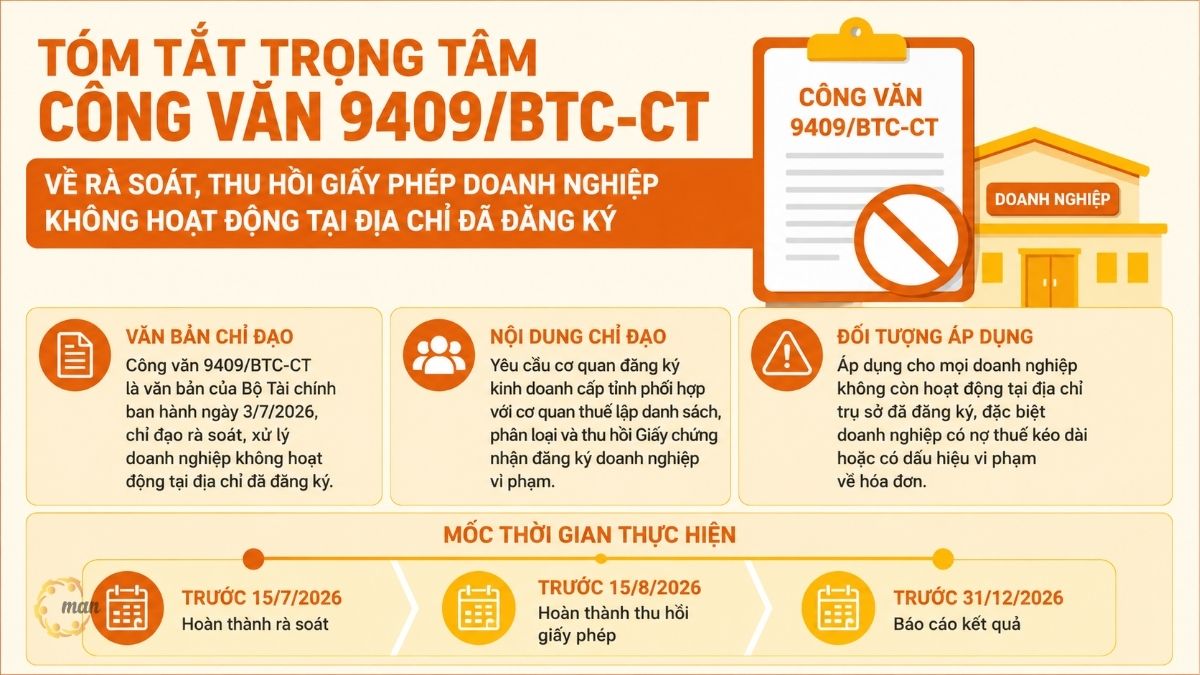
- Official document 9409/BTC-CT is a document issued by the Ministry of Finance on July 3, 2026, directing the review and handling of businesses that are not operating at their registered addresses.
- This is used to request the provincial business registration authority to coordinate with the tax authority to compile a list, classify, and revoke the business registration certificates of violating enterprises.
- This applies to all businesses that are no longer operating at their registered address, especially those with long-standing tax debts or suspected invoice violations.
- Timeline: Complete review before July 15, 2026; complete license revocation before August 15, 2026; report results before December 31, 2026.
What is Official Document 9409/BTC-CT? Definition and legal basis for its issuance.
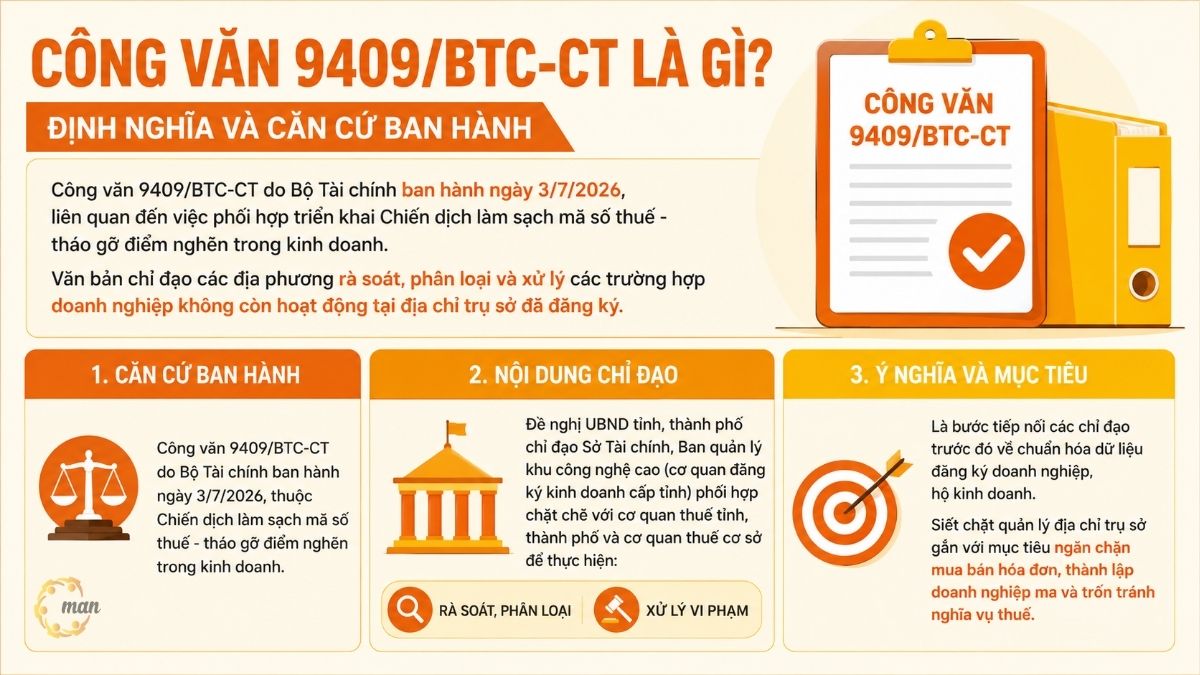
Circular No. 9409/BTC-CT, issued by the Ministry of Finance on July 3, 2026, concerns the coordination of the campaign to clean up tax identification numbers – removing bottlenecks in business. In short, this document directs localities to review, classify, and handle cases of businesses that are no longer operating at their registered addresses.
The core content of the official letter requests the People's Committees of provinces and cities to direct the Department of Finance and the Management Board of High-Tech Parks, i.e., the provincial-level business registration agency, to closely coordinate with the provincial and city tax authorities and local tax authorities to carry out two major groups of tasks: reviewing and handling violations.
This is a continuation of a series of previous directives on standardizing business and household business registration data. Tightening the management of registered addresses is linked to the goal of preventing the buying and selling of invoices, the establishment of shell companies, and the evasion of tax obligations, which have persisted for many years.
Why is the Ministry of Finance tightening control over business registration addresses?
The situation where businesses register a registered address but do not actually operate there causes many problems: tax authorities cannot serve notices, cannot verify tax obligations, and this also creates loopholes for some individuals to establish businesses for the purpose of buying and selling illegal invoices. The review and revocation of licenses according to Official Letter 9409/BTC-CT aims to clean up business registration data nationwide and clearly define responsibilities between tax authorities and business registration agencies.
Which entities are affected by Official Letter 9409/BTC-CT?
Essentially, official documents are internal administrative documents between state management agencies, but their practical impact directly affects businesses belonging to the following groups:
- The business is no longer operating at its registered address, even though it has moved, but has not yet completed the procedures to change its business registration.
- Businesses with long-standing tax debts and a lack of cooperation with tax authorities during the verification process are eligible for coercive measures to revoke their licenses.
- Businesses showing signs of buying and selling invoices, evading taxes, or exploiting their legal entity or tax identification number to commit illegal acts.
- In cases where business registration documents are found to be fraudulent or personal information is used illegally to establish a business.
Point to note: the official document does not discriminate based on the size or type of business. From manufacturing, trading, and service companies to foreign-invested enterprises, any company that is not operating at its registered address and has tax violations is subject to review.
Mandatory deadlines as per Official Letter 9409/BTC-CT
One of the biggest differences between this document and previous directives is the setting of specific deadlines, requiring relevant agencies to complete the work on schedule. The table below summarizes the key deadlines.
| Job Description | Implementing agency | Completion deadline |
| Review and compile a list of businesses that are not operating at their registered address. | Provincial business registration agencies coordinate with tax authorities. | Before July 15, 2026 |
| Prepare a file requesting the revocation of the license due to tax enforcement. | Tax authorities | Before August 15, 2026 |
| Revocation of the Business Registration Certificate at the request of the tax authority. | Provincial Business Registration Authority | Before August 15, 2026 |
| Require businesses to report on legal compliance. | Provincial Business Registration Authority | Before August 15, 2026 |
| Report on the results of license revocations during the year. | Provincial Business Registration Authority | Before December 31, 2026 |
For businesses, the deadlines of July 15, 2026 and August 15, 2026 serve as a clear warning: if a company is on the review list and does not proactively update its address or settle its tax debts, the possibility of having its license revoked within a month thereafter is very real.
The specific procedure for handling violations is outlined in Official Letter 9409/BTC-CT.
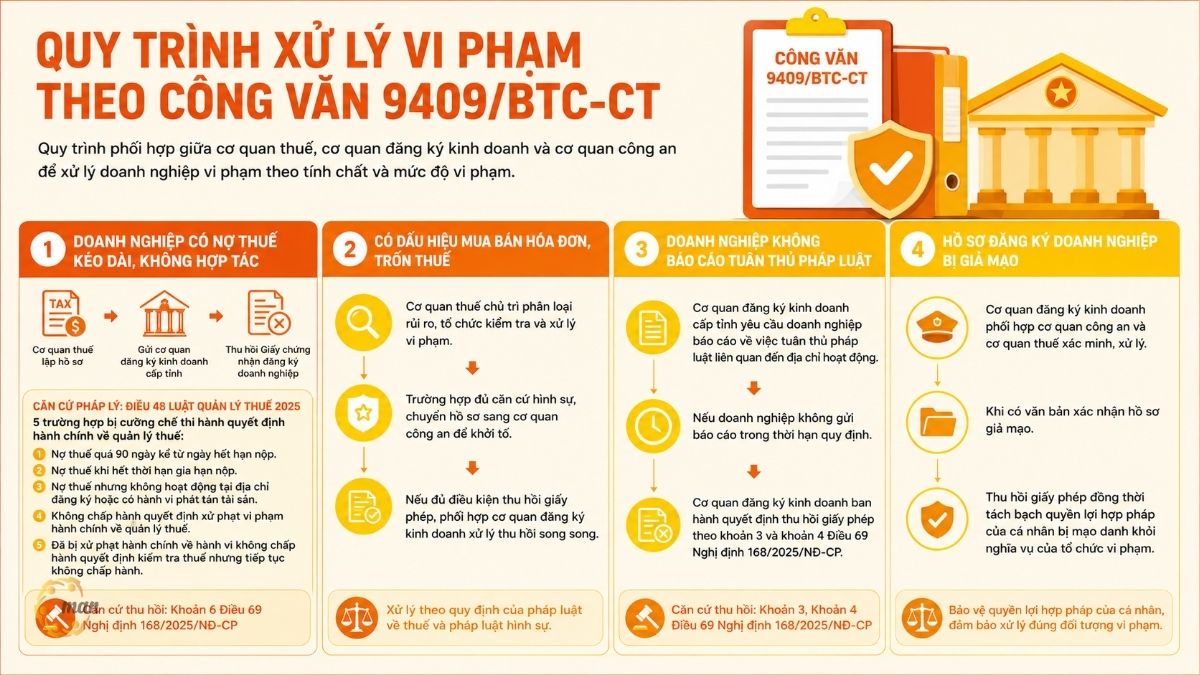
Circular 9409/BTC-CT clearly stipulates the coordination process between tax authorities, business registration authorities, and police authorities to handle violations by businesses. Depending on the nature and severity of the violation, businesses may be subject to forced revocation of their business registration certificate, transfer of files to investigative agencies, or penalties for failing to fulfill reporting obligations or using forged registration documents. Below is the process applicable to each specific case.
In cases where businesses have long-standing tax debts and are uncooperative,
According to the official document, businesses that are not operating at their registered address, have long-standing tax debts, are uncooperative, and meet the conditions for compulsory license revocation will have their files prepared by the tax authorities and sent to the provincial business registration agency requesting revocation. The provincial business registration agency will then issue a violation notice and subsequently issue a decision to revoke the Business Registration Certificate in accordance with Clause 6, Article 69. Decree 168/2025/ND-CP, and simultaneously updated the legal status to "Revoked due to enforcement of tax management regulations".
The legal basis for this enforcement lies in Article 48 of the 2025 Tax Administration Law, which fully stipulates five cases in which taxpayers are subject to coercive enforcement of administrative decisions on tax administration as follows:
- There are tax debts that are more than 90 days overdue from the deadline for payment as stipulated by law.
- There are outstanding tax debts even after the tax payment extension period has expired.
- Having outstanding tax debts but not operating at the registered address or engaging in asset dissipation activities.
- Failure to comply with administrative penalty decisions regarding tax management within the deadline specified in the decision, except in cases where the enforcement of the penalty decision is postponed or temporarily suspended.
- Having already been fined for failing to comply with a tax audit order, he continued to disobey the tax audit order.
Therefore, a business that is not operating at its registered address and simultaneously has tax arrears falls under the third case mentioned above, meaning it is automatically subject to enforcement measures against administrative decisions on tax management, without having to wait 90 days as in the case of ordinary tax arrears.
In cases where there are signs of invoice trading or tax evasion.
For businesses that are not operating at their registered address but show signs of buying and selling invoices, tax evasion, or abusing their legal entity or tax identification number to violate the law, the tax authorities will take the lead in risk assessment, inspection, and handling of violations. If there are sufficient grounds for criminal charges, the case will be transferred to the police for prosecution as prescribed by law. If conditions for license revocation are also met, the tax authorities will coordinate with the business registration agency to revoke the license simultaneously.
Cases where businesses fail to report compliance with the law.
The provincial business registration authority has the right to request businesses to report on their compliance with laws related to their operating address. If the business fails to submit the report within the prescribed time limit, the business registration authority will issue a decision to revoke the license in accordance with the procedures in Clauses 3 and 4 of Article 69 of Decree 168/2025/ND-CP on business registration.
In the case of falsified business registration documents.
In cases where there is evidence to suggest that business registration documents are forged, or that personal information has been stolen or used illegally to establish a business, the business registration authority will coordinate with the police and tax authorities to verify and handle the matter. Once a document confirming the forgery of the documents is issued, the license will be revoked simultaneously with the separation of the legitimate rights of the individual whose identity was impersonated from the obligations of the violating organization.
How is inactivity at a registered address determined?
This is a core legal concept that many businesses are still unclear about. Article 98 of Decree 168/2025/ND-CP specifically stipulates the legal status of household businesses in the Household Business Registration Database, comprising the following four statuses:
- Currently operating: refers to the legal status of a household business that has been granted a Certificate of Household Business Registration and does not fall under any of the other legal statuses.
- Temporarily suspending business: This refers to the legal status of a business household that is currently temporarily suspended from business operations as per regulations.
- Revocation due to enforcement of tax administration regulations.: This refers to the legal status of a household business whose business registration certificate has been revoked by the commune-level business registration authority at the request of the tax authority as part of enforcement measures to implement administrative decisions on tax management.
- Not operating at the registered address.: This refers to the legal status confirmed by the tax authority in a written report stating that the business is not operating at the registered address. This information is provided by the tax authority to the commune-level business registration agency for recording and updating in the Business Registration Database.
The conversion and termination of the legal status of "not operating at the registered address" is decided by the tax authority, except in cases where the business household is in one of the other legal statuses mentioned above. In other words, once the tax authority has issued a verification report confirming inactivity at the address, the verified entity has almost no way to object to the procedure other than proving that it is still operating normally at that address or promptly completing the procedure to change the registered address.
Legal technical note: Article 98 of Decree 168/2025/ND-CP directly regulates business households, with the commune-level business registration agency as the focal point. Circular 9409/BTC-CT, however, applies a similar principle to enterprises, with the provincial-level business registration agency (Department of Finance, High-Tech Park Management Board) as the focal point. Enterprises need to clearly distinguish between these two levels of agencies when submitting feedback or complaints, avoiding confusion between the procedures applied to business households and those applied to enterprises.
Summary of legal basis related to Official Letter 9409/BTC-CT
Before applying review, enforcement, or license revocation measures, the regulatory agency relies on numerous relevant legal documents. Circular 9409/BTC-CT plays a guiding role in implementation, and is carried out based on the provisions of the 2025 Tax Administration Law, Decree 168/2025/ND-CP, and guiding documents from the tax authorities. Below is a summary of important legal grounds that businesses need to be aware of.
| Legal documents | Number / Date of Issue | Related content |
| Official Document 9409/BTC-CT | Ministry of Finance, July 3, 2026 | Directing a review and revocation of business licenses for companies that are not operating at their registered addresses. |
| Decree 168/2025/ND-CP | Government, regarding business registration | Article 69 stipulates the procedure for revoking the Certificate of Business Registration; Article 98 defines the legal status of a household business. |
| Tax Administration Law 2025 | No. 108/2025/QH15 | Article 48 stipulates the cases in which administrative decisions on tax management are enforced. |
| Official Dispatch 18/CD-CT | Tax Department, July 13, 2026 | Focus resources on implementing the campaign to clean up tax identification numbers – removing bottlenecks in business. |
Important Note: To date, the specific implementation at each locality still depends on the progress of coordination between the Department of Finance and the local tax authorities. Experts at MAN It is recommended that businesses proactively monitor notifications from their direct tax authorities, instead of waiting until they receive a revocation decision before taking action.
Case Study: How do commercial businesses in Ho Chi Minh City handle the issue of abandoned registered addresses?
Background
Company Y, a limited liability company operating in the consumer goods distribution sector, has its registered office in a central district of Ho Chi Minh City. Due to rising rental costs, the company moved its physical office to a different address from the beginning of 2026 but has not yet updated this information with the business registration authority. The company also has outstanding value-added tax debts arising from the fourth quarter of 2025 that have not been fully settled.
Risks arise
When the local tax authority conducted a planned on-site inspection as part of the implementation of Circular 9409/BTC-CT, they discovered that the registered address was no longer operational. The tax authority then drew up a verification report. Because the company still owed taxes and did not respond to the verification notice within the specified time, the case was classified as being at risk of having its license revoked through coercive measures.
Solution
According to advice from MAN – Master Accountant Network, The company immediately took three steps: first, it filed an application to change its head office address to the actual operating location and notified the tax authorities in writing; second, it proactively contacted the tax authorities to develop a plan for gradually paying off the outstanding tax debt; and third, it prepared documents proving continuous business operations, including the new office lease agreement and invoices for both incoming and outgoing transactions during the period.
The measured results
- The company avoided the decision to revoke its business registration certificate during the review period before August 15, 2026.
- Proactively updating your address helps ensure transparent processing of tax returns and avoids the need for further enforcement measures against bank accounts.
- The processing time for the entire case was shortened to about 3 weeks thanks to complete supporting documentation, instead of taking many months if waiting for the authorities to issue a revocation decision before filing a complaint.
Expert opinion: Common business risks and how to avoid them.
Experts at MAN – Master Accountant Network With over 30 years of practical experience in auditing, accounting, and tax consulting in Vietnam, we note four key risks that businesses need to proactively avoid when implementing Circular 9409/BTC-CT.
- Risk 1: Delays in updating the registered office address: Many businesses relocate their physical operating address but delay the procedures for changing their business registration, believing it can be done later. In the context of the accelerated review campaign, this gap is precisely what makes them most susceptible to being cited for not operating at their registered address.
- Risk 2: Lack of response when tax authorities conduct verification: When tax authorities conduct on-site inspections but cannot meet with business representatives, many cases result in official reports being filed without the businesses' knowledge until they receive notification of license revocation. Assigning personnel to be on duty and updating contact information for the tax authorities is a simple but often overlooked preventative measure.
- Risk 3: Allowing tax debts to accumulate without a plan to address them: From this perspective MAN, Having tax debts exceeding 90 days combined with inactivity at the registered address is the highest risk combination leading to the forced revocation of the license. Businesses should proactively request an extension or plan to pay gradually before being subjected to enforcement action.
- Risk 4: Confusion between recovery due to tax enforcement and recovery due to business registration violations: There are two license revocation procedures, one under tax management law and the other under business registration law, with different authorities and processes. Businesses need to clearly identify which category they fall under in order to prepare the correct response documents for the competent authority, avoiding wasting time sending documents to the wrong recipient.
Conclude
Circular 9409/BTC-CT marks a significant tightening in the management of business registration addresses, assigning specific responsibilities for coordination between tax authorities and business registration agencies with mandatory deadlines. For businesses, the most important thing right now is to proactively review the status of their registered address, outstanding tax obligations, and their ability to respond when authorities conduct on-site verification, instead of waiting until they receive a revocation decision before taking action.
Over 500 clients have returned for a second time in the past year, a tangible testament to the quality of advice and peace of mind that MAN provides. For specific support tailored to your business needs, contact MAN – Master Accountant Network for a free consultation.
Tax services at MAN – Master Accountant Network
- Tax accounting services
- Tax consulting services
- Tax settlement services
- Tax reporting services
- VAT refund service
Service contact information at MAN – Master Accountant Network
- Address: No. 19A, Street 43, Tan Thuan Ward, Ho Chi Minh City
- Mobile/Zalo: 0903 963 163 – 0903 428 622
- E-mail: man@man.net.vn
- Google Business Profile: View MAN – Master Accountant Network's Google Business Profile
- LinkedIn Founder: View expert Le Hoang Tuyen's LinkedIn profile.
Responsible for production and professional content review by: Mr. Le Hoang Tuyen – Founder & CEO of MAN – Master Accountant Network, CPA Vietnam with over 30 years of experience in accounting, auditing, taxation, and corporate financial consulting.
Frequently Asked Questions about Official Document 9409/BTC-CT
Circular 9409/BTC-CT issued by the Ministry of Finance on July 3, 2026, directs the review and handling of businesses that are not operating at their registered addresses.
No. The tax authorities must first conduct a verification report, and then, depending on whether the business owes taxes, is uncooperative, or shows signs of other violations, they will apply the corresponding processing procedure. Immediate recovery is not permitted in all cases.
The review and listing process must be completed before July 15, 2026. The revocation of licenses at the request of the tax authorities, as well as the requirement for businesses to report on compliance, must be completed before August 15, 2026. The report on the revocation results for the year must be submitted before December 31, 2026.
Businesses should promptly complete the procedures for changing their registered office address at the business registration authority and simultaneously notify the directly managing tax authority in writing to avoid being issued a verification report for not operating at the old address.
According to Article 48 of the 2025 Tax Administration Law, compulsory license revocation applies to cases where a business both owes taxes and is not operating at its registered address. If the business continues to operate normally at its registered address, enforcement measures for tax debt may be applied in other forms such as freezing accounts, rather than automatically leading to license revocation. When was Official Document 9409/BTC-CT issued, and by which agency?
If a business is found not to be operating at its registered address, will its license be revoked immediately?
What is the deadline for completing the review and revoking the license?
What should a business do if it has moved its address but hasn't updated its business registration?
If a business has tax debts but continues to operate normally at its registered address, will its business license be forcibly revoked?




