

Banks must provide customers' account balances to the tax authorities. This is the official regulation from July 1, 2026, according to Decree 252/2026/ND-CP instruct Tax Administration Law 2025. This represents an expansion from the old mechanism, where banks only provided account identification information and were not required to share periodic balances. With the tax authorities holding data on approximately 250 million bank accounts, of which about 200 million are personal accounts, this regulation affects almost all individuals, household businesses, and enterprises with banking transactions in Vietnam.
Many business owners and individuals are concerned about the requirement for banks to provide account balances to tax authorities, believing it infringes on their financial privacy. However, from a legal perspective, this is a clearly defined legal obligation with specific scope and purpose. This article, compiled from the professional perspective of MAN – Master Accountant Network, a tax, accounting, and auditing consulting firm with over 30 years of practical experience in Vietnam, will comprehensively analyze this regulation.
| Providing bank account balances to tax authorities is a monthly obligation for credit institutions and payment intermediaries to send account data, transactions, and balances of taxpayers to tax authorities. |
| Legal basis: Clause 7, Article 61 of Decree 252/2026/ND-CP, effective from July 1, 2026, guiding the 2025 Law on Tax Administration. |
| Target entities: commercial banks, branches of foreign banks, payment intermediaries, international card organizations. |
| Applicable subjects: all taxpayers with payment accounts, including individuals, household businesses, and enterprises. |
| Execution time: periodically, sending data before the 10th of each month, or upon sudden request when there are unusual transactions. |
What is the purpose of banks having to provide customer account balances to the tax authorities?
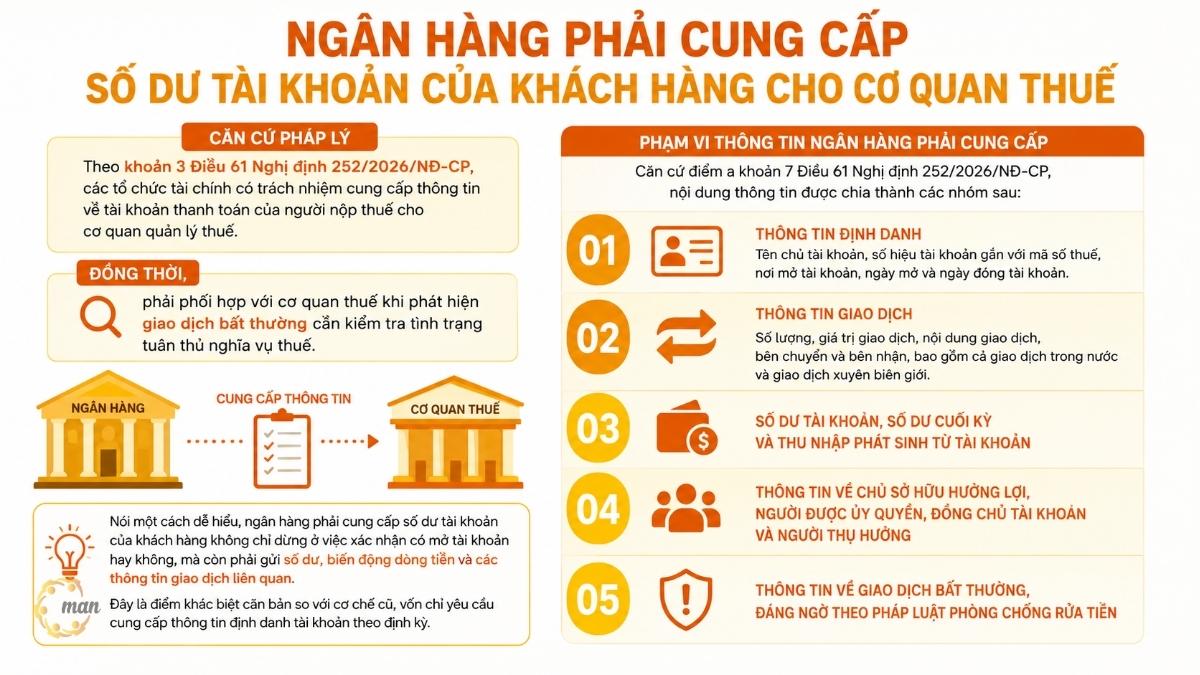
According to Clause 3, Article 61 of Decree 252/2026/ND-CP, credit institutions, branches of foreign banks, payment service providers, payment intermediary service providers, and international card organizations are responsible for providing information on taxpayers' payment accounts to the tax authorities. At the same time, these organizations must cooperate with the tax authorities when detecting unusual transactions requiring verification of tax compliance.
To put it simply, The bank must provide the customer's account balance. It's not just about confirming whether a customer has opened an account; it also requires submitting the balance, cash flow changes, and related transaction information. This is a fundamental difference from the old mechanism, which only required providing account identification information periodically.
The scope of information banks must provide to tax authorities:
Based on point a, clause 7, Article 61 of Decree 252/2026/ND-CP, the information content is divided into the following groups:
- Identifying information: account holder's name, account number linked to tax identification number, account opening location, account opening date, and account closing date.
- Transaction information: quantity, transaction value, transaction details, sender and receiver, including both domestic and cross-border transactions.
- Account balance, ending balance, and income generated from the account.
- Information about the beneficial owner, authorized representative, co-account holder, and beneficiary.
- Information regarding unusual or suspicious transactions under anti-money laundering laws.
Why is the requirement for banks to provide customer account balances important to the tax authorities?
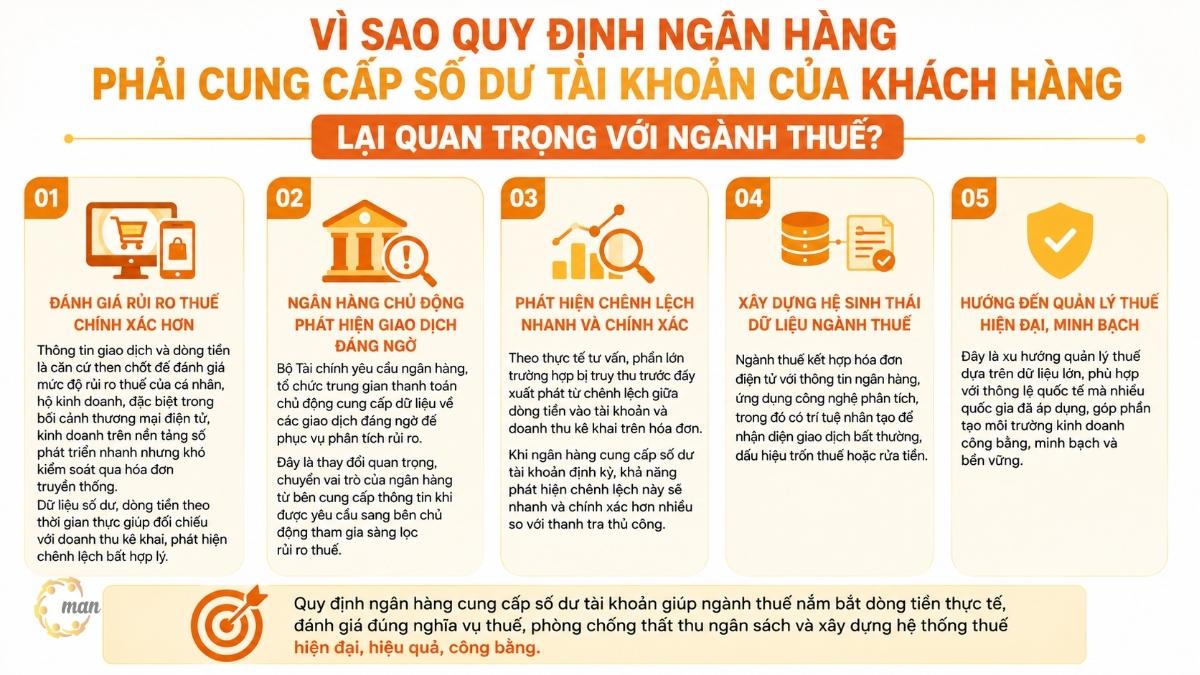
The Ministry of Finance identifies transaction information and cash flow as key factors in assessing the tax risk level of individuals and business households, especially in the context of rapidly developing e-commerce and digital businesses that are difficult to control through traditional invoices. Having real-time balance and cash flow data helps tax authorities compare declared revenue and detect unreasonable discrepancies.
The Ministry of Finance also requires banks and payment intermediaries to proactively provide data on suspicious transactions for risk analysis, instead of passively reviewing lists sent by tax authorities as before. This is a significant change, shifting the role of banks from providing information upon request to actively participating in tax risk screening.
From this perspective MAN – Master Accountant Network, After many years of advising small and medium-sized enterprises on tax settlements, we have found that most of the cases of tax arrears previously stemmed from discrepancies between cash inflows into accounts and revenue declared on invoices. When banks are required to provide account balances periodically, the ability to detect these discrepancies will be much faster and more accurate than manual audits.
The tax sector is also building a data ecosystem that combines electronic invoices with banking information, applying analytical technologies, including artificial intelligence, to identify unusual transactions, signs of tax evasion, or money laundering. This is a trend in tax management based on big data, consistent with international practices that many countries have already adopted.
Who is responsible for implementing the changes, and who will be affected?
The regulation requiring banks to provide account balances applies to two groups of entities with different roles.
The group has an obligation to provide information.
- Domestic commercial banks and branches of foreign banks in Vietnam.
- Payment service providers, payment intermediary service providers.
- Organizations providing online payment services, if any, operate in Vietnam.
- International card organizations operate legally in Vietnam.
The group was affected by the data sharing.
All taxpayers with payment accounts opened at the aforementioned organizations are subject to this regulation, regardless of whether they are individuals, household businesses, or enterprises. This includes non-residents of Vietnam who have payment accounts in the country, and the reports must also meet the standards for exchanging financial account information for non-residents, in accordance with the standards of the Global Forum on Transparency and Information Exchange for Tax Purposes.
When and how often are banks required to provide customers' account balances?
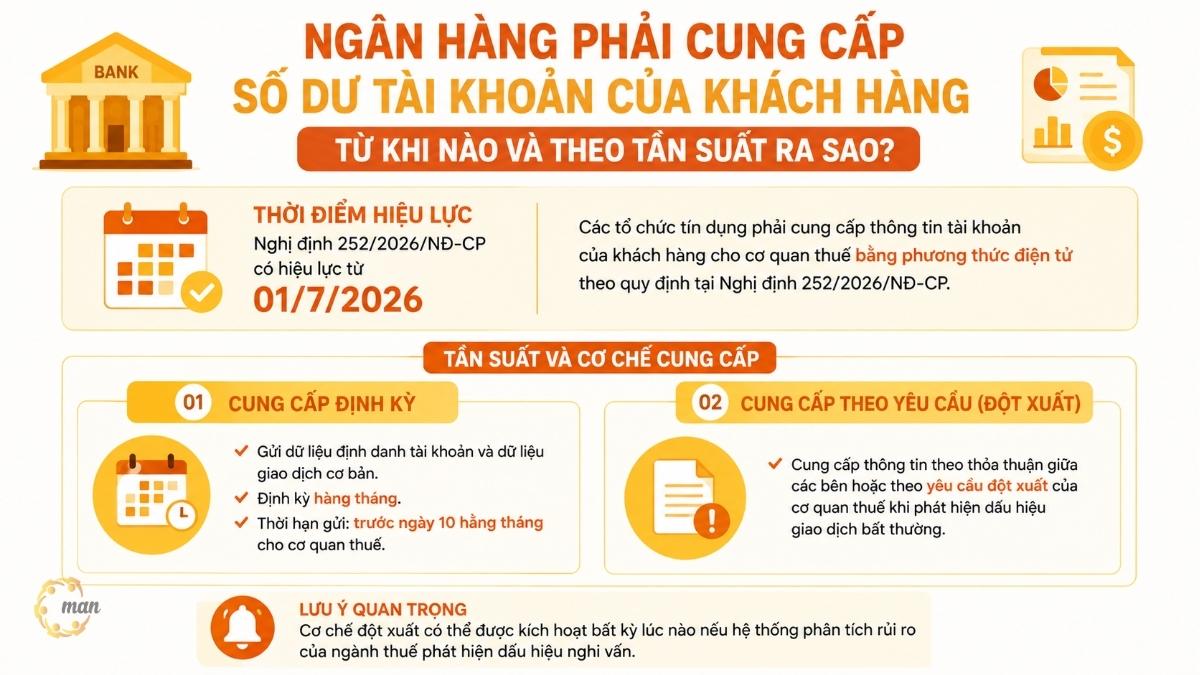
Decree 252/2026/ND-CP takes effect from July 1, 2026. According to the regulations, account identification data must be sent electronically to the tax authorities periodically, before the 10th of each month. In addition to this periodic provision, credit institutions must also share information as agreed upon by the parties or upon sudden requests from the tax authorities when detecting signs of unusual transactions.
Thus, there are two parallel mechanisms for providing information: a monthly provision of identification information and basic transaction data, along with a coordinated mechanism on demand when the tax authorities need to verify a specific case. Businesses and individuals should note that the ad hoc mechanism can be activated at any time if the tax authorities' risk analysis system detects suspicious activity.
Compilation of legal documents related to banks providing account balances.
Below are the key legal documents regulating how banks provide account information, balances, and transactions to tax authorities. Compared to the past, when banks mainly provided identifying information and only shared balances and transactions upon request for inspection and audit, Decree 252/2026/ND-CP has expanded the scope and shifted to a more proactive, periodic information provision mechanism.
| Legal documents | Number / Validity | Related content |
| Decree 252/2026/ND-CP | Effective from July 1, 2026 | Article 61 details the obligation of banks to provide information on account details, balances, and transactions to the tax authorities. |
| Tax Administration Law 2025 | National Assembly issued | Based on Clause 2, Article 40, which stipulates the content of taxpayer account information; and Clause 2, Article 14, which stipulates the method of tax payment. |
| Decree 26/2025/ND-CP | Regulations on the functions of the State Bank of Vietnam | Regulations on foreign exchange management tasks and coordination in providing data for tax management purposes related to cross-border transactions. |
| Laws on preventing and combating money laundering. | Current | Any unusual or suspicious transactions must be reported to the tax authorities. |
| Global Financial Information Exchange Standards | International Tax Transparency Forum | Based on the account information report of non-resident taxpayers in Vietnam. |
Important Note: Compared to the old regulations, where banks only periodically provided identifying information and only shared balances and transactions upon request for inspection or audit, the scope of information under Decree 252/2026/ND-CP has expanded significantly, shifting from a passive to a proactive, periodic provision mechanism.
Besides banks, what other entities are required by Decree 252/2026/ND-CP to provide information to the tax authorities?
A notable new point is that Decree 252/2026/ND-CP for the first time stipulates the responsibility of press agencies to provide information to tax authorities. Previously, the obligation to provide information mainly rested with banks and payment intermediaries.
According to the new regulations, when requested, media outlets must provide the tax authorities with information gathered during their reporting activities related to the production, business operations, selling prices, and market conditions of relevant organizations and individuals. At the same time, media outlets are also responsible for reporting to the tax authorities any information they discover that shows signs of tax violations or potential tax risks.
This regulation demonstrates that a data-driven approach to tax management is expanding beyond the financial and banking system, aiming to mobilize various social information sources to identify tax risks early, especially for individuals and organizations whose business, advertising, and media activities frequently appear in the press.
Case Study: Online businesses in Ho Chi Minh City have their bank account balances checked.
Background
Ms. B runs an online cosmetics business in Ho Chi Minh City, declaring a flat-rate tax with a reported revenue of approximately 80 million VND per month. From July 2026, balance and transaction data from the bank where Ms. B maintains her business account will be periodically sent to the tax authorities in accordance with Decree 252/2026/ND-CP.
Risk arises
Upon verification, the tax authorities discovered that the total cash inflow into Ms. B's account in one month amounted to 350 million VND, many times higher than the declared revenue. This falls under the category of transactions showing signs of unusual discrepancies, leading to Ms. B receiving a review notice and a request to explain the source of funds and the basis of her actual revenue.
The solution as advised by MAN.
Experts at MAN – Master Accountant Network When assisting similar cases, three steps are often recommended: (1) clearly separate business accounts and personal accounts from the outset; (2) keep complete records of input documents, invoices, and orders corresponding to each amount deposited into the business account; (3) proactively review actual revenue against cash flow periodically, and adjust the lump-sum tax amount in a timely manner before the tax authority requests an explanation.
The measured results
After providing complete documentation proving that a portion of the cash flow consisted of personal loans, not business revenue, Ms. B only had to adjust her taxable revenue upwards by a suitable amount instead of having the entire 350 million VND assessed as taxable revenue. Having clear documentation meant the explanation process only took about a week, instead of months like in cases lacking supporting documents.
Expert opinion: Common risks faced by businesses and household businesses.
Experts at MAN – Master Accountant Network With over 30 years of experience in auditing and tax consulting in Vietnam, we note the following four common risks following the implementation of regulations requiring banks to provide account balances.
- Risk 1: Confusion between personal accounts and business accounts: Many online businesses and individuals use the same account for both personal expenses and business transactions. When balance data is reconciled, all incoming funds may be mistakenly considered revenue, leading to the risk of being assessed higher taxes than the actual amount.
- Risk 2: Lack of documentation proving the source of funds: Loans, payments for goods, and internal family money transfers without clear contracts or receipts can easily be mistakenly included in taxable revenue when tax authorities compare account balances with tax returns.
- Risk 3: Slow updates to cross-border transactions: Businesses that conduct international transactions and receive payments from foreign partners should note that cross-border transaction data also falls within the scope of what banks must provide to tax authorities, requiring that foreign trade contracts and international payment documents be fully archived.
- Risk 4: Being caught off guard when receiving unexpected requests for explanation: When the data analysis system detects unusual transactions, the tax authorities may request an explanation within a short period. Businesses without a systematic document archiving process will spend more time compiling information, increasing the risk of being deemed uncooperative or facing unfavorable tax assessments.
From July 1, 2026, what methods can taxpayers use to pay their taxes?
In parallel with the obligation to provide bank account balances, the 2025 Tax Administration Law also redefines the tax payment methods that taxpayers can use from July 1, 2026. Based on Clause 2, Article 14 of the 2025 Tax Administration Law, there are two main groups of tax payment methods.
Pay taxes electronically.
Taxpayers can pay through the Tax Management Information System, the State Treasury's online public service system, or through electronic payment services provided by payment service providers, payment intermediary service providers, and other service organizations that are directly or indirectly connected to the tax management information system.
Pay taxes directly
Taxpayers can also pay directly at payment service providers, payment intermediaries, system-connected service organizations, competent state agencies, tax authorities, or organizations authorized by the tax authorities to collect taxes.
It is noteworthy that most of the aforementioned tax payment channels are linked to payment accounts opened at banks or intermediary payment organizations. This means that, simultaneously, the bank acts as both the official channel for collecting budget revenue and the primary source of balance and transaction data for the tax authorities, making it easier to reconcile tax obligations with actual cash flow.
What role does the State Bank of Vietnam play in monitoring foreign exchange data for tax purposes?
Besides the obligations of commercial banks, the State Bank of Vietnam also plays a role in managing foreign exchange, directly affecting the control of cross-border transactions, which is part of the data that banks must provide to tax authorities. According to Clause 14, Article 2 of Decree 26/2025/ND-CP, the State Bank of Vietnam has the following tasks and powers in state management of foreign exchange and gold trading:
- Managing foreign exchange activities in current account transactions, capital account transactions, the use of foreign exchange within Vietnam, and foreign exchange business and service provision, including in border areas.
- Managing the State's foreign exchange reserves, conducting domestic and international foreign exchange transactions to serve national monetary policy, as well as dealing with the state budget and international organizations.
- Announcing exchange rates and determining the exchange rate management regime and mechanism.
- Granting and revoking approvals for credit institutions and branches of foreign banks to conduct foreign exchange business and provide foreign exchange services.
- Foreign exchange management for foreign investment in Vietnam and overseas investment by Vietnamese organizations and individuals.
- Managing gold trading operations nationwide.
- Managing foreign borrowing and repayment under the self-borrowing and self-repaying mechanism, and providing guidance on procedures for confirming registration or registration changes for foreign loans guaranteed by the Government.
- Managing lending activities, foreign debt recovery, and guarantees for non-residents by credit institutions and economic organizations.
For businesses with international transactions, the State Bank of Vietnam's tightening of foreign exchange management, along with the obligation for banks to provide account balances, means that cross-border cash flows may be subject to double-checking, through both foreign exchange and tax data channels. (According to advice from...) MAN – Master Accountant Network, Import-export businesses and FDI enterprises should proactively review documents proving the purpose of money transfers, foreign trade contracts, and foreign loan registration documents to avoid delays when verification is required.
Conclude
The regulation requiring banks to provide customer account balances to tax authorities marks a significant shift in tax management in Vietnam, moving from manual inspections to data-driven monitoring. This necessitates individuals, business households, and enterprises to proactively transparently disclose their cash flows and maintain proper documentation now, rather than waiting until they receive a request for explanation before taking action.
MAN – Master Accountant Network We are a leading tax, accounting, and auditing consulting firm with a team of experts boasting over 30 years of practical experience and a deep understanding of tax risk management in Vietnam. We provide comprehensive services. tax consulting services, tax accounting services, tax reporting services, tax filing services and tax settlement services Serving FDI businesses, domestic businesses, household businesses, and individuals. Over 500 clients have returned for a second use in the past year. Contact MAN – Master Accountant Network for a free consultation.
Service contact information at MAN – Master Accountant Network
- Address: No. 19A, Street 43, Tan Thuan Ward, Ho Chi Minh City
- Mobile/Zalo: 0903 963 163 – 0903 428 622
- E-mail: man@man.net.vn
- Google Business Profile: View MAN – Master Accountant Network's Google Business Profile
- LinkedIn Founder: View expert Le Hoang Tuyen's LinkedIn profile.
Responsible for production and professional content review by: Mr. Le Hoang Tuyen – Founder & CEO of MAN – Master Accountant Network, CPA Vietnam with over 30 years of experience in accounting, auditing, taxation, and corporate financial consulting.
Frequently Asked Questions about Banks Having to Provide Customer Account Balances to Tax Authorities
From July 1, 2026, according to Decree 252/2026/ND-CP detailing the Law on Tax Administration 2025.
Identification information and basic transaction data are provided periodically for all taxpayer payment accounts. In-depth joint audits are only conducted when unusual or suspicious transactions are detected.
Yes. The regulation applies to all taxpayers with a payment account, including non-business individuals, especially if they have unusually large cash flows compared to their declared income.
Businesses should separate accounts according to their purpose, and keep complete records of contracts, invoices, and payment documents corresponding to each amount of money entering and leaving the account, so that they are ready to provide explanations when needed.
Yes. The provision of information must comply with laws on personal data protection, laws on credit institutions, and must only directly serve tax administration within the prescribed scope. From what date are banks required to provide customer account balances to the tax authorities?
Were all bank accounts provided with balances, or only the suspicious accounts?
Will individual users be affected by this regulation?
What preparations should businesses make to avoid risks when their account balances are being audited?
Is account balance information secure?




