


Night shift and overtime pay are tax-exempt. Officially effective from July 1, 2026, as stipulated in the 2025 Personal Income Tax Law, this is the most significant change in personal income tax policy in many years, directly impacting millions of workers who work night shifts and overtime in industrial zones, factories, hospitals, and service establishments nationwide. Previously, this additional income was subject to a progressive tax rate, disadvantaging many workers.
According to Personal Income Tax Law 2025, There are a total of 21 types of income exempt from tax, including night shift and overtime pay, which are new additions compared to the old law. This article provides a detailed analysis of the regulations, application conditions, risks businesses need to avoid, and practical guidance from an in-depth perspective. MAN – Master Accountant Network, a tax consulting firm with over 30 years of practical experience in Vietnam.
Key points: Tax exemption for night shift and overtime pay.
- Tax exemption for night shift and overtime pay means that personal income tax is not levied on the additional salary (the difference compared to the normal salary) when an employee works at night or outside of regular working hours.
- Legal basis: Personal Income Tax Law 2025, effective from July 1, 2026.
- Beneficiaries: All workers who earn income from wages and salaries for night work and overtime as stipulated in the Labor Code.
- Scope of application: Only the amount exceeding the normal salary is exempt from tax; the basic salary is still subject to normal taxation.
- Unlike the old law: This is a NEW tax exemption, added for the first time in the 2026 fiscal year.
What does it mean to be exempt from taxes on night shift and overtime pay? What is the standard legal definition?
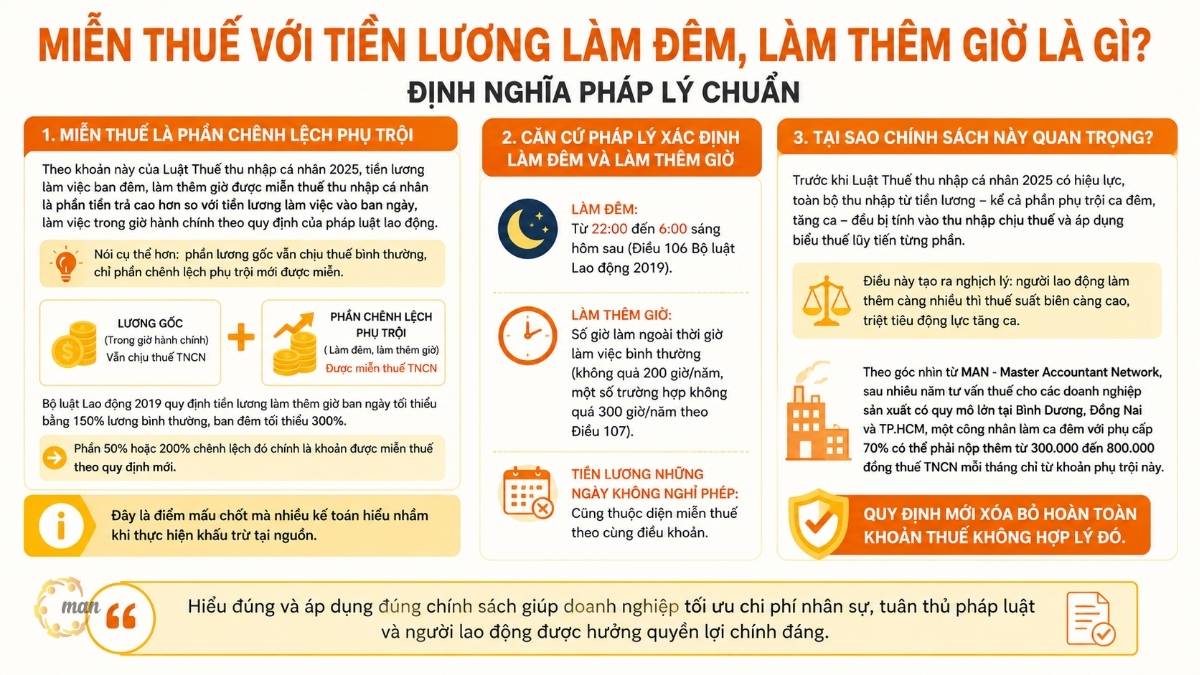
According to this provision of the Personal Income Tax Law 2025, Night shift and overtime pay are exempt from personal income tax. This refers to the portion of the salary paid in excess of the regular daytime working hours as stipulated by labor laws. More specifically: the base salary is still subject to normal taxation; only the excess amount is exempt.
The 2019 Labor Code stipulates that the minimum overtime pay for daytime work is 150% of the normal salary, and for nighttime work it is 300%. Therefore, the difference of 50% or 200% is the amount exempt from tax according to the new regulations. This is a key point that many accountants misunderstand when performing withholding tax.
Legal basis for determining night work and overtime work.
- Night shift: from 10:00 PM to 6:00 AM the following morning (Article 106 of the 2019 Labor Code).
- Overtime: the number of hours worked outside of normal working hours (not exceeding 200 hours/year, in some cases not exceeding 300 hours/year according to Article 107).
- Salary for days not taken as vacation: also exempt from tax under the same provisions.
Why is tax exemption for night shift and overtime pay important?
Before the Personal Income Tax Law of 2025 came into effect, all income from salaries – including night shift and overtime pay – was taxable and subject to a progressive tax rate. This created a paradox: the more overtime workers worked, the higher the marginal tax rate, eliminating the incentive to work overtime.
From this perspective MAN – Master Accountant Network, After years of advising large-scale manufacturing businesses in Binh Duong, Dong Nai, and Ho Chi Minh City on taxes, a night shift worker with a 70% allowance could have to pay an additional 300,000 to 800,000 VND in personal income tax each month solely from this extra income. The new regulation completely eliminates this unreasonable tax.
Which individuals are eligible for tax exemption on night shift and overtime pay?
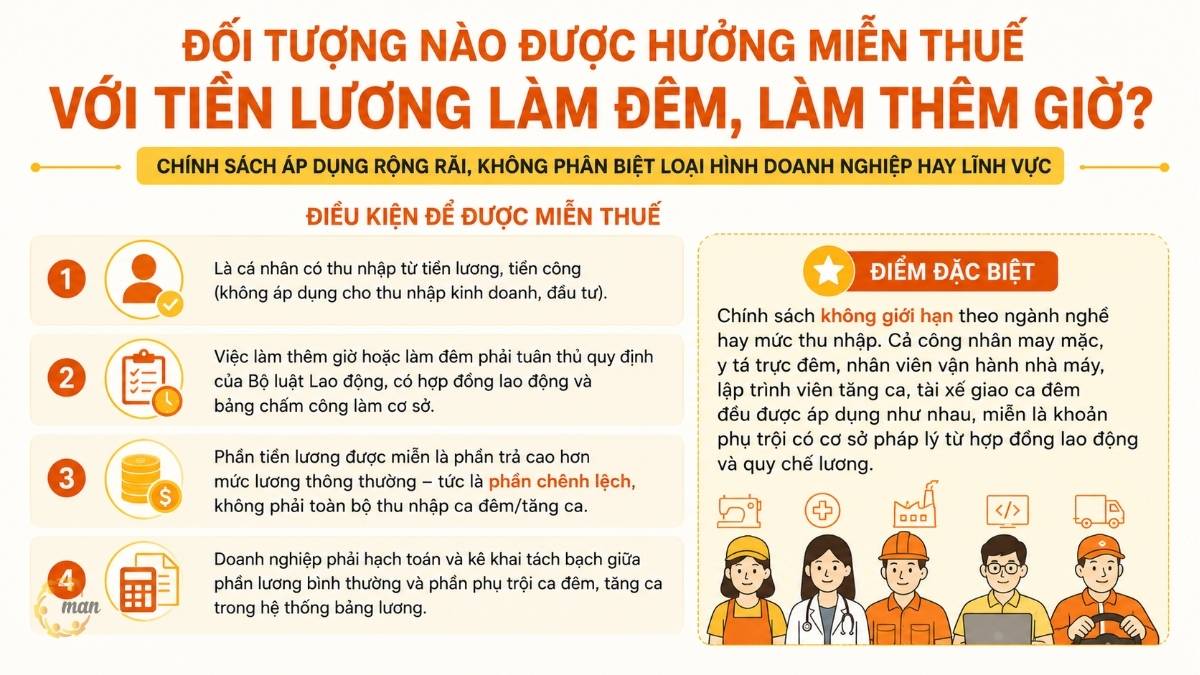
This policy applies broadly, regardless of the type of business or sector. Conditions for tax exemption include:
- This applies to individuals with income from salaries and wages (excluding income from business or investments).
- Overtime or night work must comply with the regulations of the Labor Code, and be based on a labor contract and time sheets.
- The portion of the salary that is exempted is the higher-than-normal salary – that is, the difference, not the entire night shift/overtime pay.
- Businesses must separately account for and declare the regular salary and the night shift/overtime pay in their payroll system.
Key features: The policy is not limited by occupation or income level.. Garment workers, night shift nurses, factory operators, programmers working overtime, and night shift drivers are all treated the same, provided that the overtime pay is legally justified by the employment contract and wage regulations.
All 21 types of income are tax-exempt under the 2025 Personal Income Tax Law.
Night shift and overtime pay are just one of 21 types of income exempt from tax under the 2025 Personal Income Tax Law. Understanding this complete list helps businesses and employees maximize their legal rights and avoid omissions during year-end tax settlements.
- Income from the transfer, inheritance, or gift of real estate between direct family members (spouses, parents and children, grandparents and grandchildren, siblings).
- Income from the transfer of a house or land use right, the sole right to live in Vietnam.
- Income derived from the value of land use rights granted by the State.
- Income of households and individuals directly engaged in the production of unprocessed or only minimally processed crops, livestock, and aquatic products.
- Income from the conversion of agricultural land allocated by the State for production.
- Income from interest on government bonds, local government bonds, interest on deposits at credit institutions, and interest on life insurance contracts.
- Income from remittances.
- Night shift pay, overtime pay; pay for days not taken as legally mandated leave. (New provision effective from July 1, 2026 – the focus of this article.)
- Pension payments are made by the social insurance fund; income from supplementary retirement insurance funds and voluntary retirement funds.
- Income from scholarships.
- Income from life insurance claims, non-life insurance claims, work-related accident claims, state compensation, and other compensation as stipulated by law.
- Income from non-profit charitable and humanitarian organizations and funds recognized by state agencies.
- Income from foreign aid for charitable and humanitarian purposes (government and non-governmental) is subject to approval by state agencies.
- Salaries and wages of Vietnamese seafarers working for foreign shipping companies or Vietnamese shipping companies engaged in international transport.
- Income of individuals who are ship owners, those with the right to use ships, and those working on ships from activities providing goods and services for offshore fishing and aquaculture.
- Income from the initial transfer of carbon credits, resulting from greenhouse gas emission reductions; interest on green bonds; initial transfer of green bonds after issuance. (New clause – related to the green economy.)
- Salaries and wages earned from performing scientific and technological tasks and innovation. (New provision – encourages R&D.)
- Income from royalties on scientific and technological research projects when the results are commercialized.
- Income of individual investors, experts, and founders from innovative startup projects; individual investors contributing capital to venture capital funds. (New provision – supporting the startup ecosystem.)
- Salaries and wages of foreign experts working on non-refundable ODA programs and projects or foreign non-governmental projects in Vietnam.
- Income after corporate income tax has been paid by the owner of a private enterprise or a single-member limited liability company. (Avoid double taxation.)
Note: The amounts in bold above are the amounts newly added Or, expanding the scope compared to the old Personal Income Tax Law, reflecting the orientation of encouraging a green economy, innovation, and entrepreneurship in Vietnam's tax policy for the period 2026-2030. Businesses and employees need to carefully review the entire list to ensure they do not miss out on their legitimate tax exemption rights.
Legal documents related to tax exemption for night shift and overtime pay.
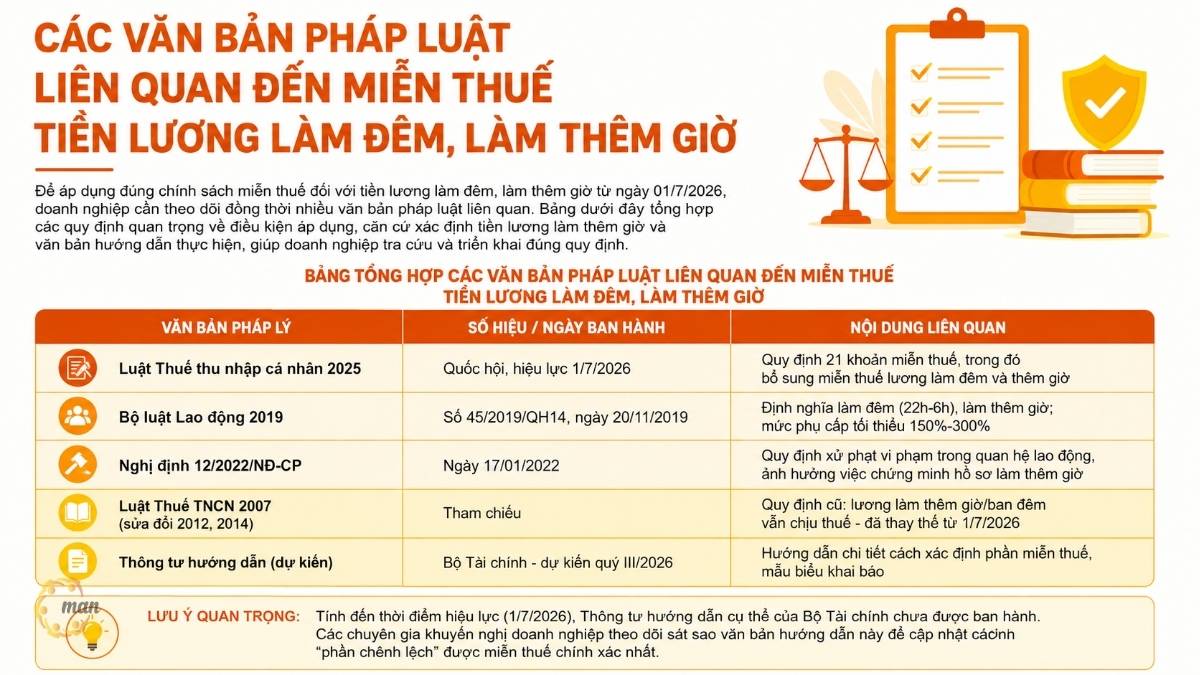
To properly apply the tax exemption policy for night shift and overtime pay from July 1, 2026, businesses need to monitor several relevant legal documents. The table below summarizes important regulations regarding application conditions, basis for determining overtime pay, and implementing guidelines, helping businesses to look up and implement the regulations correctly.
| Legal documents | Number / Date of Issue | Related content |
| Personal Income Tax Law 2025 | National Assembly, effective July 1, 2026 | The regulations stipulate 21 tax exemptions, including the addition of tax exemptions for night work and overtime pay. |
| Labor Code 2019 | Resolution No. 45/2019/QH14, dated November 20, 2019 | Definition of night shift (10 PM - 6 AM), overtime; minimum allowance level 150%-300% |
| Decree 12/2022/ND-CP | January 17, 2022 | Regulations on penalties for violations in labor relations affect the process of proving overtime work. |
| Personal Income Tax Law 2007 (amended 2012, 2014) | Reference | Old regulation: overtime/night shift wages were still subject to tax – replaced from July 1, 2026. |
| (tentative) Circular providing guidance | Ministry of Finance – projected Q3/2026 | Detailed instructions on how to determine the tax-exempt portion, declaration forms. |
Important Note: As of the effective date (July 1, 2026), the Ministry of Finance's specific guiding circular has not yet been issued. Experts at MAN Businesses are advised to closely monitor this guidance document to stay updated on the most accurate way to determine the tax-exempt "difference".
How to calculate tax-exempt income – A practical example
This is where most accountants get it wrong. Tax exemption. This does not mean that all night shift or overtime income is tax-exempt. Only the difference exceeding the normal salary is exempt.
Here's a specific example calculation:
Employee A has a basic salary of 200,000 VND/hour. According to regulations, overtime work during the day is paid at 300,000 VND/hour. The tax-exempt portion is: 300,000 - 200,000 = 100,000 VND/hour. If A works 40 overtime hours in a month, the tax-exempt portion is 100,000 x 40 = 4,000,000 VND. The remaining basic salary of 200,000 x 40 = 8,000,000 VND is still subject to normal personal income tax.
For night shift workers (300% hourly wage): the tax-exempt portion is 200% of the hourly wage, equivalent to VND 400,000/hour. This is a very significant tax reduction for workers working three shifts.
| Type of shift | Minimum level (% basic salary) | Tax-exempt portion | Example (basic salary 200k/hour) |
| Daytime overtime | 150% | 50% of basic salary | 100,000 VND/hour |
| Nighttime overtime | 210% | 110% of basic salary | 220,000 VND/hour |
| Working at night | 130% (may be higher according to TULA) | Excess portion compared to the day shift | Depending on company regulations |
| Unused vacation days | 100% holiday pay | This entire amount | Based on the cumulative number of days |
Case Study: How do manufacturing businesses in Binh Duong handle tax exemptions?
Background
Company X (manufacturer of electronic components, 1,200 workers) in Binh Duong has an average of 301 night shift workers and 201 overtime workers per month. Before July 1, 2026, all night shift and overtime allowances were added to the monthly salary for personal income tax calculation.
Processing after July 1, 2026
Following advice from MAN – Master Accountant Network, the company took 3 steps: (1) Updated payroll software to separate “night shift pay”, “overtime allowance” and “amount exceeding basic salary” into separate lines in the payroll sheet; (2) Built a process for verifying shift time sheets (day shift – night shift – overtime) with signatures from the team leader and the HR department; (3) Adjusted personal income tax settlement monthly by deducting the tax-exempt portion before calculating the tax on the remaining income.
The measured results
- Each night shift worker saves an average of 280,000 – 650,000 VND per month in personal income tax.
- For all 1,200 workers: this will reduce the amount of taxes they have to pay each month by approximately 400-600 million VND.
- Clearly, when it comes to tax audits, keeping attendance records and payroll separate allows the audit to be completed within two days, without errors.
Expert opinion: Common business risks and how to avoid them.
Experts at MAN – Master Accountant Network With over 30 years of experience in auditing and tax consulting in Vietnam, we note four main risks that businesses often face when handling tax exemptions for night shift and overtime pay:
- Risk 1: Tax exemption on the basic salary portion: Many accountants make mistakes by exempting the entire night shift income from tax instead of just the difference. For example, if a worker receives 5 million VND in night shift income per month, the accountant exempts the entire 5 million VND, while only the additional amount (which may only be 2-3 million VND) should be exempted. When the tax authorities conduct an audit, the business will have to pay back the tax and may face penalties for late payment.
- Risk 2: Lack of documentation proving legal overtime work: The tax authorities require the following documents: employment contracts with overtime clauses, certified shift attendance records, and decisions or written agreements on overtime work as stipulated in Article 107 of the Labor Code. If any document is missing, overtime income may be deducted from taxable income.
- Risk 3: Failure to update accounting software: Many domestic accounting software programs lack a separate data field for "tax-exempt items." If accountants handle this outside the system, discrepancies can easily occur between the accounting records and the monthly tax return (Form 05/QTT-TNCN). This poses a risk when reconciling data during the annual tax settlement.
- Risk 4: Adding tax exemptions but forgetting to refund taxes already paid: For months where salaries were paid before July 1, 2026, but after that date, or in cases of year-end tax settlements in 2026, it is necessary to carefully check which months' income is eligible for tax exemption. Accountants should keep clear records to avoid disputes with the tax authorities.
Conclude
The policy of exempting night shift and overtime pay from taxes is a practical step forward in Vietnam's tax policy, helping workers retain more of their rightful income. However, to truly be effective, businesses need to prepare proper documentation, procedures, and payroll management systems before the law takes effect. Correct handling minimizes tax risks; incorrect handling could lead to back taxes and penalties that may outweigh the savings.
MAN – Master Accountant Network is a tax, accounting, and auditing consulting firm with a team of experts boasting over 30 years of experience and expertise in tax risk management in Vietnam. We provide comprehensive services. tax consulting services, tax accounting, tax reporting, tax filing and tax settlement Serving FDI businesses, domestic businesses, and individuals. Over 500 returning customers in the past year is proof of our quality and reliability. Contact MAN for a free consultation.
Service contact information at MAN – Master Accountant Network
- Address: No. 19A, Street 43, Tan Thuan Ward, Ho Chi Minh City
- Mobile/Zalo: 0903 963 163 – 0903 428 622
- E-mail: man@man.net.vn
- Google Business Profile: View MAN – Master Accountant Network's Google Business Profile
- LinkedIn Founder: View expert Le Hoang Tuyen's LinkedIn profile.
Responsible for production and professional content review by: Mr. Le Hoang Tuyen – Founder & CEO of MAN – Master Accountant Network, CPA Vietnam with over 30 years of experience in accounting, auditing, taxation, and corporate financial consulting.
Frequently Asked Questions about Tax Exemptions on Night Shift and Overtime Pay
From July 1, 2026, according to the Personal Income Tax Law 2025, night shift allowances and overtime pay for hours worked from this date onwards will be tax-exempt.
Yes, if they are individuals residing in Vietnam (staying for more than 183 days/year) and have income from salaries and wages that includes overtime/night shift work. Non-resident individuals are subject to the 20% tax rate on their entire income but are still entitled to deduct the tax-exempt portion as stipulated.
Yes, provided they have an employment contract (including short-term contracts of 3 months or more), and overtime/night shift income is clearly recorded in the payroll in accordance with labor laws.
Yes. During the 2026 personal income tax settlement period (deadline March 2027), businesses need to recalculate all tax-exempt income from July 1, 2026, to determine the accurate tax amount. If tax exemptions were underdeclared, employees will be refunded the excess tax deducted.
Current law does not specify a maximum limit for this tax exemption. The entire amount exceeding the normal salary is exempt, without any absolute limit. However, further information should be consulted regarding the Ministry of Finance's guiding circular (expected in Q3/2026) for the most accurate details. From what date does this tax exemption regulation come into effect?
Are foreign workers employed in Vietnam exempt from taxes?
Does the tax exemption apply to probationary or part-time workers?
Does the company need to adjust its 2026 personal income tax return?
Is there a maximum limit on the tax-free value?




