


The debt threshold of 1 million VND is becoming a focal point of attention for the business community and individual entrepreneurs as it has been included in the draft guiding decree. Law on Tax Administration No. 108/2025/QH15. This is a landmark change, directly impacting the freedom of movement of tax debtors who are no longer operating at their registered address. In the context of increasingly stringent tax enforcement measures using digital technology, understanding the true nature of the 1 million VND figure is extremely crucial.
According to observations from MAN – Master Accountant Network, many individuals still mistakenly believe that only large debts amounting to billions of VND lead to a temporary travel ban. However, experts at MAN, with 30 years of experience, note that, under the new regulations, even a small debt arising from a technical error or a management shortfall can halt your business or travel plans right at the border.
Information for managers
- The debt threshold of 1 million VND is: The minimum debt level required for tax authorities to apply a temporary travel ban to individuals who are "no longer operating at their registered address".
- Purpose: Eliminate micro-debts due to technical errors and focus on entities showing signs of abandoning their business address to evade obligations.
- Applicable objects: Individual business owners, household business owners, legal representatives, and beneficial owners of "missing" businesses.
- Effective date: It is expected to be implemented concurrently with the effective date of the Law on Tax Administration No. 108/2025/QH15 and the new guiding decree.
Definition and legal context of the VND 1 million debt threshold.
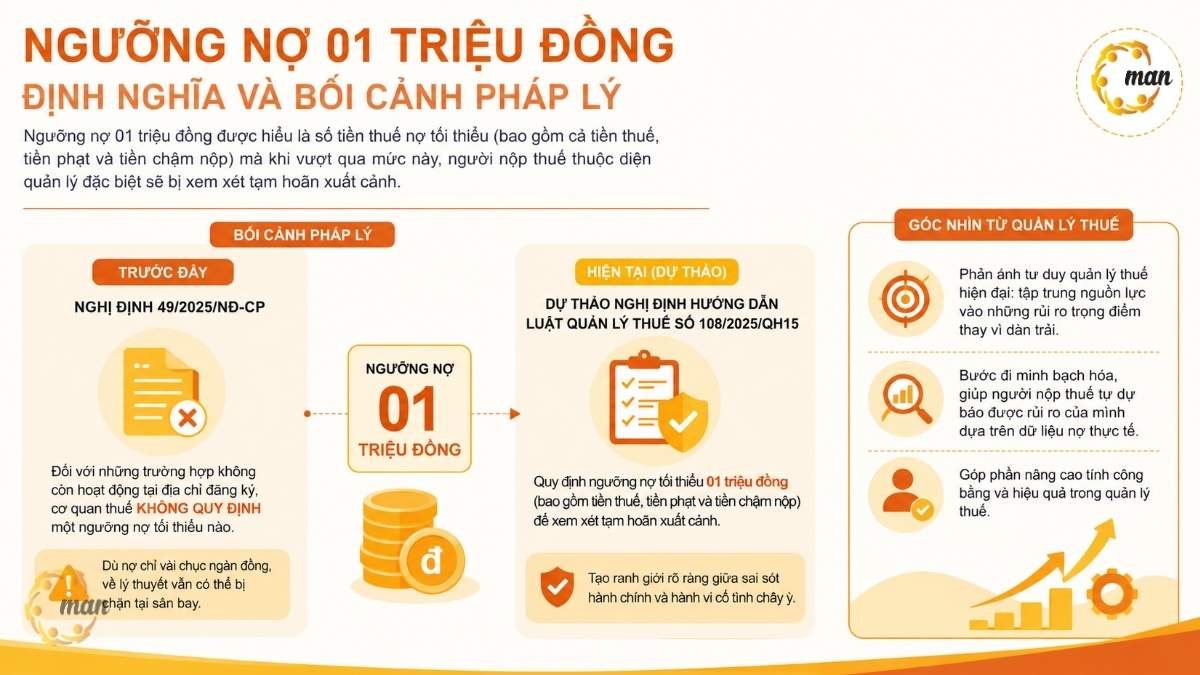
Debt threshold: 1 million VND This refers to the minimum amount of tax owed (including tax, penalties, and late payment fees) beyond which taxpayers are subject to special management and will be considered for a temporary travel ban. This regulation did not appear randomly but is the result of adjustments from Decree 49/2025/ND-CP to draft Decree guiding the Law on Tax Administration No. 108/2025/QH15.
Previously, according to Decree 49/2025/ND-CP, for businesses no longer operating at their registered address, the tax authorities did not specify a minimum debt threshold. This meant that even if you owed only a few tens of thousands of dong, theoretically, you could still be stopped at the airport. Introducing a specific figure is an effort by the drafting agency to clarify the regulation, creating a clearer distinction between administrative errors and deliberate evasion of payment.
From MAN's perspective, this change reflects a modern tax management mindset: focusing resources on key risks instead of spreading them thinly. Experts at MAN consider this a step towards greater transparency, helping taxpayers predict their own risks based on actual debt data.
Why is a debt threshold of 1 million VND considered a policy relaxation?
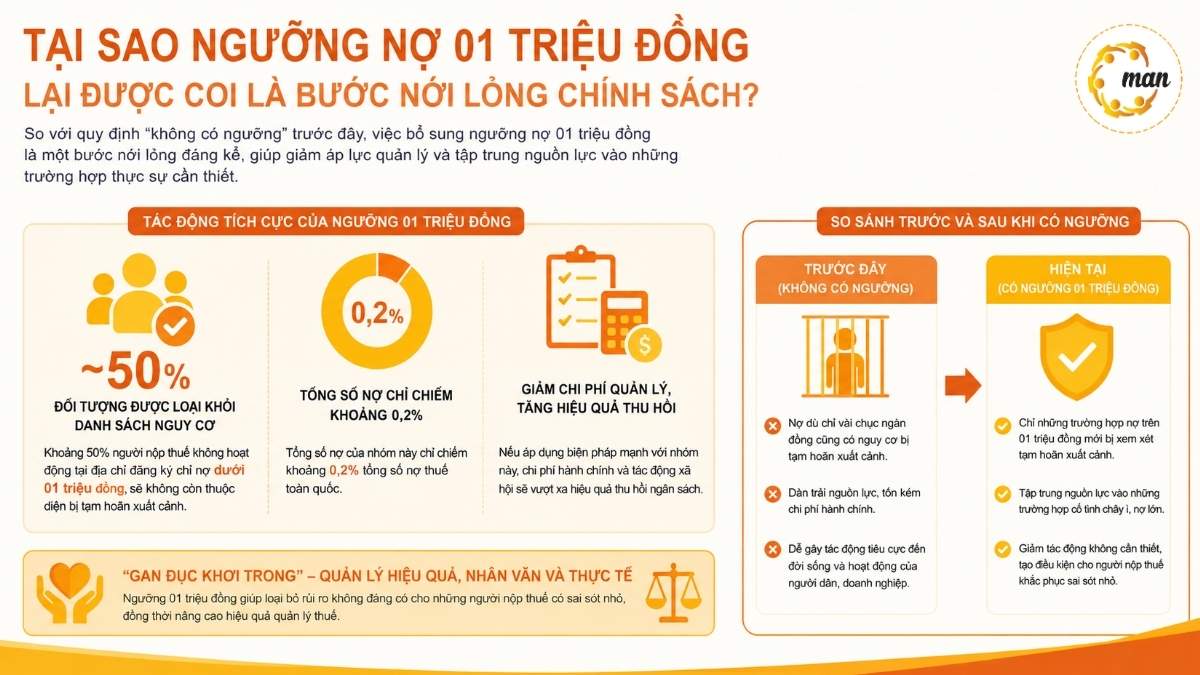
Many have commented that the 1 million VND threshold is too low at present. However, compared to the previous "no threshold" regulation, this is actually a significant relaxation. Adding the 1 million VND debt threshold helps remove approximately 50% individuals who are currently inactive from the list of those at risk of being temporarily suspended from leaving the country.
Statistics show that more than half of taxpayers who are not operating at their registered address owe less than 1 million VND. The total debt of this group accounts for only about 0.21% of the total national tax debt. If the tax authorities continue to apply strong measures against this group, the administrative costs and social impact will far outweigh the effectiveness of budget recovery.
Experts at MAN, with 30 years of experience, emphasize that setting a threshold of 1 million VND helps to "separate the wheat from the chaff." It allows taxpayers with minor errors, such as forgetting to pay a business license fee or small amounts of late payment penalties due to slow system updates, to have the opportunity to resolve the issue without immediately restricting their freedom of movement. This demonstrates a humane and practical approach to state management.
Specific target groups affected by the VND 1 million debt threshold.
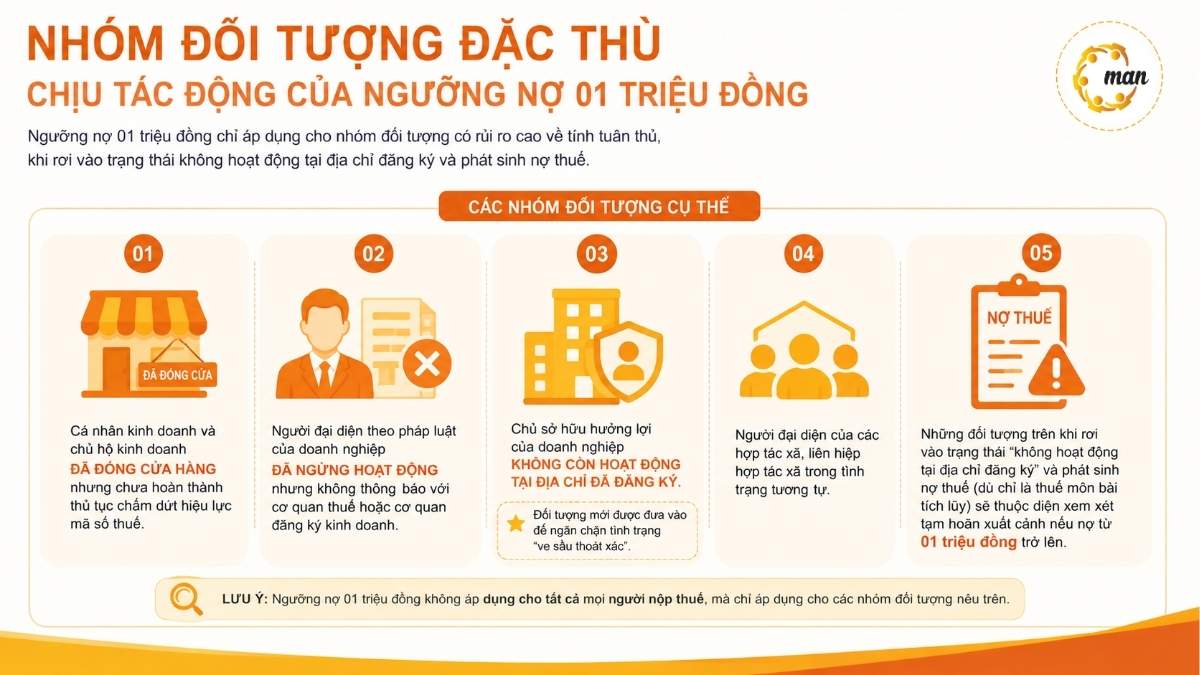
It is important to clarify that the VND 1 million debt threshold does not apply to all taxpayers. It is reserved only for those with a high risk of non-compliance. Specifically, this includes:
- Individual business owners and household business owners have closed their shops but have not yet completed the procedures for terminating their tax identification numbers.
- The legal representative of the business has ceased operations but has not notified the tax authorities or the business registration agency.
- The beneficial owner of a business is no longer operating at the registered address. This is a new category included to prevent the phenomenon of "the cicada shedding its skin.".
- Representatives of cooperatives and cooperative unions in similar situations.
At MAN – Master Accountant Network, we frequently encounter cases where business owners overlook an old company that ceased operations many years ago. When that company becomes "inactive at its registered address" and incurs tax debts (even just accumulated business license tax), the legal representative immediately falls under the scrutiny of this regulation.
Distinguish between the VND 1 million debt threshold and other tax debt levels.
To effectively manage tax risks, businesses need to understand the classification of debt thresholds. The draft of the new Decree clearly categorizes them to ensure proportionality:
| Object | Operating status | Debt thresholds that apply to travel bans |
| Individuals, business owners | Operating normally | From 50 million VND or more |
| Legal representative | The business is currently operating. | From 500 million VND or more |
| All of the above | No longer at the registered address. | From 1 million VND or more |
| Foreigner | Overdue tax debt | No threshold is set (debt is deferred). |
The comparison table above shows that the debt threshold of 1 million VND is the lowest for domestic taxpayers. This is because the act of "not operating at the registered address" is considered a serious violation of information obligations, disrupting communication between the State and the taxpayer. Once contact is lost, even small debts become a difficult-to-recover risk, forcing tax authorities to take preventative measures early on.
The three-step process for applying for temporary travel bans will be implemented starting in 2026.
The new regulations do not allow tax authorities to "ambush" taxpayers. All processes must adhere to principles of openness and transparency. According to analysis from MAN, this process consists of three strict steps:
Step 1: Determine the debt status and amount.
The tax authorities, through inspections, address verification, or based on information received, determine that the taxpayer is no longer operating at the registered address. Simultaneously, the centralized tax management system (TMS) will finalize the outstanding debt. If the debt reaches the threshold of 1 million VND, the process will continue.
Step 2: Give 30 days' notice.
This is an important new feature. Before issuing a formal decision, the tax authority must send a warning notice. This notice is sent via the electronic tax transaction account and publicly posted on the tax authority's website.
Step 3: Issue an order to temporarily suspend departure.
Only after the 30-day period from the date of notification has expired and the taxpayer still has not paid the full amount of outstanding tax will the tax authority send the list to the immigration management agency (Ministry of Public Security) to block their departure from the country.
According to the solution from MAN – Master Accountant Network, this 30-day period is the "golden time" to process the request. If you proactively pay the fee during this period, all procedures for postponing your departure will be suspended, helping to protect your personal travel plans.
The meaning of inactivity at the registered address
Many customers ask MAN why they are treated so harshly for a debt of only 1 million VND. The answer lies in the nature of the "inactive" status. In tax administration, this is known as the "R" status (inactive but not yet having completed the tax code closure procedures).
When a business or individual ceases to be at their registered address without notification, the authorities will consider this an act of evasion. Searching for and pursuing debt collection from these entities consumes significant state resources. Therefore, the 1 million VND debt threshold serves as an early warning signal.
It forces taxpayers to be more responsible for updating their address information. If you move offices or close your business, make the necessary changes or close your tax identification number as required. Don't let a small debt combined with an incorrect address become a barrier to important trips.
Case Study: Risks from a forgotten old branch
Below is a real-life case study that MAN's experts handled in early 2026 for a client who was the director of an import-export company in Ho Chi Minh City.
Situation: Mr. A is the legal representative of Company X, which is operating very successfully. However, five years ago, he registered a small business owned by a relative in a provincial town under his name. This business has long since ceased operations but did not complete the tax registration process. Due to this error, the business owes 1.2 million VND in business license tax and late payment penalties. The local tax authority verified the information and concluded that the company was "not operating at the registered address.".
Consequence: The automated system scanned and added Mr. A's name to the list of those notified of temporary travel bans. Because he no longer resided at his old address, Mr. A did not receive a physical notification. However, due to his regular use of MAN's risk control services, our system detected the electronic notification from the tax authority on the portal.
Handle: MAN assisted Mr. A in immediately paying 1.2 million VND in outstanding taxes and submitting the business dissolution declaration within the first week of the 30-day warning period. As a result, Mr. A's name was removed from the blacklist before the official ban took effect.
This example demonstrates that a debt threshold of 1 million VND is entirely real and can cause problems for anyone if not professionally managed.
How to check your tax debt to avoid being temporarily detained from the country.
In the digital age, not knowing you owe taxes is no longer a valid reason to file a complaint. Taxpayers have many channels to proactively check their tax liabilities:
- eTax Mobile app: This is the most effective tool for individuals. You simply log in using your tax identification number or citizen ID to view details of your debts, including debts in different localities.
- The General Department of Taxation's online portal: In the section for checking travel ban notices, you can check if your name or company name is on the publicly available list.
- Information system for handling administrative procedures: Access your website using your electronic identity account to receive official notifications from government agencies.
Based on MAN's management experience, we recommend that clients establish a routine quarterly check. This is especially important about one month before important overseas trips to allow sufficient time to address any data discrepancies.
Expert insights from MAN – Master Accountant Network on tax risk management.
With over 30 years of practical experience in the industry, experts at MAN recognize that the regulation setting a debt threshold of 1 million VND demonstrates a shift from "pre-audit" to "post-audit" management based on risk assessment. Tax authorities now possess a massive database interconnected with banks and the police. Evading tax addresses is no longer a safe solution.
The biggest risk is not the amount of debt, but the lack of information. Many Vietnamese businesses still maintain lax accounting practices, leading to tax debts arising without the business owner's knowledge.
Our expert-level solutions include:
- Review all tax identification numbers for individuals and businesses that have been registered under their names in the past.
- Complete the procedure for closing the tax identification numbers of units that are no longer operating.
- Update your tax notification address to your current address or use the address of a reputable accounting service provider like MAN to ensure you don't miss any notifications.
- When a dispute arises regarding debt, it is necessary to contact the tax authorities immediately for verification; the 30-day deadline should not be exceeded.
Conclude
The 1 million VND debt threshold is a regulation that serves both as a deterrent and demonstrates the management's willingness to listen to practical shortcomings. Setting a specific figure encourages taxpayers to be more proactive in maintaining contact with government agencies and fulfilling their financial obligations. In the era of big data-driven tax management, transparency and proactiveness are key to protecting individual rights.
MAN – Master Accountant Network is proud to be a trusted partner of thousands of businesses over the past three decades. We offer more than just services. tax settlement services, tax accounting services good tax reporting services Beyond simply providing solutions, MAN offers comprehensive risk management solutions. With a team of experts deeply knowledgeable in Vietnamese tax law, MAN is committed to partnering with you in this endeavor. tax consulting services, This helps you control your tax debt and ensures that all your business operations and personal plans run smoothly and securely.
Service contact information at MAN – Master Accountant Network
- Address: No. 19A, Street 43, Tan Thuan Ward, Ho Chi Minh City
- Mobile/Zalo: 0903 963 163 – 0903 428 622
- Email: man@man.net.vn
Content production by: Mr. Le Hoang Tuyen – Founder & CEO MAN – Master Accountant Network, Vietnamese CPA Auditor with over 30 years of experience in Accounting, Auditing and Financial Consulting.
5 frequently asked questions about the 1 million VND debt threshold.
According to the new draft, if the debt is below 1 million VND, you are not immediately subject to a temporary travel ban. However, the tax authorities can still apply other enforcement measures such as freezing bank accounts.
Due to differing risk characteristics, operating companies with clear addresses are easily contacted by tax authorities for invoice or account enforcement. Businesses that have disappeared pose a higher risk, therefore a lower debt threshold is applied to prevent debt evasion.
It's very difficult. The process of lifting a travel ban requires time for the tax system to update and for notifications to be sent to the police. It usually takes 1 to 3 business days. Therefore, settle your debts before going to the airport.
No. Tax obligations are the personal responsibility of the taxpayer or the legal representative of the organization owing the tax. Relatives are not directly liable for the temporary travel ban.
You have 30 days from the date of notification to work with the tax authorities. Please provide payment receipts or documents proving the incorrect debt amount to correct the data in the system before the travel ban is issued. I owe 900,000 VND in taxes and have abandoned my business address. Will I be banned from leaving the country?
Why haven't I been denied exit from the country for owing 50 million VND to my current company, but not for owing 1 million VND to my old business?
If I pay at the airport, can I leave immediately?
My spouse owes over 1 million VND in taxes. Will this affect my ability to leave the country?
I received a notice that I owe 1.5 million VND, but I believe this amount is incorrect. What should I do?




